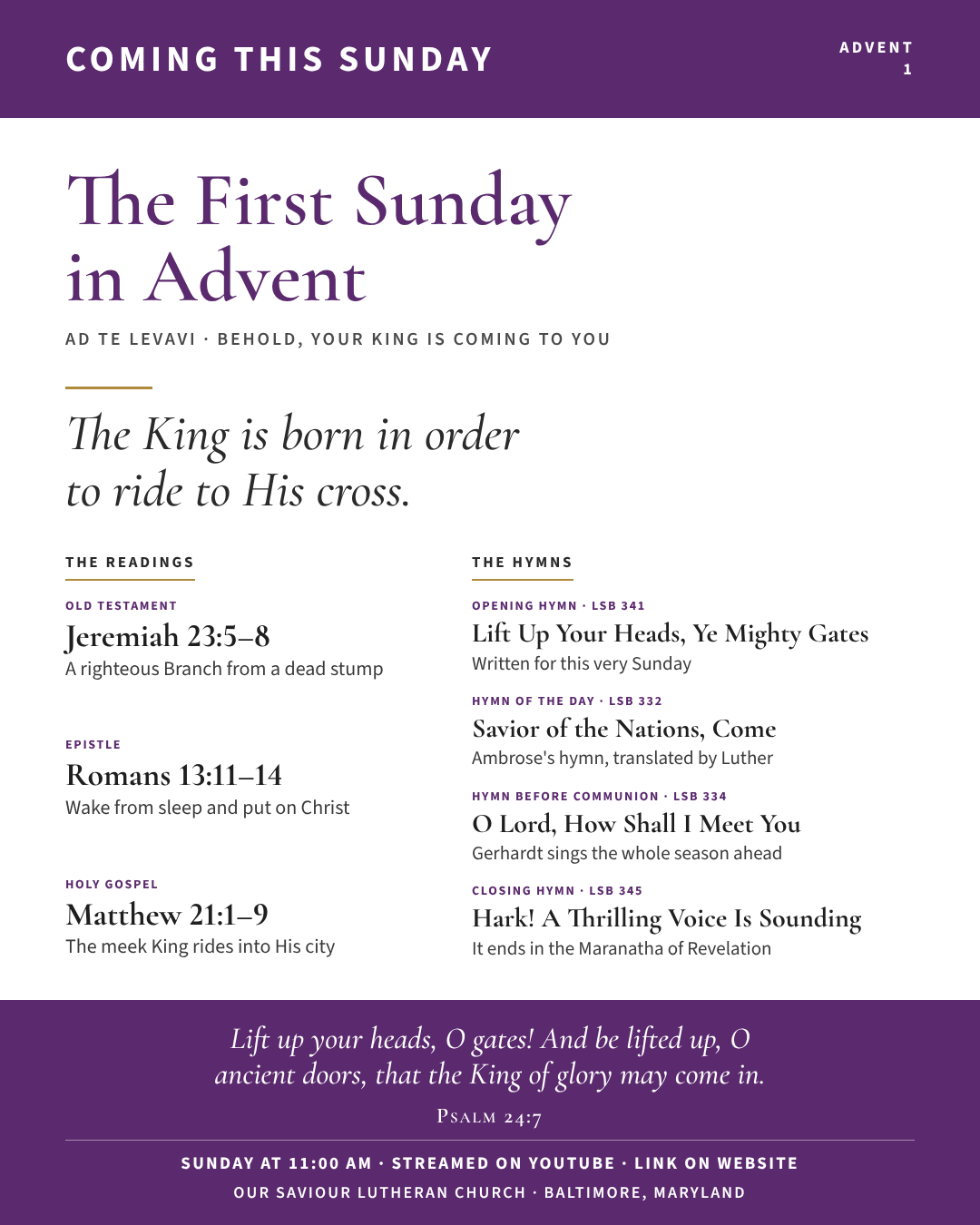
Today the Church Year begins. Advent opens on the Sunday nearest the Festival of St. Andrew (November 30), and the day takes its name, as the Sundays of Advent and Lent do, from the opening words of its Introit in Latin: Ad te levavi animam meam, “To You, O Lord, I lift up my soul” (Psalm 25:1). Advent means a coming, and the season holds three together: Christ in the flesh at Bethlehem, Christ now in Word and Sacrament, Christ in glory at the last. The oldest emphasis is the last one. Advent began with an eschatological focus on the coming of Christ for judgment, and the darkening days of November and the dormant ground between harvest and planting were themselves reminders of mortality that called for repentance. The season is penitential, though never without hope: the Church waits upon her Lord knowing that this present world is passing away.
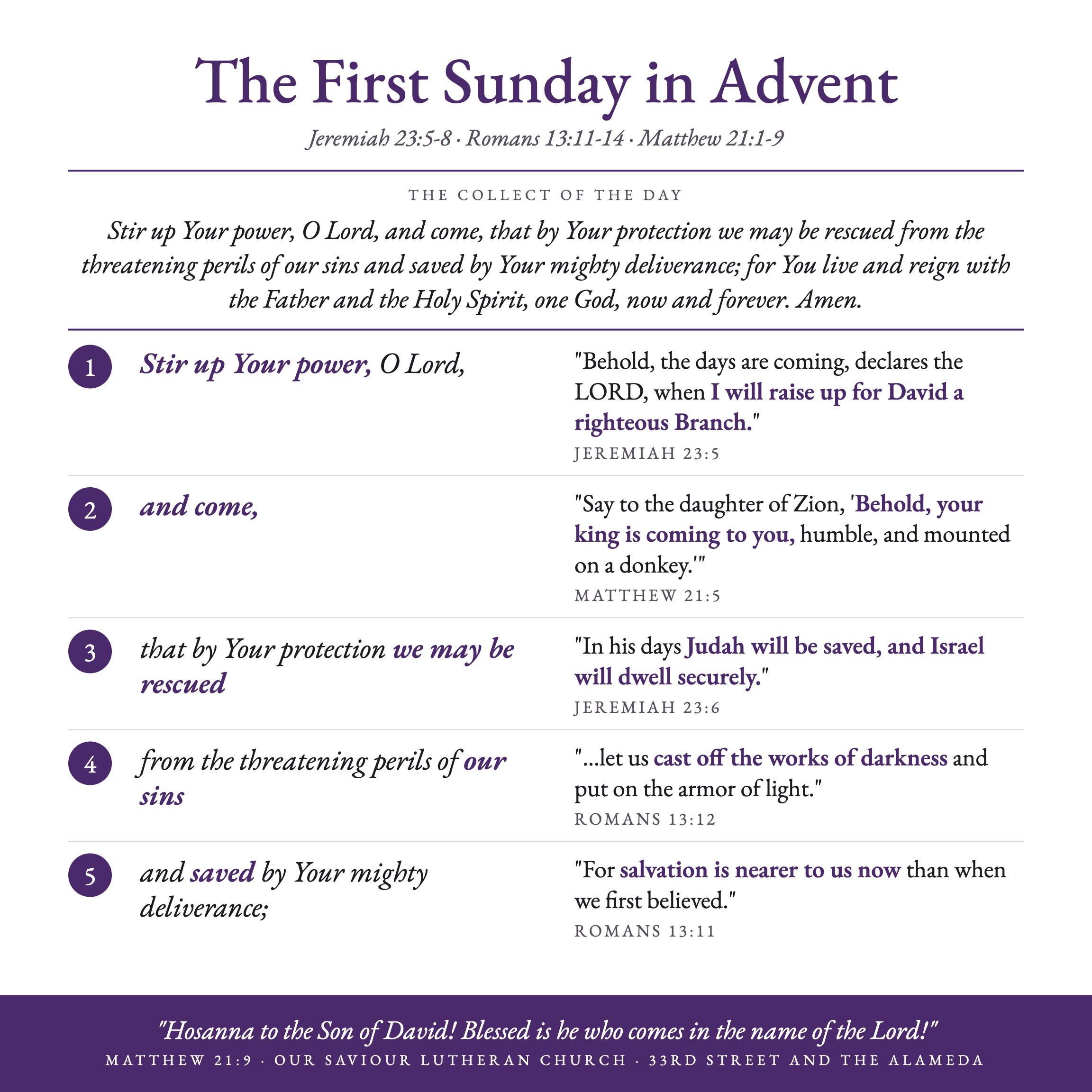
The Color Is Blue or Violet, and the Proper Preface is that of Advent. The Collect is the first of the season’s four “Stir up” prayers: “Stir up Your power, O Lord, and come, that by Your protection we may be rescued from the threatening perils of our sins.”
A Palm Sunday Gospel on the First Day of the Year. The historic Gospel is the Triumphal Entry. This is deliberate: the King is born in order to ride to His cross, and the expectation fulfilled at His first coming guarantees His second. Matthew reports the city “stirred” at His entry with the same word he used when Herod and all Jerusalem were stirred at the coming of the Magi.
The Verse Is the Opening Hymn. The appointed Verse is Psalm 24:7, “Lift up your heads, O gates! And be lifted up, O ancient doors, that the King of glory may come in” — the very line the congregation has just sung.
Hosanna, Then and Now. “Hosanna” is not praise but a plea: “Save us now,” from Psalm 118:25. Every Sunday the congregation sings the angels’ Christmas song in the Gloria and then the Jerusalem crowd’s cry in the Sanctus, welcoming the same Lord immediately before receiving His body and blood.
The readings at a glance
Old Testament
Jeremiah 23:5–8
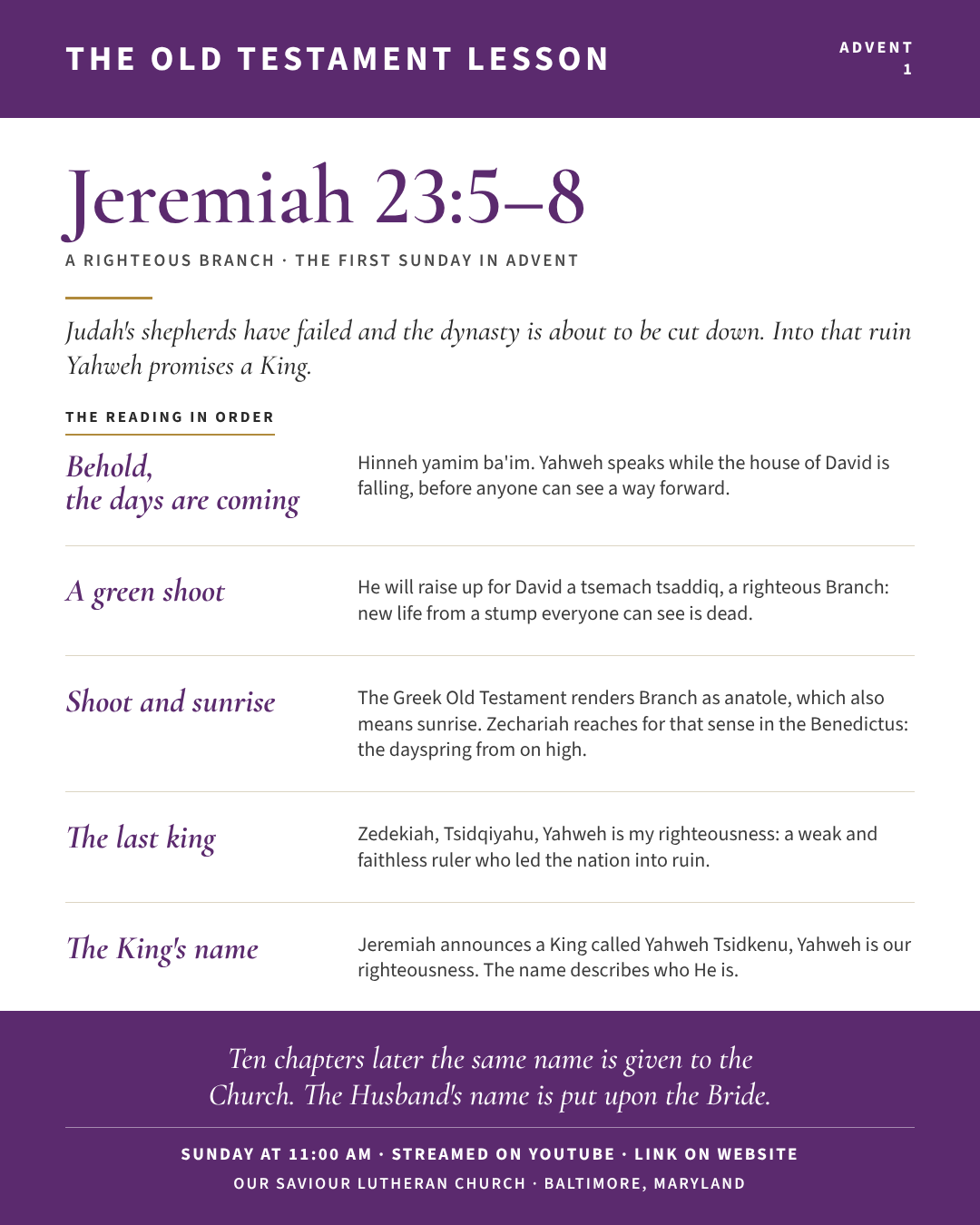
Judah’s shepherds have failed and the dynasty is about to be cut down, and into that ruin Yahweh says hinneh yamim ba’im, “Behold, the days are coming.” He will raise up for David a tsemach tsaddiq, a righteous Branch: a green shoot from a stump everyone can see is dead. The Greek Old Testament renders tsemach as anatole, which means a shoot but also a sunrise, and that second sense is what Zechariah reaches for in the Benedictus when he sings of the dayspring from on high. The sharpest stroke is the King’s name. The last man on David’s throne was Zedekiah, Tsidqiyahu, “Yahweh is my righteousness,” a weak and faithless ruler who led the nation into ruin. Jeremiah announces a King called Yahweh Tsidkenu, “Yahweh is our righteousness,” which is not a title but a description. Ten chapters later the same name is given to the Church. The Husband’s name is put upon the Bride.
The Old Testament: Jeremiah 23:5–8.
Epistle
Romans 13:11–14
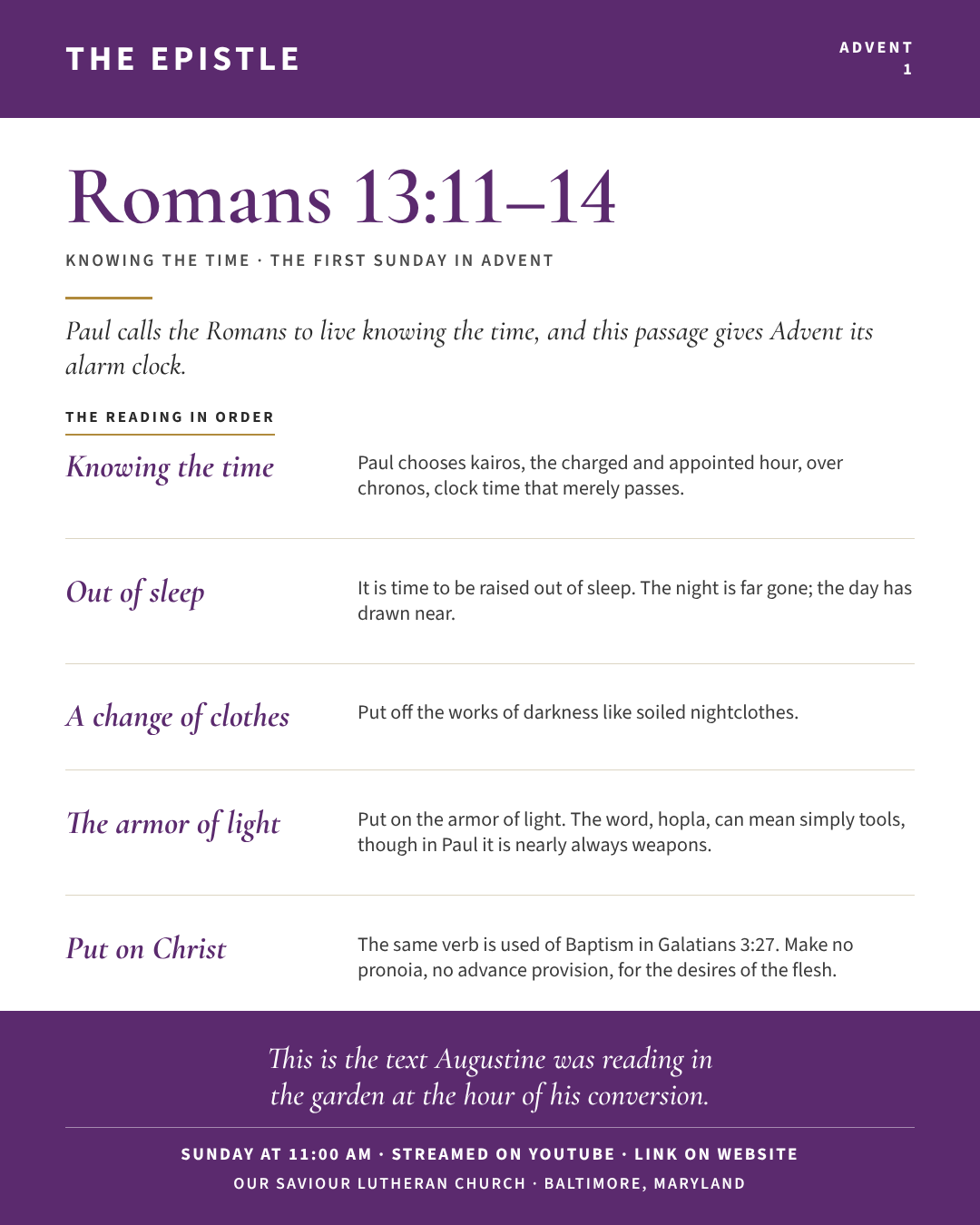
Paul tells the Romans to live “knowing the time,” and the word he chooses is not chronos, clock time that merely passes, but kairos, the charged and appointed hour. It is time to be raised out of sleep. The night is far gone; the day has drawn near. Then comes a change of clothes: put off the works of darkness like soiled nightclothes, and put on the armor of light. The word for armor, hopla, can mean simply tools, but in Paul it is nearly always weapons. The passage ends with the command to put on the Lord Jesus Christ, the same verb used of Baptism in Galatians 3:27, and to make no pronoia, no forethought or advance provision, for the desires of the flesh. This is the text Augustine was reading in the garden at the hour of his conversion, and it is the passage that gives Advent its alarm clock.
The Epistle: Romans 13:11–14.
Holy Gospel
Matthew 21:1–9
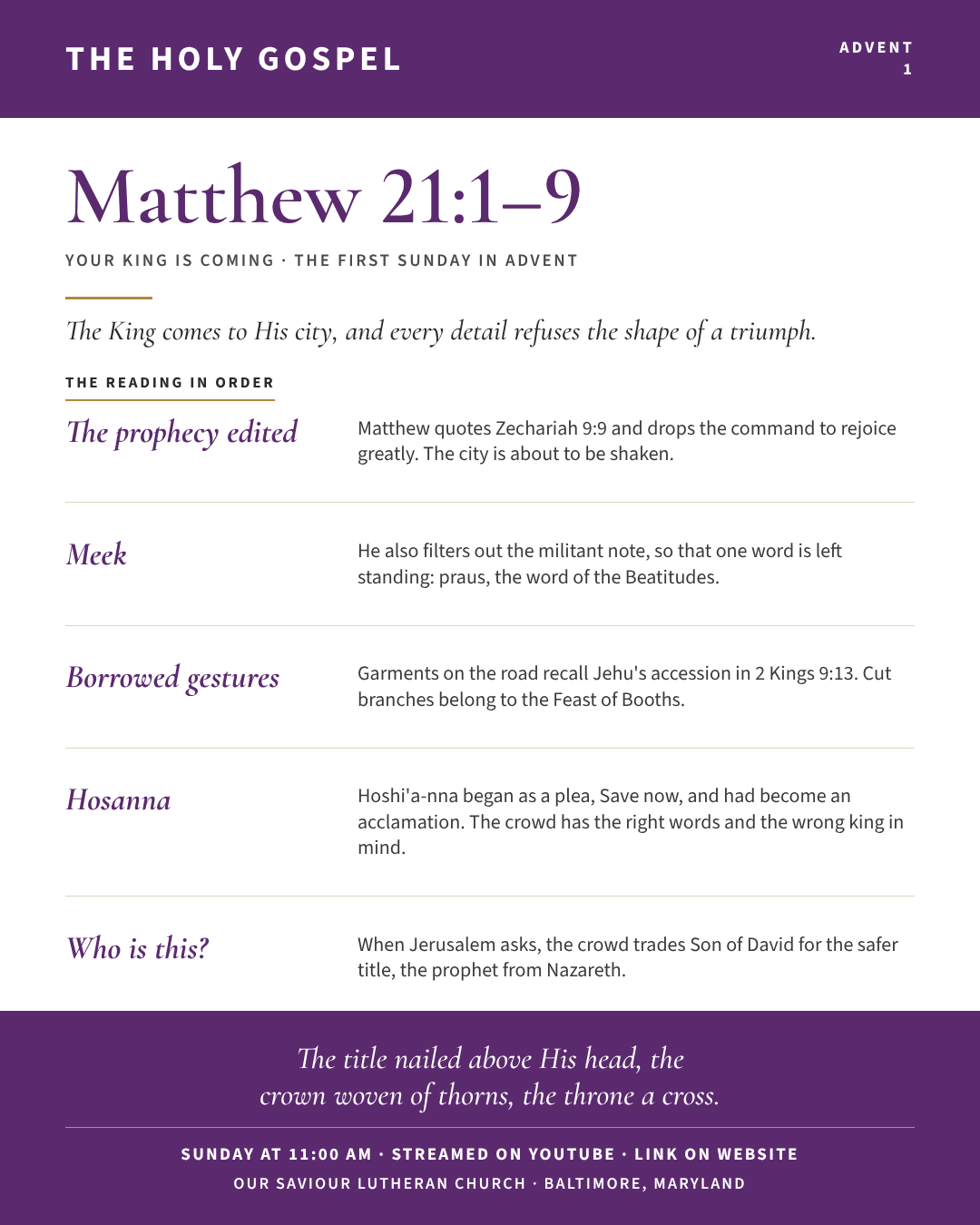
The King comes to His city, and every detail refuses the shape of a triumph. Matthew quotes Zechariah 9:9 and edits it twice: he drops the command to “rejoice greatly,” since the city is not about to rejoice but to be shaken, and he drops “righteous and having salvation,” filtering out the militant note so that one word is left standing: praus, meek. It is the word of the Beatitudes and of “I am gentle and lowly in heart.” The crowd’s gestures are borrowed. Spreading garments on the road is what Jehu’s officers did at his accession in 2 Kings 9:13, an act of vassal submission; cutting branches belongs to the Feast of Booths. Their cry, Hosanna, began as a plea, hoshi‘a-nna, “Save now,” and had become an acclamation. They have the right words and the wrong king in mind, and when Jerusalem asks “Who is this?” they trade “Son of David” for the safer “the prophet from Nazareth.” The coronation goes forward regardless: the title nailed above His head, the crown woven of thorns, the throne a cross.
The Holy Gospel: Matthew 21:1–9.
The hymns and their stories
Opening Hymn
“Lift Up Your Heads, Ye Mighty Gates” · LSB 341
Georg Weissel wrote this in Königsberg, and when it was printed in 1642, seven years after his death, it carried the heading “Am Ersten Sontag deß Advents” — For the First Sunday in Advent. So a hymn full of opened gates and an arriving King was written for this exact morning, not borrowed from Palm Sunday. It is built on two texts: Psalm 24:7, which is also the appointed Verse today, and the Gospel just read. Weissel most likely wrote it for the dedication of a newly built church in the Rossgarten district, where he was installed as first pastor in 1623, which explains why the gates and doors are so literal. The tune is a surprise. Despite its German name, MILWAUKEE was written by August Lemke, a Lutheran schoolteacher and musician at Trinity Lutheran Church in Milwaukee. Its origin was obscure for decades; the first publication anywhere to credit him was a Concordia music reader for Lutheran schools in 1933. Catherine Winkworth filed her 1855 translation under the Fourth Sunday in Advent, then reworked the last two lines of every stanza in 1863 so it would fit the German tune. Our stanzas 4 and 5 are hers; stanzas 1 through 3 carry later hands.
Hymn of the Day
“Savior of the Nations, Come” · LSB 332
Ambrose of Milan was a Roman civil governor, unbaptized, when he went to calm a mob quarreling over the election of a bishop in 374. While he was speaking, a voice cried out “Ambrose, bishop!” and the whole crowd took it up. He was thirty-four. He was baptized on December 7 and consecrated, and went on to become one of the four great Latin Doctors of the Church. Very little ancient hymnody can be assigned to a named author with confidence; this one can, since Pope Celestine names him as its author in 430. Luther translated it in 1523 and made one deliberate change, cutting each line from eight syllables to seven so it would move like a folk song, and simplifying the old chant so a congregation could sing it. He also moved it: medieval breviaries assigned the Latin to Christmas Day, and in the last hymnal Luther ever wrote a preface for, the Babst book of 1545, it stands as one of only two Advent hymns. It has been the Hymn of the Day for this Sunday ever since. What we sing took sixteen centuries and eight hands.
Hymn before Communion
“O Lord, How Shall I Meet You” · LSB 334
Paul Gerhardt wrote through the Thirty Years’ War and out of it. By 1668 he had lost his pastorate in Berlin for refusing to compromise his Lutheran confession, and had buried his wife and four of his five children. He wrote 133 hymns. This one appeared in 1653 in two collections at once, and the only two known copies of the first were destroyed in the Second World War. Sing it today and you sing the whole season in advance: Gerhardt’s original stanzas engage the Gospel of every Sunday in Advent. Stanza 2 is the triumphal entry we just heard. Stanza 3 recalls John the Baptist in prison, read on Gaudete. Stanza 5 is the Lamb who bears away sin, heard on Advent 4. Stanza 6 is the coming for judgment of Advent 2. The heart is stanza 4, where Gerhardt asks why Christ would become incarnate for sinners and answers with one word repeated five times in that stanza: love. Most of the English is Catherine Winkworth’s, but stanza 5 was stitched together in 1906 from four translators across two centuries.
Closing Hymn
“Hark! A Thrilling Voice Is Sounding” · LSB 345
This hymn has been ascribed to Ambrose for centuries, which makes an instructive pairing with the Hymn of the Day, where the attribution is secure. Here it is not: the editors judge it almost certainly not his, and probably no older than the tenth century. The medieval Latin opened “Vox clara ecce intonat,” “Lo, a clear voice thunders.” Then Pope Urban VIII, who reigned from 1623, ordered the breviary hymns rewritten to fit classical Latin meter, and the line became the metrically correct but less singable “En clara vox redarguit.” The revisions were never popular, and they stood for three centuries until the original wording was restored between 1971 and 1974. Edward Caswall translated the papal version, not the original, in 1849, and his own first line has since been revised too: he wrote “Hark! an awful voice is sounding,” using awful in its older sense of awe-inspiring. One small change is worth noticing. Caswall wrote “Cast away the dreams of darkness”; our hymnal reads “works of darkness,” putting the closing hymn into the exact words of the Epistle. The last stanza ends where Advent ends, in the Maranatha of Revelation 22: “Come quickly, King of kings!”