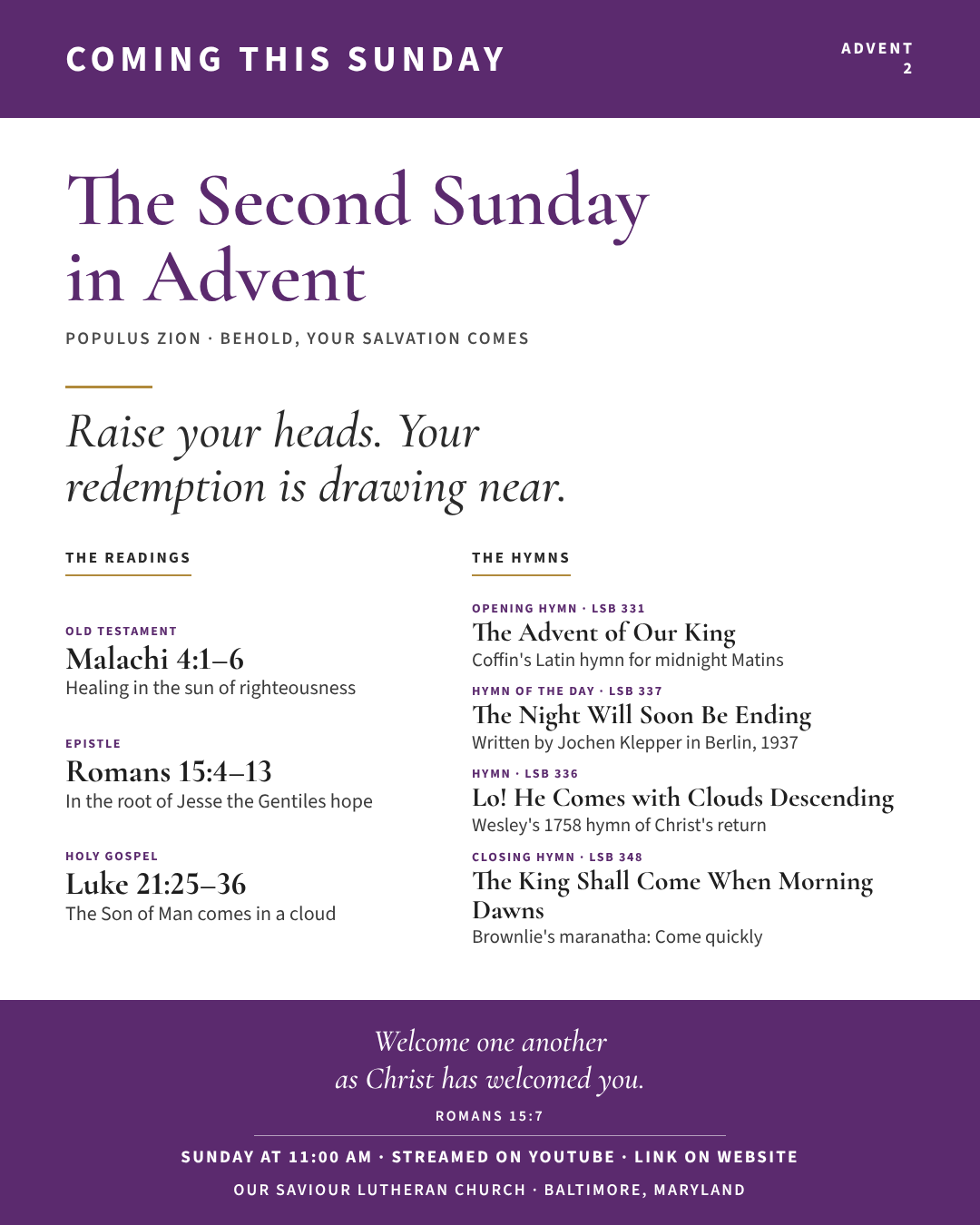
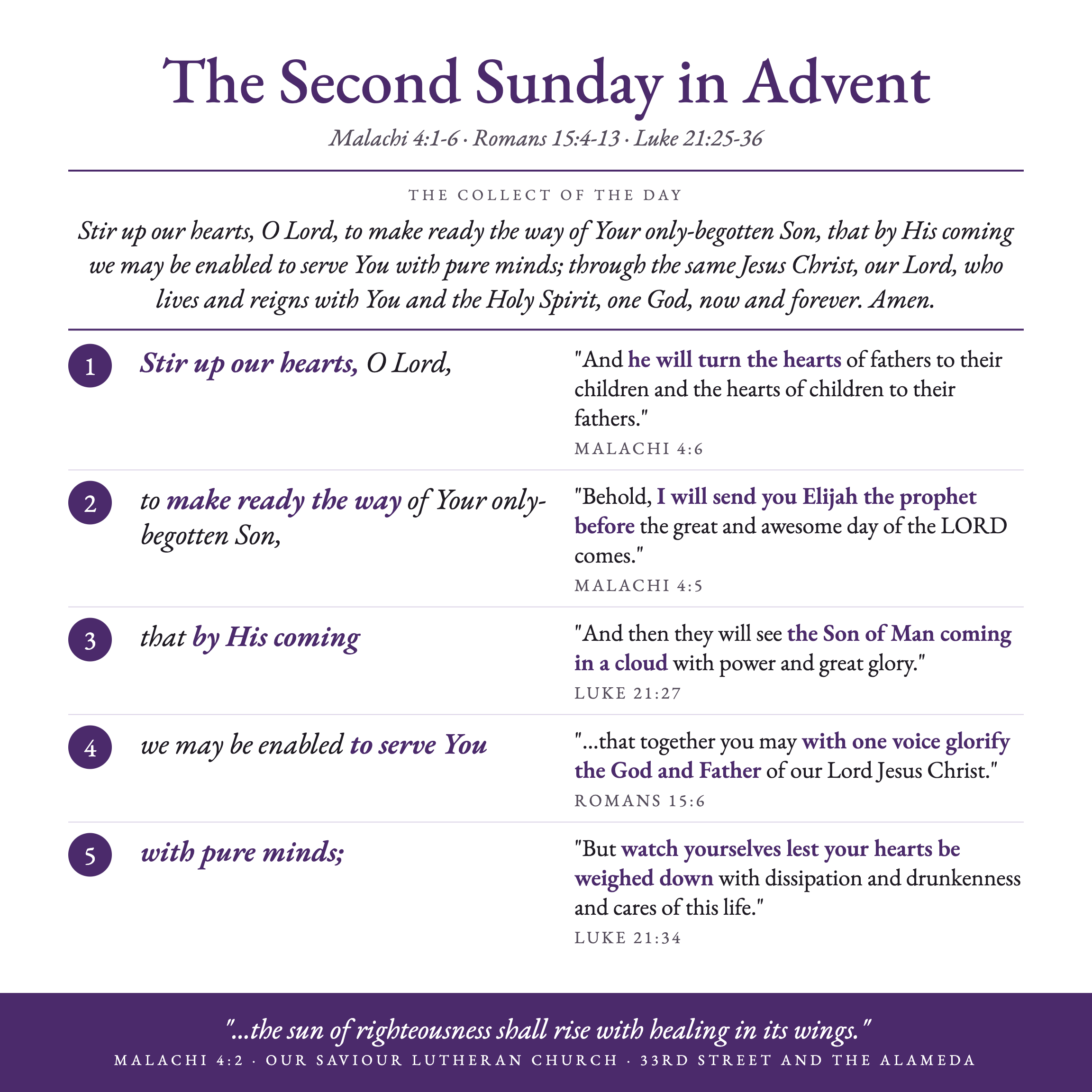
The Second Sunday in Advent takes its historic name, Populus Zion, from the ancient Latin Introit antiphon drawn from Isaiah 62:11 and Isaiah 30:29–30: “Say to the daughter of Zion, Behold, your salvation comes.” Where the First Sunday in Advent, Ad Te Levavi, sets before the Church Christ’s humble entry into Jerusalem, Populus Zion turns her gaze forward to His second coming in glory, the final judgment, and the full redemption of His bride, Zion herself. The classic Western propers for the day, fixed for centuries in the historic one-year lectionary, gather around this same expectation. The Introit calls upon the Shepherd of Israel enthroned upon the cherubim to shine forth; the Collect asks God to stir up hearts to prepare the way of His Son; and the Gradual and Alleluia verse, drawn from the very Gospel appointed for the day, proclaim that the Son of Man will come in a cloud with power and great glory. Though three Sundays of Advent still remain before Christmas, the Church here looks past the manger entirely to the Last Day, holding both comings, the first in humility and the second in glory, together in a single expectant gaze.
The Introit draws on Psalm 80 with the antiphon “Say to the daughter of Zion, Behold, your salvation comes” (Isaiah 62:11b; 30:29–30), calling on the Shepherd of Israel enthroned upon the cherubim to shine forth and restore His people.
The Collect. one of Advent’s classic “Stir up” (Excita) prayers, asking God to stir up our hearts to make ready the way of His Son, that by His coming we may serve Him with pure minds.
The Epistle. Romans 15:4–13, in which Paul draws on the Law, the Psalms, and the Prophets to show that Christ’s coming was always meant to gather Jew and Gentile into a single voice of hope and praise.
The Gospel. Luke 21:25–36, Christ’s own description of the cosmic signs that precede His return, and His charge to watch, pray, and stand unafraid before the Son of Man.
The readings at a glance
Old Testament
Malachi 4:1–6
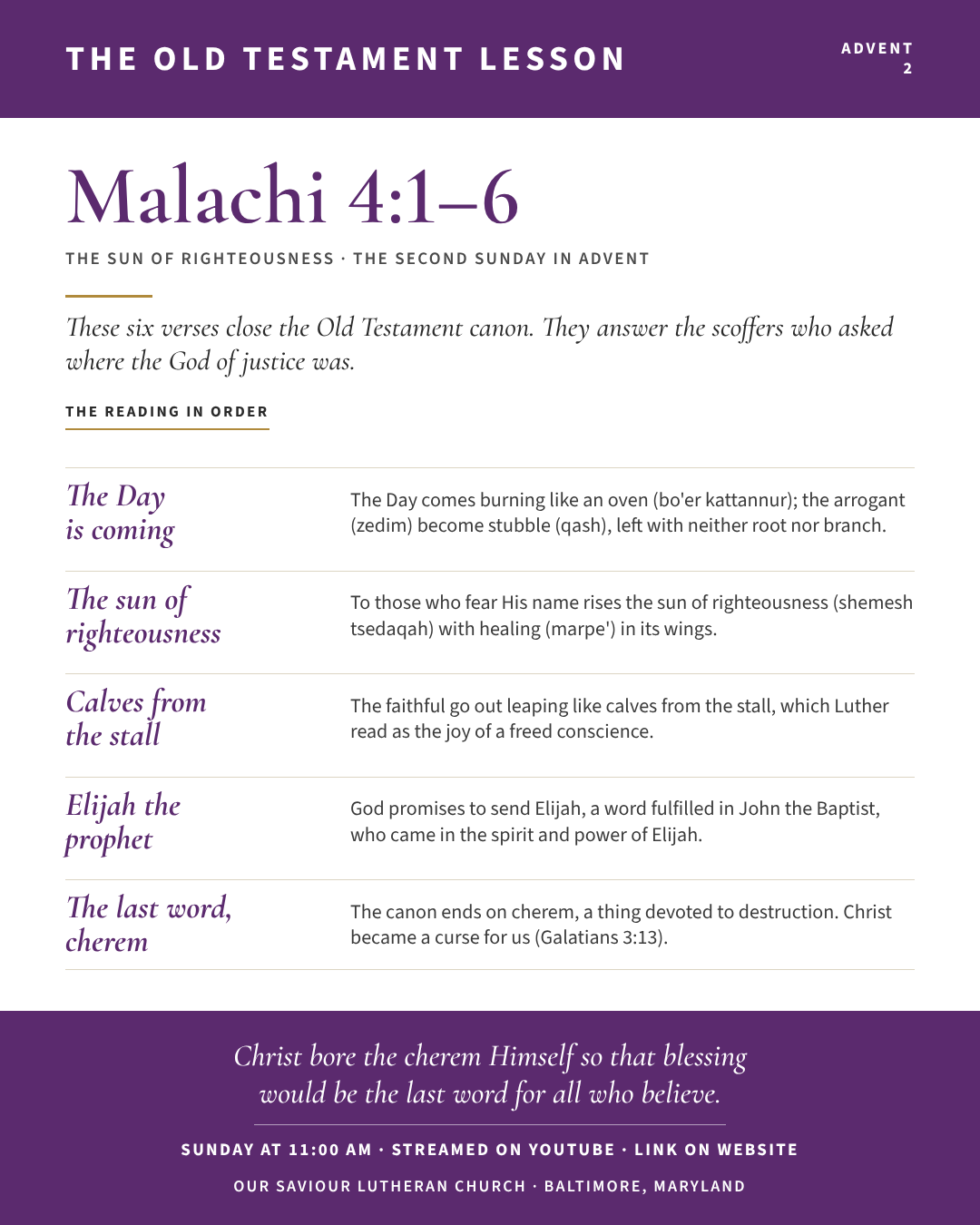
The last verses of the Old Testament canon set two harvests before the hearer. The arrogant and the evildoer become qash, dry stubble, thrown into a tannur, a baking oven, and burned until neither root nor branch is left; but those who fear God’s name watch the shemesh tsedaqah, the sun of righteousness, rise with healing in its wings, and they go out leaping like calves loosed from the stall. The Septuagint’s verb for that rising, anatellei, stands behind the title anatole, the “Dayspring from on high,” that Zechariah sings over his infant son in the Benedictus. Before the prophetic voice falls silent for four hundred years, God promises to send Elijah to turn the hearts of fathers to their children, a promise Jesus applies directly to John the Baptist, the herald sent in Elijah’s spirit and power to prepare a people for the true Sun of Righteousness.
The Old Testament: Malachi 4:1–6.
Epistle
Romans 15:4–13
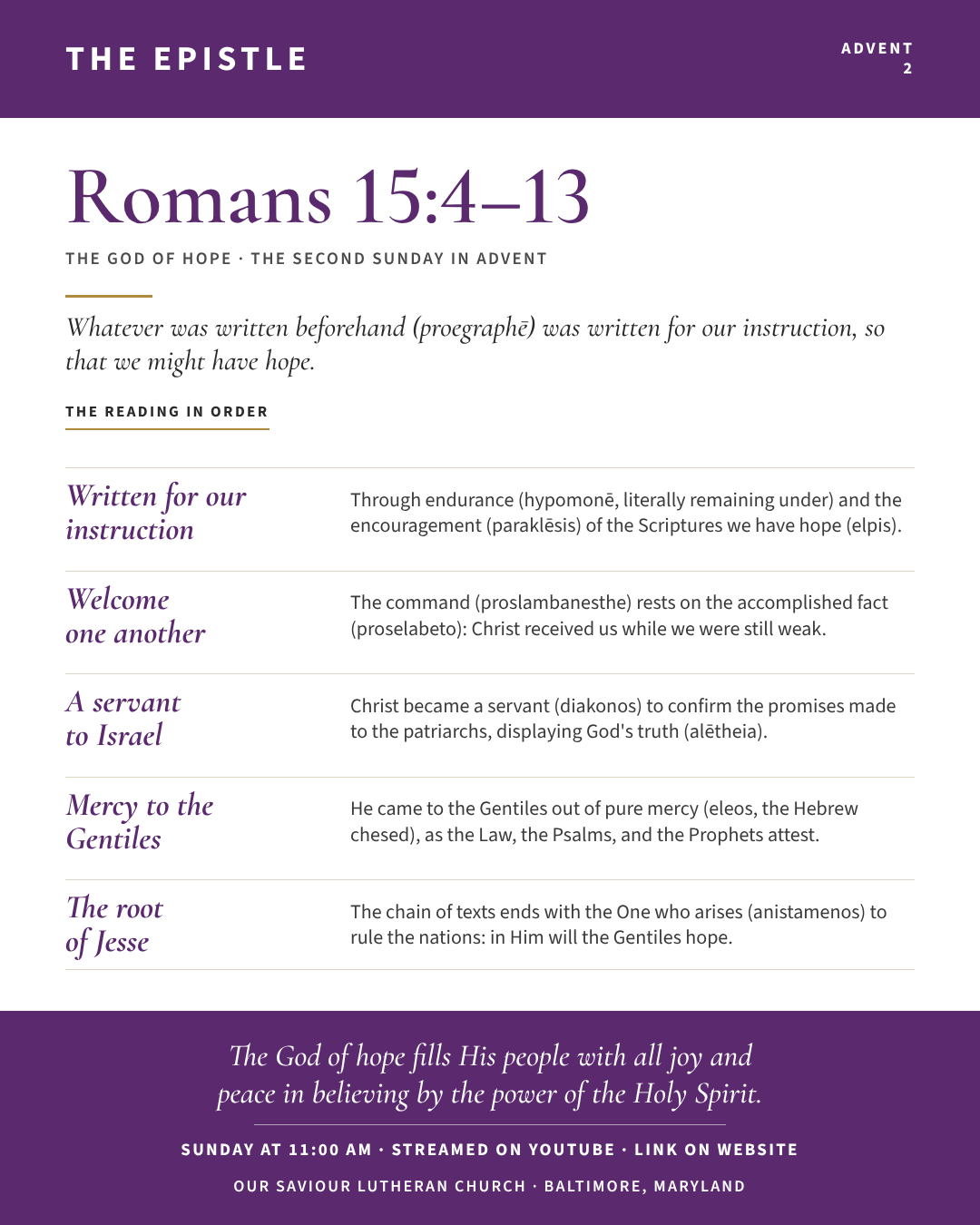
Paul closes the great doctrinal argument of Romans by proving from every division of the Hebrew canon, the Law, the Psalms, and the Prophets, that God always intended Jew and Gentile to glorify Him with one voice, en heni stomati. Christ, he writes, became a diakonos, a servant, to the circumcised to confirm the promises made to the patriarchs, and became mercy itself, eleos, to the nations who held no prior claim on those promises. Quoting the root of Jesse from Isaiah 11, the rhiza tou Iessai in whom the Gentiles hope, Paul brings the Advent theme of hope, elpis, to its climax: not a wish but a confident trust anchored in what God has already accomplished. The chapter closes in one of the New Testament’s great benedictions, a prayer that the God of hope would fill His people with joy and peace in believing, so that by the Spirit’s power they might overflow with hope until the Root of Jesse returns in glory.
The Epistle: Romans 15:4–13.
Holy Gospel
Luke 21:25–36
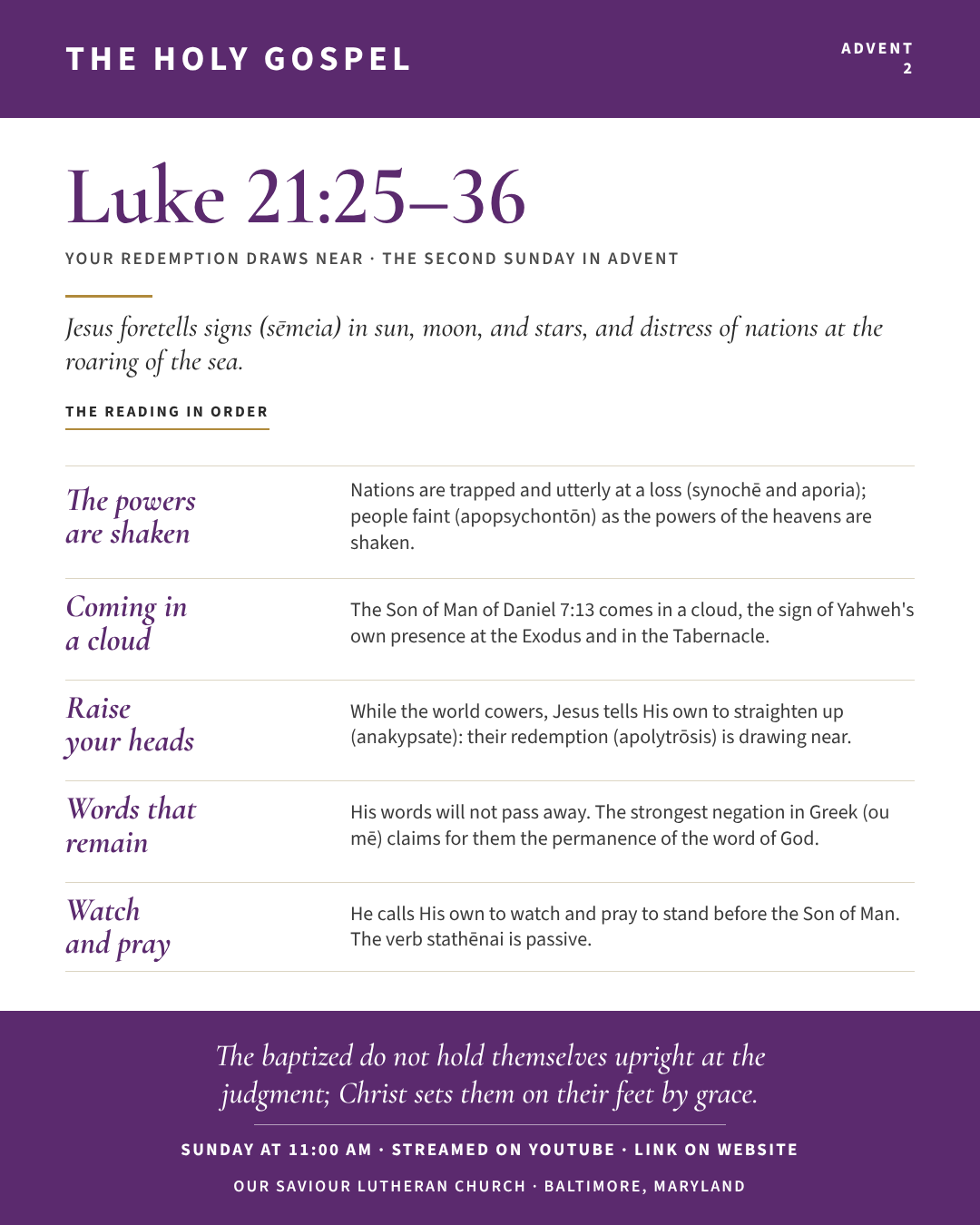
Christ describes His own return in language drawn from the prophets: signs, semeia, in sun, moon, and stars; the roaring of the sea; and the powers of the heavens shaken, saleuo, as creation trembles before its Judge. While the nations faint from fear, Jesus commands His own to do the opposite: anakypsate, straighten up, and lift up your heads, for your redemption, apolytrosis, draws near. The word echoes Zechariah’s song and Simeon’s, the same redemption long hoped for now arriving in the coming of the Son of Man on the clouds of Daniel 7. The fig tree, budding before summer, becomes a parable of discernment; the promise that Christ’s words will never pass away, even after heaven and earth do, becomes a Christological claim to the eternal permanence Isaiah reserves for the word of Yahweh alone. The reading closes not in dread but in a call to watch and pray, that believers may stand approved before the Son of Man rather than be caught unready like a bird in a snare.
The Holy Gospel: Luke 21:25–36.
The hymns and their stories
Opening Hymn
“The Advent of Our King” · LSB 331
Our opening hymn began as a poem no one thought was a hundred years old, though everyone assumed it was. Charles Coffin, rector of the University of Paris, wrote Instantis adventum Dei in 1736 for the newly revised Paris Breviary, intending it to replace older medieval Advent hymns for the night office of Matins, sung in the small hours of the morning. A century later the English clergyman John Chandler, hunting through old Latin service books for genuinely ancient prayers to translate, took Coffin’s text for exactly what it appeared to be, an early relic of the primitive Church, and rendered it into English in 1837 without realizing it was barely a hundred years old. Its lines still carry a trace of that midnight setting: the plea not to despise “the peace He comes to bring” and the prayer that sin’s dark deeds be gone “before the dawning day” spoke as much of the coming sunrise over the chanting monks as of Christ’s own advent. The later refrain “O Zion’s daughter, rise” echoes Zechariah 9:9, tying this hymn straight back to Populus Zion’s own Introit and its call for the daughter of Zion to behold her salvation.
Hymn of the Day
“The Night Will Soon Be Ending” · LSB 337
Jochen Klepper wrote this hymn on December 18, 1937, in a Berlin already darkening under the Third Reich. Married to a Jewish wife, Klepper lived under mounting persecution and, in his final years, under crushing insomnia and spiritual affliction; night, for him, was no passing metaphor. He set his text, Die Nacht ist vorgedrungen, beneath the words of Romans 13:11–12, the traditional Epistle for Advent’s first Sunday, and drew his opening line almost word for word from Luther’s own translation of that verse, “the night is far gone, the day is at hand.” The hymn moves from Genesis 3:15’s ancient promise of mercy through Christ’s bearing of judgment to John the Baptist’s witness of the Lamb, closing on the dawn of the new creation still to come. Herman G. Stuempfle Jr. supplied the present English translation for Hymnal Supplement 98 after earlier attempts failed to hold Klepper’s tight German meter, and Lutheran Service Book sets his five stanzas to the sturdy Welsh tune LLANGLOFFAN. Written by a man who knew personally how long the night could feel, it fits its place as the Hymn of the Day, standing exactly where Advent’s watchfulness meets Advent’s hope.
Hymn before Communion
“Lo! He Comes with Clouds Descending” · LSB 336
This hymn passed through three hands before reaching its present form. John Cennick, an Anglican of Quaker upbringing who moved through Methodism, the Moravians, and Independency in the span of a single lifetime, published the earliest version in 1752. Charles Wesley took Cennick’s core idea, Christ’s return on the clouds of heaven, and rewrote it almost entirely for his 1758 collection Hymns of Intercession for All Mankind; Lutheran Service Book prints Wesley’s four stanzas essentially as he left them. Its tune, HELMSLEY, first appeared around 1763 in a collection tied to London’s Lock Hospital, a charity chapel serving former prostitutes, and was originally sung as a light, almost dance-like air; only in the twentieth century did Ralph Vaughan Williams slow its tempo and thicken its harmonies into the stately processional now familiar in Lutheran hymnals. The text gathers Acts 1:11’s promise that Christ will return as He left, Revelation 1:7’s vision of even His mockers acknowledging Him, and John 20:28’s risen Christ still bearing His wounds in glory: a fitting choice for the moment before Communion, when the same Christ who will come on the clouds first comes to His people in bread and wine.
Closing Hymn
“The King Shall Come When Morning Dawns” · LSB 348
John Brownlie, a minister of the Free Church of Scotland, published this text in 1907 in a collection called Hymns from the East, its title suggesting a translation from ancient Greek or Syriac liturgy. Brownlie himself admitted in his preface that the pieces were less translations than “centos and suggestions,” meaning the hymn is substantially his own composition, only inspired by Eastern liturgical imagery rather than rendered from it. In its span of stanzas the hymn compresses the whole of salvation history: the apocalyptic imagery of Daniel and Matthew, the contrast between the humble Child of the manger and the King who returns in uncreated glory, and Christ’s own victory over the grave, closing on the ancient cry of 1 Corinthians 16:22 and Revelation 22:20, maranatha, “Come quickly, King of kings.” Lutheran Service Book keeps four of Brownlie’s original seven stanzas, paired with CONSOLATION, an early American shape-note tune by Lucius Chapin, giving a Scottish meditation on Eastern liturgy an American voice. Closing Populus Zion, it sends the congregation out still watching for the King these readings describe.