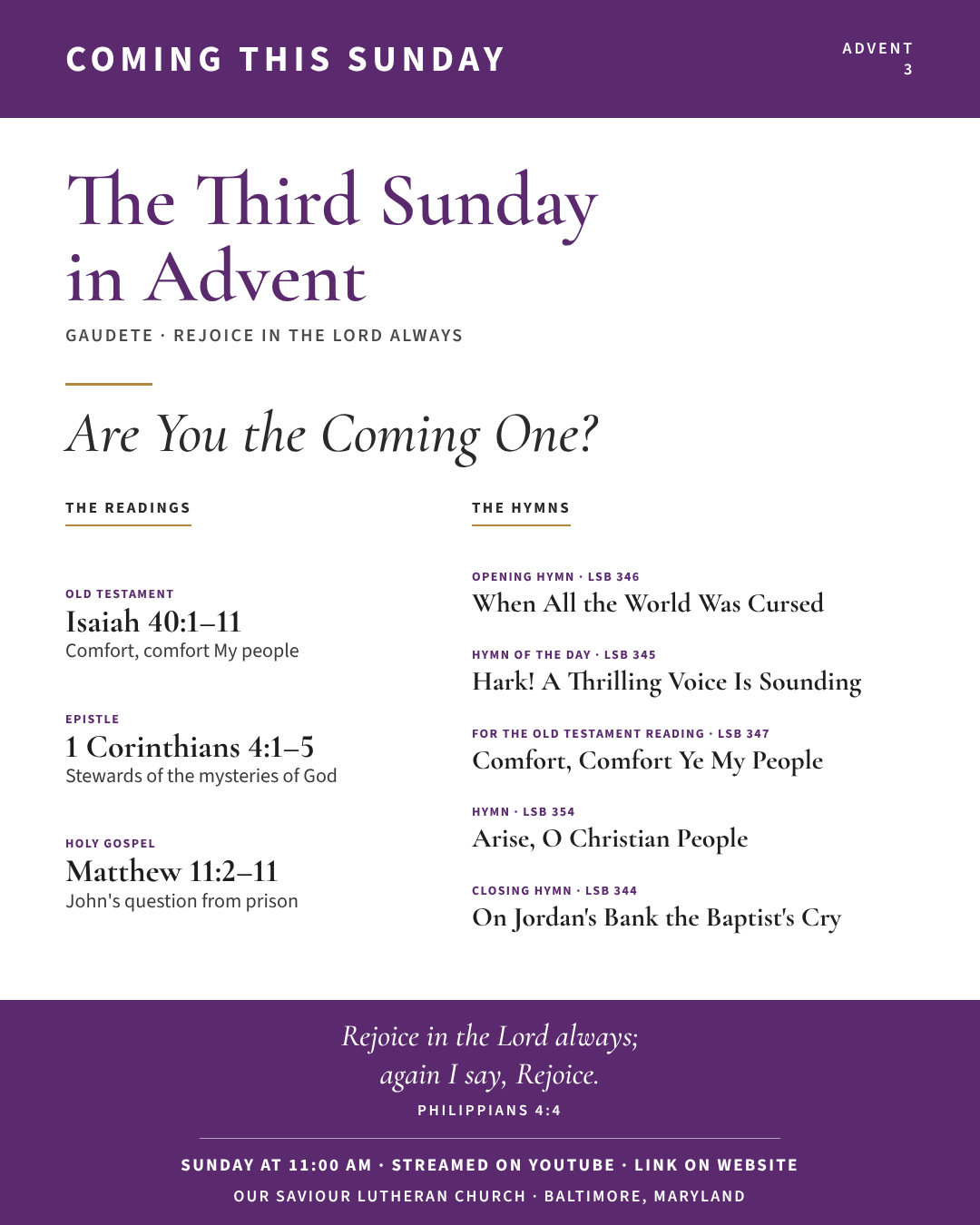
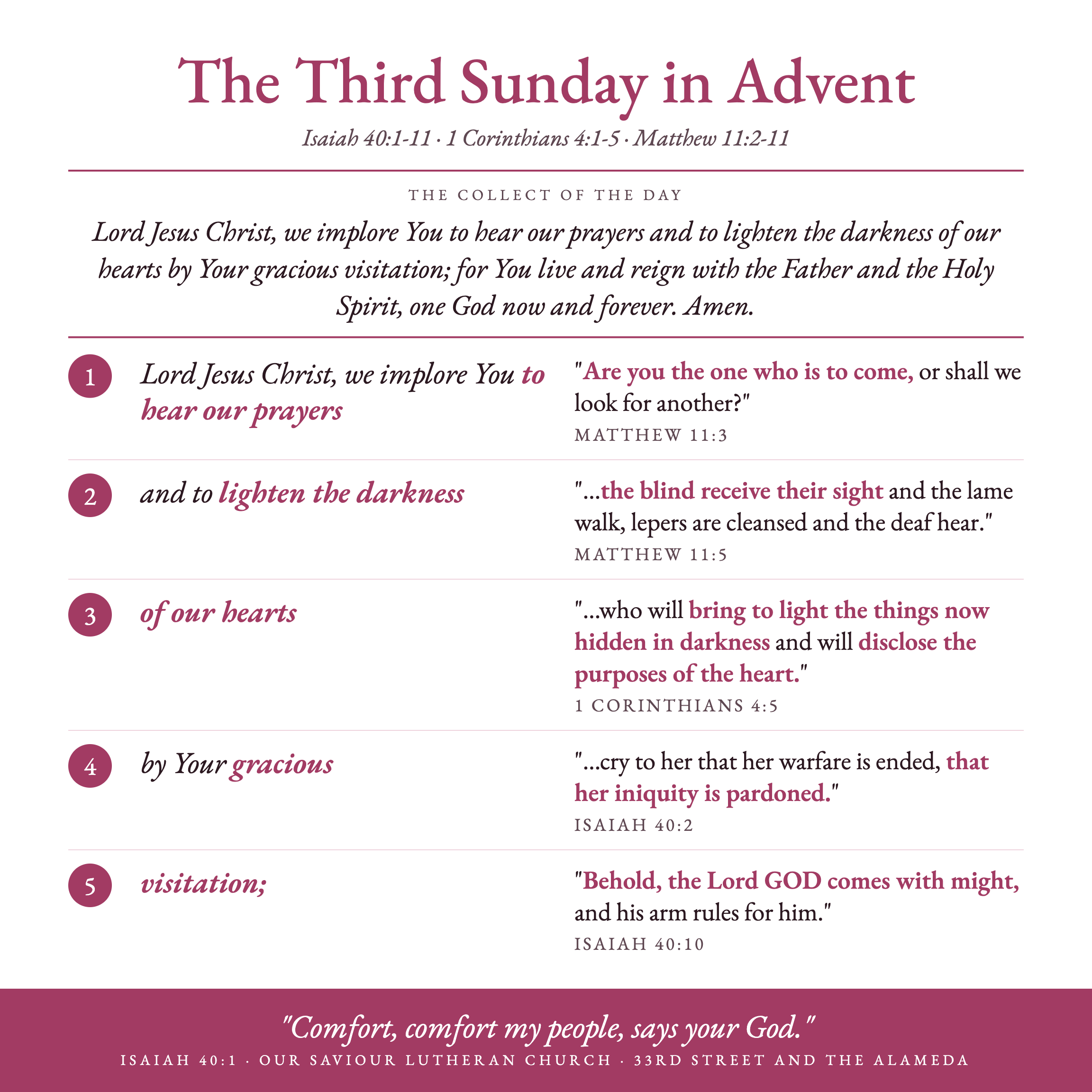
The Third Sunday in Advent takes its name, Gaudete, from the opening word of its historic Latin Introit, drawn from Philippians 4:4: Gaudete in Domino semper, iterum dico, gaudete, “Rejoice in the Lord always; again I say, Rejoice.” Where the surrounding Sundays of Advent keep the season’s sober, penitential tone, violet vestments and all, Gaudete interrupts that severity with a single Sunday of anticipatory joy, much as Laetare does midway through Lent. Rose-colored paraments and the rose candle of the Advent wreath mark the pause, a lighter shade of violet signaling the light of Christ already breaking into the world’s darkness. The historic one-year lectionary’s Collect for the day is one of the rare prayers addressed not to the Father through Christ but to the Lord Jesus Christ directly, asking Him to lighten the darkness of our hearts by His gracious visitation, and its Gospel turns to John the Baptist, now in Herod’s prison, sending his own disciples to ask whether Jesus is truly the One who is to come.
The Introit draws its name and words from Philippians 4:4, “Rejoice in the Lord always; again I say, Rejoice,” setting the tone for the day’s one Sunday of anticipatory Advent joy.
The Collect. addressed directly to the Lord Jesus Christ rather than to the Father, asking Him to lighten the darkness of our hearts by His gracious visitation.
The Epistle. 1 Corinthians 4:1–5, Paul’s reminder that Christ’s ministers are stewards of God’s mysteries, answerable finally to Him alone.
The Gospel. Matthew 11:2–11, John the Baptist’s question from Herod’s prison, “Are You the One who is to come?”, and Christ’s answer given in His works of healing and mercy.
The readings at a glance
Old Testament
Isaiah 40:1–11
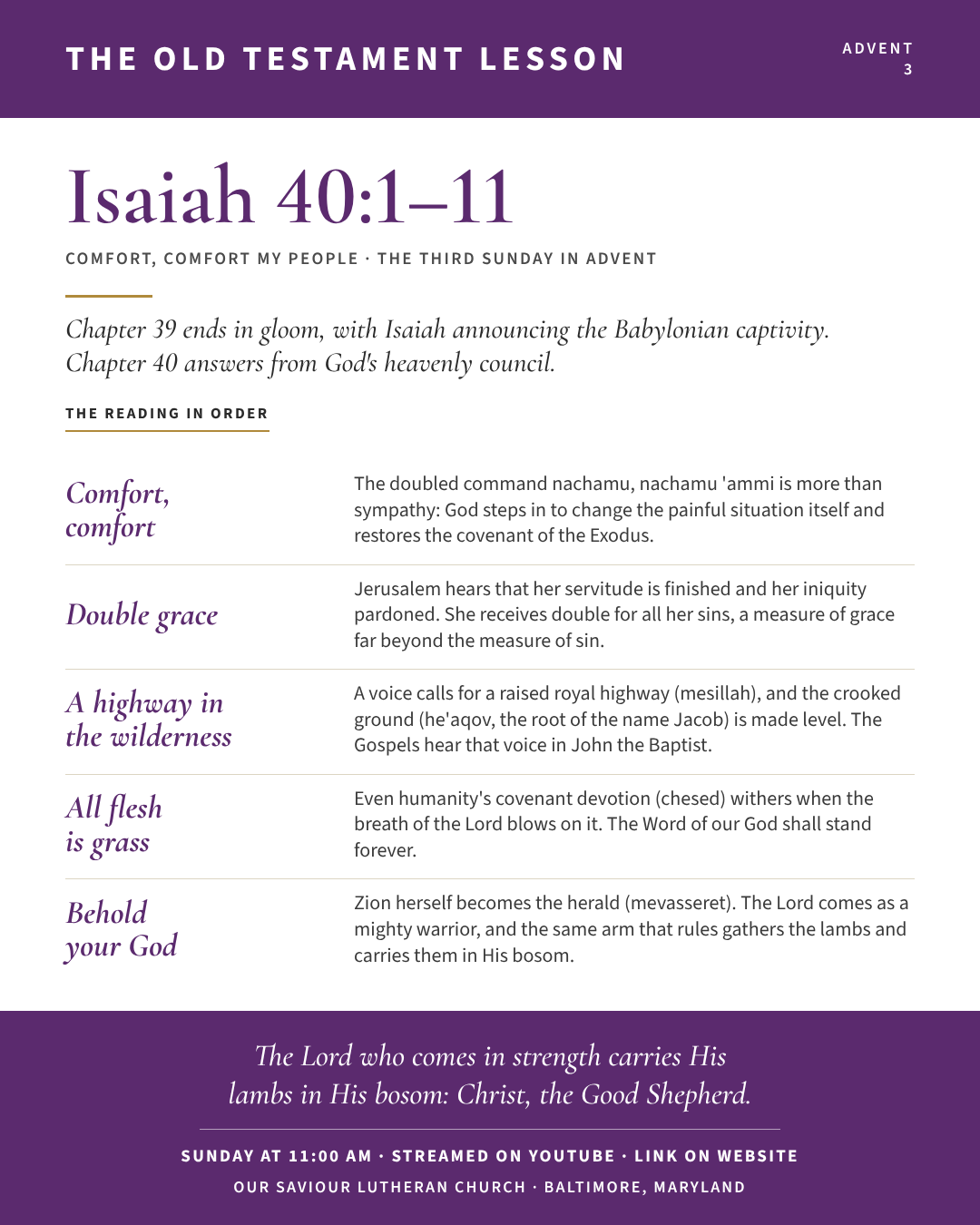
This passage opens the Book of Comfort with a doubled imperative, nachamu nachamu, “Comfort, comfort My people,” the repetition itself a Hebrew figure for certainty and abundance of grace after the announced Babylonian exile. Jerusalem’s iniquity is described as paid kiplayim, double, not because God’s judgment was excessive but because His grace exceeds it still further; a voice then cries to prepare in the wilderness a mesillah, a raised royal highway, for Yahweh’s advent, a text all four Gospels apply to John the Baptist. All flesh is grass, chatsir, withering before the scorching ruach of God, and yet that same divine Word, unlike the grass, yaqum le’olam, stands forever, a text St. Peter quotes to describe the Gospel itself. The chapter closes with Yahweh revealed at once as conquering warrior and gentle shepherd, gathering the lambs in His arm and carrying them against His breast, an image fulfilled in Christ, the Good Shepherd who bears His flock through death into life.
The Old Testament: Isaiah 40:1–11.
Epistle
1 Corinthians 4:1–5
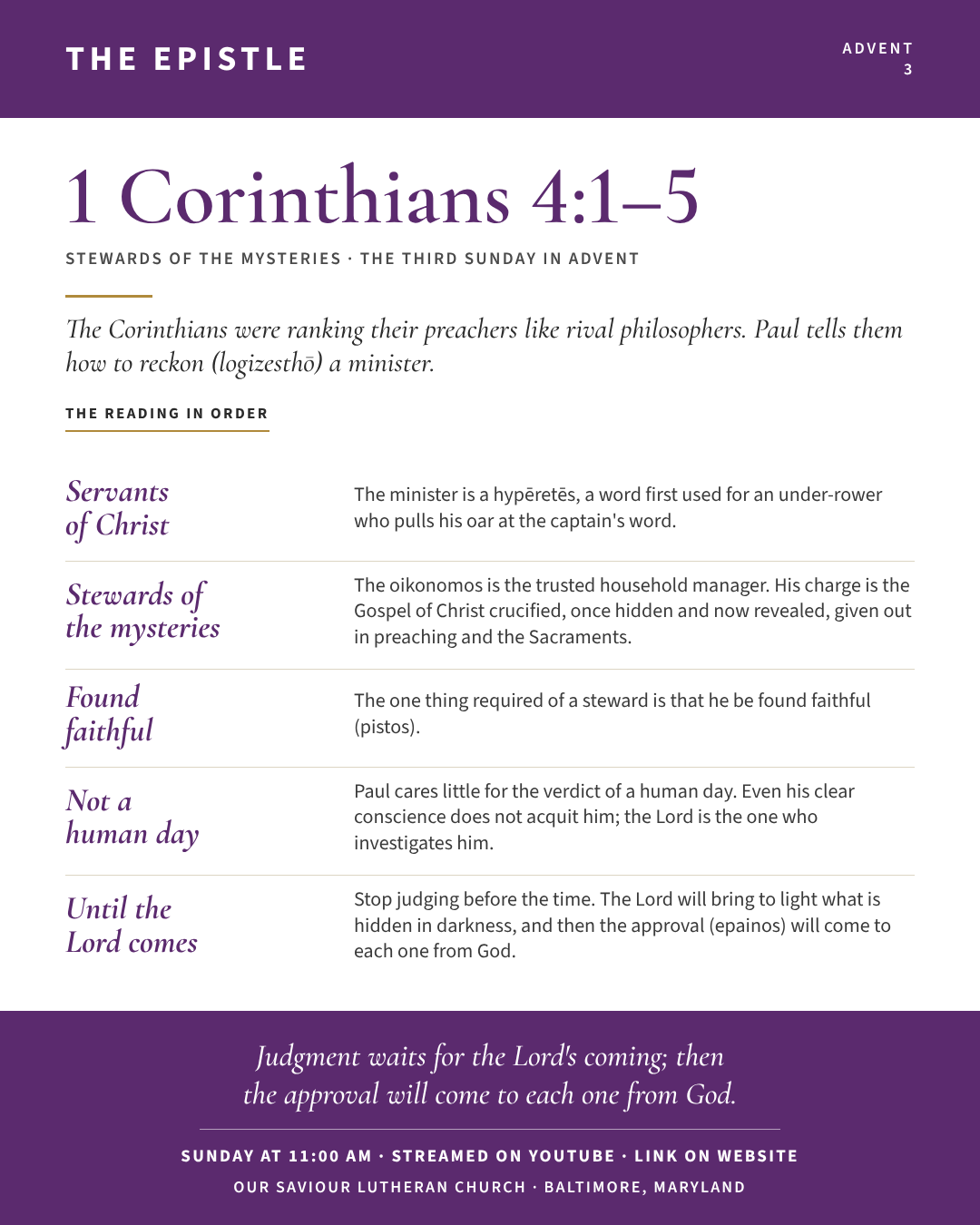
Paul answers the Corinthians’ habit of ranking their teachers like celebrities by defining the ministry in two humble titles: hyperetai, under-rowers who serve at another’s command, and oikonomoi, household stewards entrusted with another’s goods. What God requires of such a steward is simply that he be found pistos, faithful, and Paul refuses to let even his own clear conscience settle the question, since a clear conscience only shows a man ignorant of his own hidden faults rather than proven innocent. The one true Judge, he insists, is Christ, who will illumine what darkness now hides and lay bare the intentions of every heart. Paul forbids judgment before its appointed hour, pro kairou, since that hour belongs to the Lord’s own coming, and only then will each faithful steward receive God’s own commendation. On Gaudete Sunday the text lifts the eye above every human day of judgment to the one Day that actually counts.
The Epistle: 1 Corinthians 4:1–5.
Holy Gospel
Matthew 11:2–11
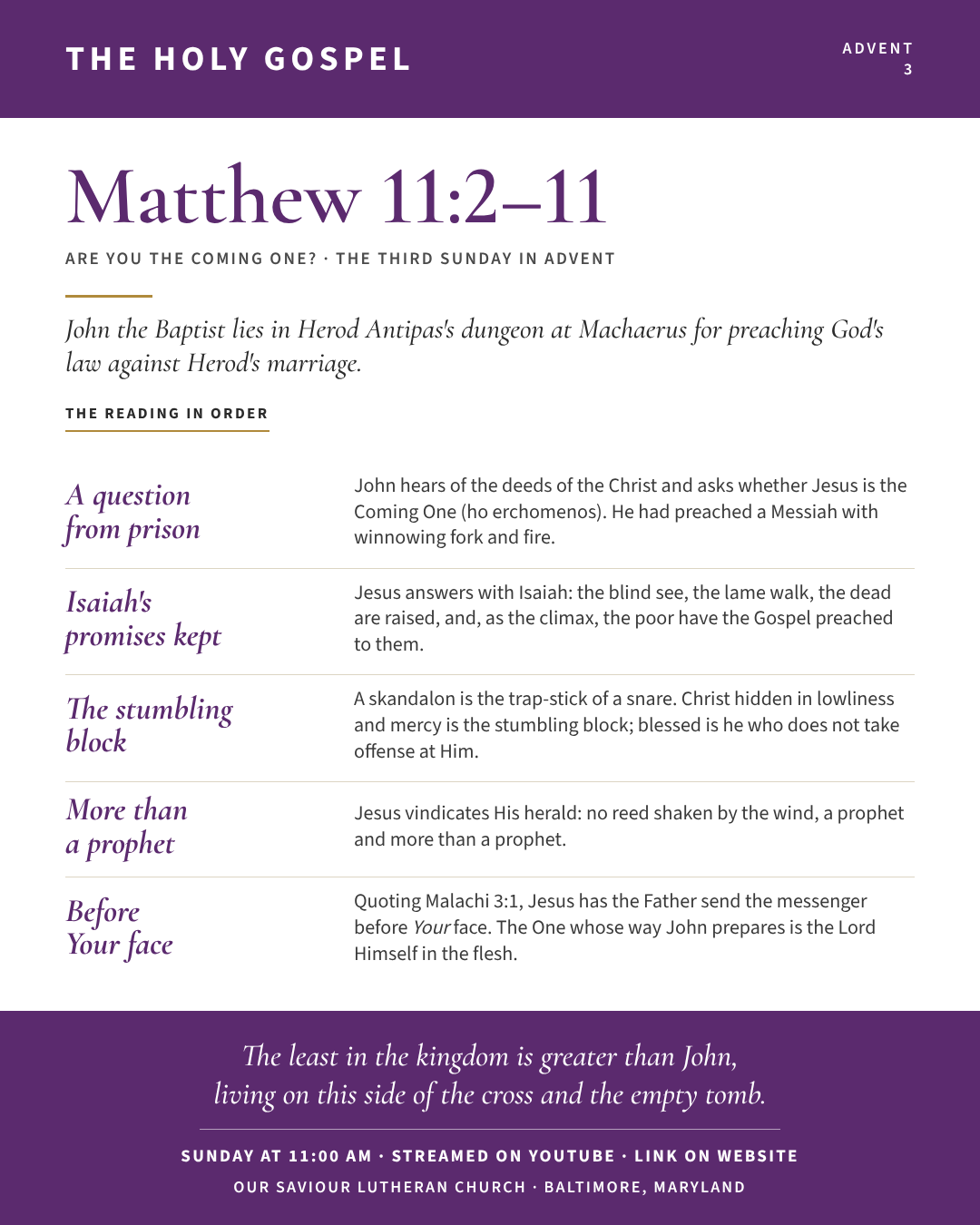
From his cell in Herod’s fortress at Machaerus, John sends word asking whether Jesus is ho erchomenos, the Coming One, or whether Israel should look for another; the herald who once preached a Messiah with winnowing fork and unquenchable fire now watches that same Messiah heal the sick and eat with sinners instead. Jesus answers not with argument but with the fulfilled signs of Isaiah 35 and 61, the blind seeing, the lame walking, the poor hearing good news, ptochoi euangelizontai, and pronounces a beatitude on whoever is not skandalized, does not stumble, over a Messiah who saves through weakness rather than force. Jesus then turns to the crowd and names John the promised messenger of Malachi 3:1, greater than any man born of woman, yet declares that the least believer now living on this side of the cross stands higher still, clothed in a fuller revelation of Christ than John himself ever received.
The Holy Gospel: Matthew 11:2–11.
The hymns and their stories
Opening Hymn
“When All the World Was Cursed” · LSB 346
Johann Gottfried Olearius wrote this hymn in 1664 for his own uncle’s feast day, so to speak: it first appeared as a text for the Nativity of St. John the Baptist, June 24, in a collection Olearius published in Halle the same year his uncle Johann Olearius, author of the very next hymn in Lutheran Service Book, was producing hymns of his own. A mid-summer festival for John the Baptist rarely appears on a modern Sunday schedule, so later hymnal editors moved the text into Advent, where its subject, the Baptist as forerunner, fits naturally beside the Advent Gospels. Olearius wrote five stanzas; Lutheran Service Book prints only four, the hymnal committee having judged the original fourth stanza dispensable once the hymn needed to fit a single printed page without a turn. Paul E. Kretzmann’s 1940 translation, made for The Lutheran Hymnal, carries the text from the world under Moses’ curse through John’s leaping in his mother’s womb and his preaching by the Jordan to a closing prayer for the light and life that curse no longer holds. As the Opening hymn on Gaudete, it sets the whole service in motion by naming the very darkness the day’s Introit rejoices to see broken.
Hymn of the Day
“Comfort, Comfort Ye My People” · LSB 347
Like the hymn before it, “Comfort, Comfort Ye My People” was written for St. John the Baptist’s Day rather than for Advent. Johann Olearius, general superintendent of the Lutheran church in Weissenfels and Halle and a survivor of the Thirty Years’ War, wrote Tröstet, tröstet meine Lieben as a direct paraphrase of Isaiah 40:1–8, the very Old Testament reading appointed for John’s festival; that same chapter of Isaiah anchors Advent’s own Gospel of the voice crying in the wilderness, so the hymn migrated naturally into this season. Olearius published it in 1671 in his own hymnal, Geistliche Singe-Kunst, a collection of 1,218 hymns of which he wrote some 300 himself. Its tune, familiar today as FREU DICH SEHR, began life as Louis Bourgeois’s setting of Psalm 42 in the 1551 Genevan Psalter, and its lively, dotted rhythm is easily lost if sung too much like a solemn quarter-note chorale. Catherine Winkworth’s 1863 translation carries Isaiah’s own comfort straight into English, and as Gaudete’s Hymn of the Day it puts Isaiah’s twofold nachamu, “comfort, comfort,” directly into the mouths of the congregation.
Hymn before Communion
“Arise, O Christian People” · LSB 354
Valentin Thilo the Younger, a professor of poetry and rhetoric in Königsberg, wrote Mit Ernst, o Menschenkinder near the end of the Thirty Years’ War and published it in 1642, appointing it originally for the Fourth Sunday in Advent, when the old lectionary’s Gospel was John the Baptist’s own testimony in John 1. Its opening stanzas paraphrase Isaiah’s voice crying in the wilderness as fulfilled in John’s ministry, and its Lutheran accent falls hard on grace alone: “To us by grace alone the truth and light were given.” Thilo’s own fourth stanza had bluntly warned that God’s fury falls on those who ignore John’s preaching; hymnal editors in 1657 judged the warning too severe for congregational singing and replaced it with a gentler close, and it is that softened form that reached English through Arthur T. Russell’s 1851 translation and, eventually, Lutheran Service Book’s “Arise, O Christian People.” Sung before Communion, its call to rise and prepare the way of the Lord meets the congregation at the very moment it comes forward to receive Him.
Closing Hymn
“On Jordan’s Bank the Baptist’s Cry” · LSB 344
This hymn passed for over a century as an ancient relic of the early Church. When John Chandler translated it in 1837 for his collection Hymns of the Primitive Church, he believed Jordanis oras praevia to be genuinely early Christian; in fact Charles Coffin, rector of the University of Paris, had written it barely a hundred years before, publishing it in the 1736 Paris Breviary for the Advent weekday office of Lauds. Chandler’s translation covered the hymn’s first three stanzas; a fourth stanza and a new Advent doxology were added for the 1859 and 1861 editions of Hymns Ancient and Modern, and hymnals since have generally dropped Coffin’s original second stanza. The text pictures John crying out along the Jordan’s banks to announce the coming Christ, the same herald the day’s Gospel has shown wrestling with that very announcement from a prison cell. As the hymn that closes Gaudete, it sends the congregation out still listening for that voice in the wilderness, urging the way prepared for the Lord who has already come and is coming still.