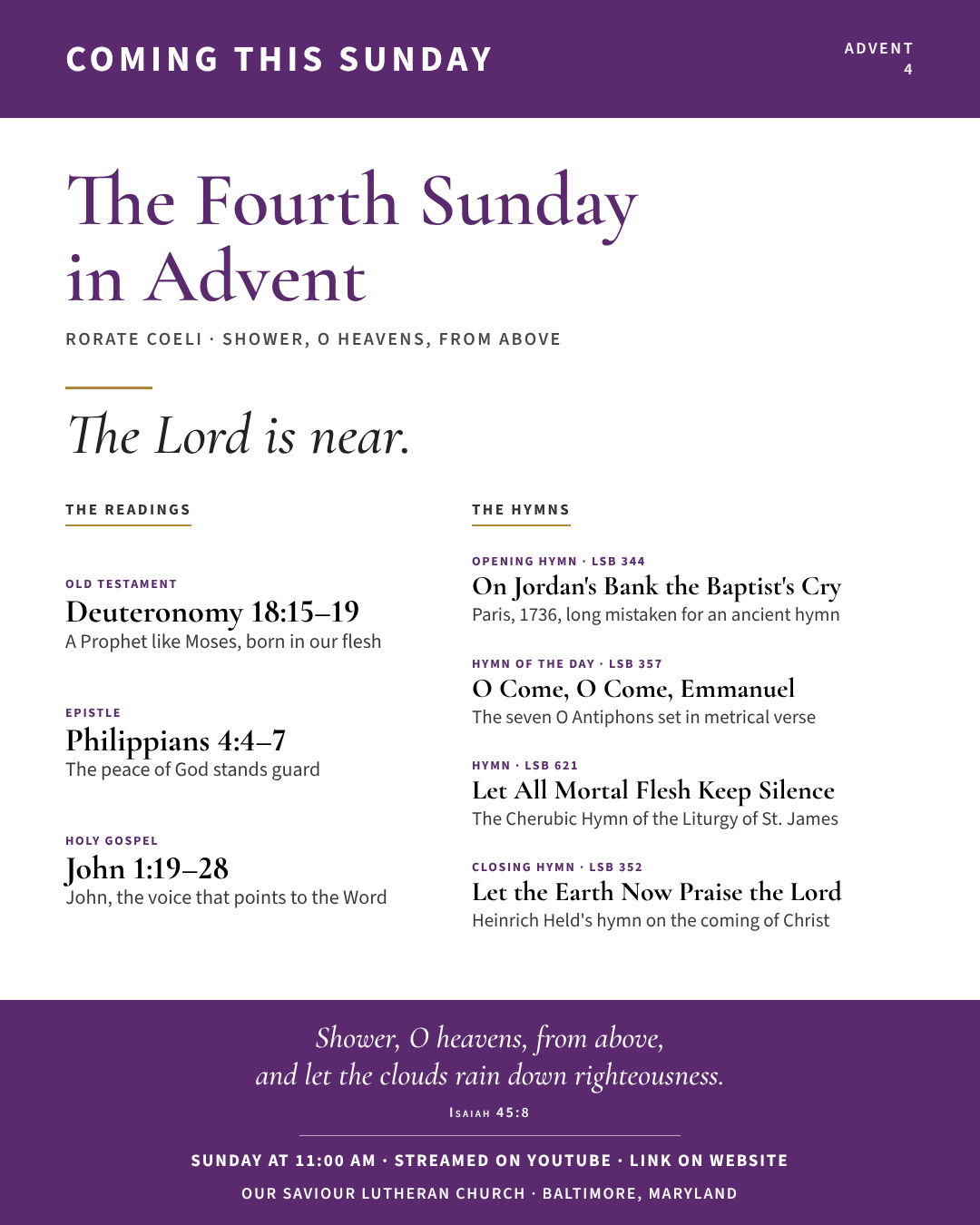
The Fourth Sunday in Advent takes its name, Rorate Coeli, from the opening word of its historic Latin Introit, drawn from Isaiah 45:8: Rorate, caeli, desuper, et nubes pluant iustum, “Drop down, ye heavens, from above, and let the skies pour down righteousness.” Standing on the very threshold of the Nativity, the Church prays this cry with fresh urgency, and the day’s Collect answers it in kind: rather than asking the Lord merely to stir up our hearts, as on the first two Sundays of the season, it asks Him to stir up His own power and come Himself to help us. The season’s O Antiphons, chanted at Vespers each evening from December 17 through 23 before and after the Magnificat, address Christ under seven Old Testament titles: O Wisdom, O Adonai, O Root of Jesse, O Key of David, O Dayspring, O King of the Nations, and O Emmanuel, the last of which supplies both the hymn appointed before Communion and the Sunday’s own governing theme of the God who draws near.
The Introit draws its name and words from Isaiah 45:8, “Drop down, ye heavens, from above, and let the skies pour down righteousness,” a plea for God’s own intervention as the Nativity draws near.
The Collect. “Stir up Your power, O Lord, and come and help us by Your might,” a direct plea for God’s own almighty deliverance rather than for our own preparation.
The Epistle. Philippians 4:4–7, Paul’s call to rejoice always because the Lord is at hand, written by an apostle in Roman chains.
The Gospel. Luke 1:39–56, Mary’s visit to Elizabeth, the unborn John’s leap for joy, and Mary’s own song of praise, the Magnificat.
The readings at a glance
Old Testament
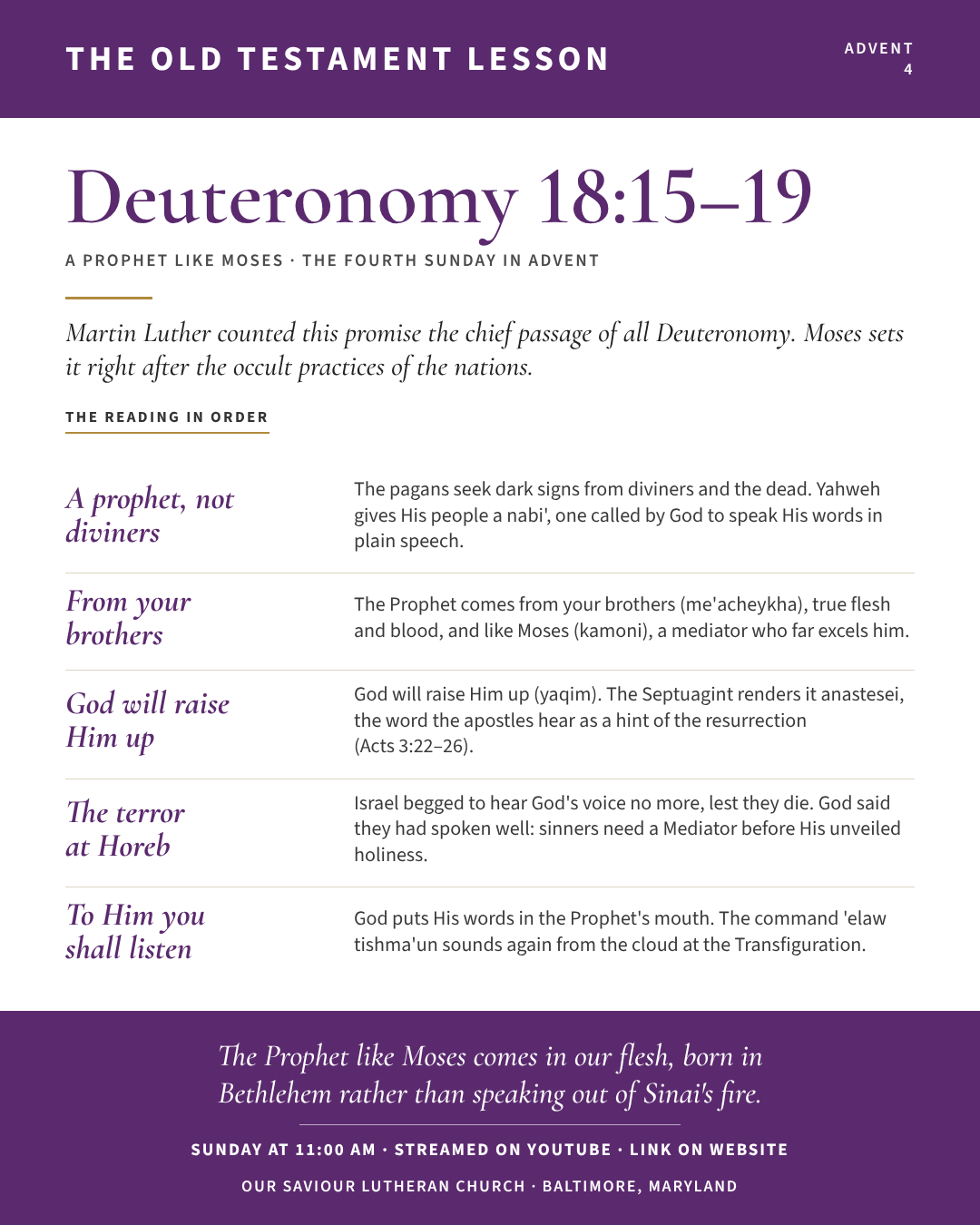
Deuteronomy 18:15–19
Moses places the word nabi, prophet, first in the Hebrew sentence for sharp contrast with the occult diviners just condemned in the verses before it, and promises a coming Prophet raised up mikqirbeka, from your midst, and kamoni, like me. Martin Luther called this the chief passage of the whole book, since it points past Moses to One who mediates grace rather than the Law’s wrath alone. The promise is grounded in Israel’s terror at Horeb, where the people begged not to hear God’s unmediated voice again lest they die, and God answered that they had spoken well, establishing the very principle of a human mediator that Christ, the true mesites of the New Covenant, fulfills. God the Father quotes this text’s closing command word for word at the Transfiguration, akouete autou, “Listen to Him,” identifying Jesus as the Prophet Moses foretold and warning that to reject His voice is to reject God Himself.
The Old Testament: Deuteronomy 18:15–19.
Epistle
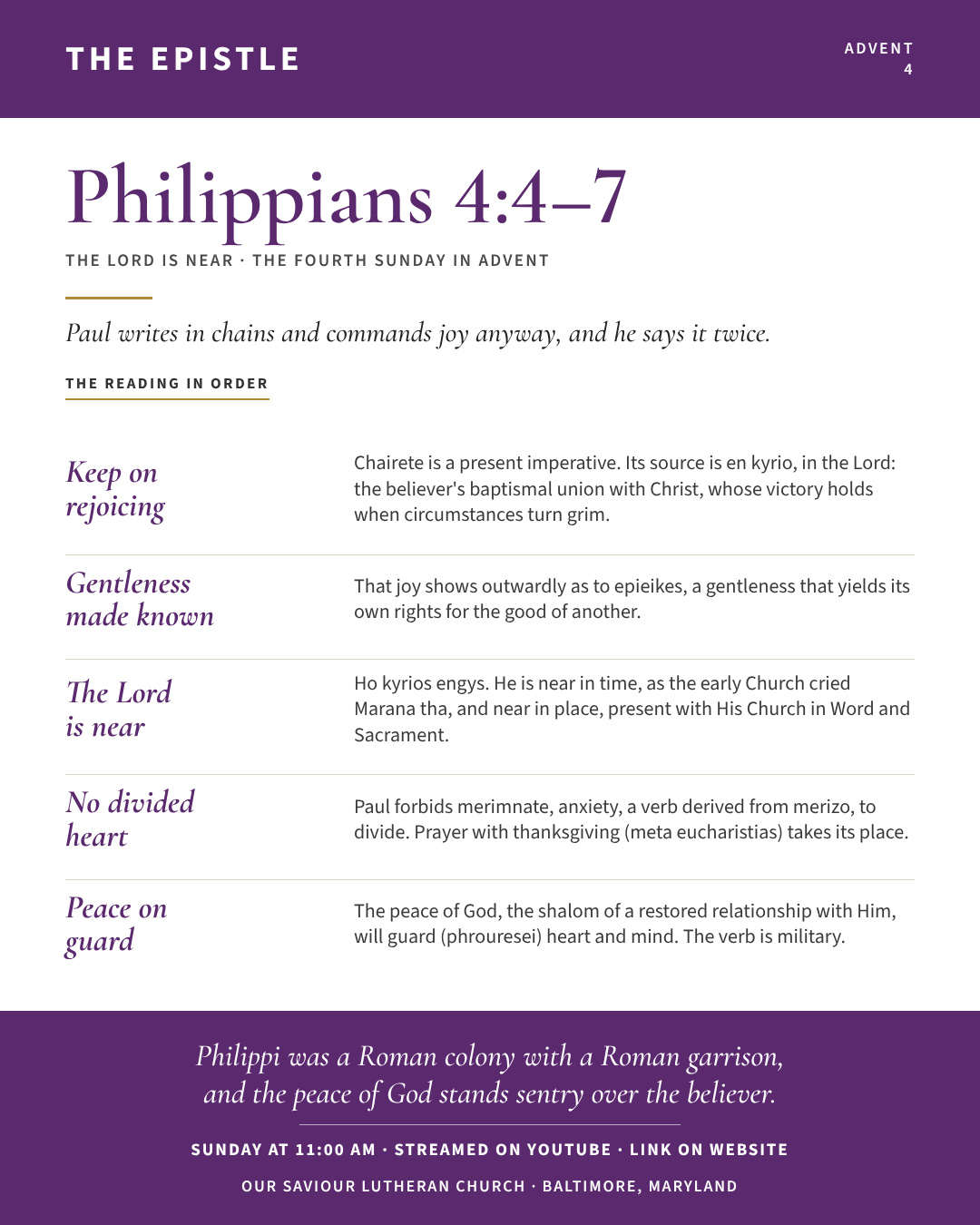
Philippians 4:4–7
Paul writes from a Roman prison cell, yet commands chairete, rejoice, twice over, a present imperative meaning to keep on rejoicing regardless of circumstance, because that joy is fixed en kyrio, in the Lord, rather than in earthly comfort. The reason given is the short, weighty acclamation ho kyrios engys, “the Lord is near,” an echo of the ancient prayer Marana tha and a promise of Christ’s nearness both at His coming again and in His Word and Sacrament even now. Because He is near, Paul forbids anxious care, merimnate, literally a fracturing of the mind, and commands prayer joined to eucharistia, thanksgiving, so that the peace of God, transcending all human reason, may stand guard, phrouresei, over heart and mind like a garrison stationed around a city.
The Epistle: Philippians 4:4–7.
Holy Gospel
Luke 1:39–56
Mary travels with haste into the Judean hill country to Elizabeth, and when Elizabeth hears her greeting the unborn John leaps, eskirtesen, in her womb, an echo of Jacob and Esau struggling in Rebekah’s womb and proof that the forerunner already worships his Lord before either child is born. Filled with the Holy Spirit, Elizabeth pronounces Mary blessed and calls her “the mother of my Lord,” an early confession of the child’s divine identity, and commends Mary as the one who believed, makaria he pisteusasa, that God would fulfill His word to her. Mary answers with the Magnificat, declaring that God has scattered the proud, cast down the mighty, and exalted the humble, language drawn from Hannah’s song that casts the Incarnation as the great reversal in which God keeps His mercy sworn to Abraham and his offspring forever.
The Holy Gospel: Luke 1:39–56.
The hymns and their stories
Opening Hymn
“Hark the Glad Sound!” · LSB 349
Philip Doddridge, an English Independent minister who wrote several hundred hymns to close his own sermons, wrote this text for a sermon on December 28, 1735, preached on Luke 4:18–19, where Jesus stands in the Nazareth synagogue and declares Himself sent “to proclaim liberty to the captives.” Doddridge’s manuscripts survive in his own hand, one dated to that December Sunday and another once owned by Lady Frances Gardiner, wife of the Scottish colonel James Gardiner. Though written for the Sunday after Christmas, the hymn found a lasting home in Advent instead, since its picture of a herald’s voice announcing the coming Savior suits John the Baptist’s preaching as readily as Christ’s own. It first reached print in 1745 in Scotland, in a collection assembled by a committee of the General Assembly of the Church of Scotland; of Doddridge’s original seven stanzas, Lutheran Service Book keeps four, unaltered from his own hand. Its tune, Chesterfield, was composed around 1791 by Thomas Haweis and named for Lord Chesterfield, a visitor to the household Haweis served as chaplain. As the Opening hymn on Rorate Coeli, it sends the whole congregation forth to listen for the very voice the day’s readings announce.
Hymn of the Day
“The Angel Gabriel from Heaven Came” · LSB 356
Sabine Baring-Gould is usually credited only as the translator of a Basque carol, but the historical record names him as author of the English text outright: the original Basque poem, Birjina gaztettobat zegoen, states plainly that an angel came down from heaven, while the vivid picture of Gabriel with “wings as drifted snow, with eyes as flame” is Baring-Gould’s own invention, and its fourth stanza is entirely his. He passed the carol to Edgar Pettman, music editor of The University Carol Book, who published it under the title “Gabriel’s Message,” the name the tune still carries. That tune is itself a nineteenth-century Basque folk melody, collected in France by Charles Bordes and printed around 1897. Later hymnal committees softened two of Baring-Gould’s own lines to avoid masculine pronouns for Gabriel and for God, so the version in Lutheran Service Book differs slightly from his 1916 original. Grounded in Luke 1:26–38, the Annunciation itself, it serves as the Hymn of the Day for Rorate Coeli by placing the whole congregation at Mary’s side to hear Gabriel’s own greeting.
Hymn before Communion
“O Come, O Come, Emmanuel” · LSB 357
This hymn descends from the Great O Antiphons, in use at Rome by the eighth century and chanted before and after the Magnificat at Vespers on each of the seven evenings before Christmas Eve, each one addressing Christ by an Old Testament title: Wisdom, Lord of Might, Root of Jesse, Key of David, Dayspring, King of the Nations, and Emmanuel. A versified Latin form, Veni, veni, Emmanuel, first appeared in print in 1710 in a Cologne hymnal with five stanzas; because two antiphons were missing, the translation committee of the Episcopal Hymnal 1940 supplied new stanzas in 1943 so all seven survive today. John Mason Neale gave English its familiar words, publishing a first version in 1851 and settling on the line “O come, O come, Emmanuel” by 1859. Neale also printed its haunting tune, crediting a “French Missal in the National Library, Lisbon”; the source eluded scholars for nearly a century until it turned up in fifteenth-century manuscripts from French convents of the Poor Clares, where the same melody had served as a funeral trope, “Bone Jesu, dulcis cunctis,” sung within the chant Libera me, domine, de morte aeterna. Sung before Communion on the very Sundays its antiphons were written for, it carries the Church’s oldest Advent longing straight to the altar where Emmanuel, God with us, comes in fact.
Closing Hymn
“Let the Earth Now Praise the Lord” · LSB 352
Heinrich Held, a German lawyer and Lutheran poet, wrote this text amid the ruin of the Thirty Years’ War and titled it Von der Zukunfft Christi, “On the Coming of Christ.” It first appeared in print in Johann Niedling’s 1658 or 1659 hymnal under its German opening line, Gott sei Dank durch alle Welt, though earlier hymnologists had mistakenly traced it to Johann Crüger’s Praxis Pietatis Melica of the year before. Hymnologists read Held’s hymn as a free companion to St. Ambrose’s ancient Advent hymn Veni redemptor gentium, the very text Luther had rendered nearly word for word as “Savior of the Nations, Come” (LSB 332); Niedling’s hymnal in fact assigned Held’s freer verses to be sung to Luther’s own tune. One stanza confesses Christ as “Him of twofold race,” Catherine Winkworth’s 1863 rendering of Held’s German phrase for a champion of two origins, a single line holding together the mystery of the Child who is fully God and fully man. Sent out as the Closing hymn on the last Sunday before the Nativity, it carries Advent’s whole longing forward into the praise the coming Child alone deserves.