The Second Sunday after Christmas
Out of Egypt I Called My Son · The Sunday after New Year
The Second Sunday after Christmas stands within the Twelve Days of Christmas, which run from December 25 to January 5, before the Epiphany on January 6. A second Sunday after Christmas Day appears only when the calendar places two Sundays inside that window. Older Lutheran hymnals, including The Lutheran Hymnal of 1941, called it the Sunday after New Year. Our Saviour keeps the historic one-year lectionary, which reads Matthew 2:13–23 on this day: the flight into Egypt, the slaughter of the innocents, and the settlement in Nazareth. The day is a hinge between the joy of the manger and the first shadow of the cross that falls across the infant Christ. Christmas proclaims the Word made flesh; this Sunday proclaims that the flesh the Word assumed was subject to exile, to a tyrant’s rage, and to the tears of grieving mothers, and that God’s saving purpose carried His Son safely through all of it.
Lectionary Primer PDF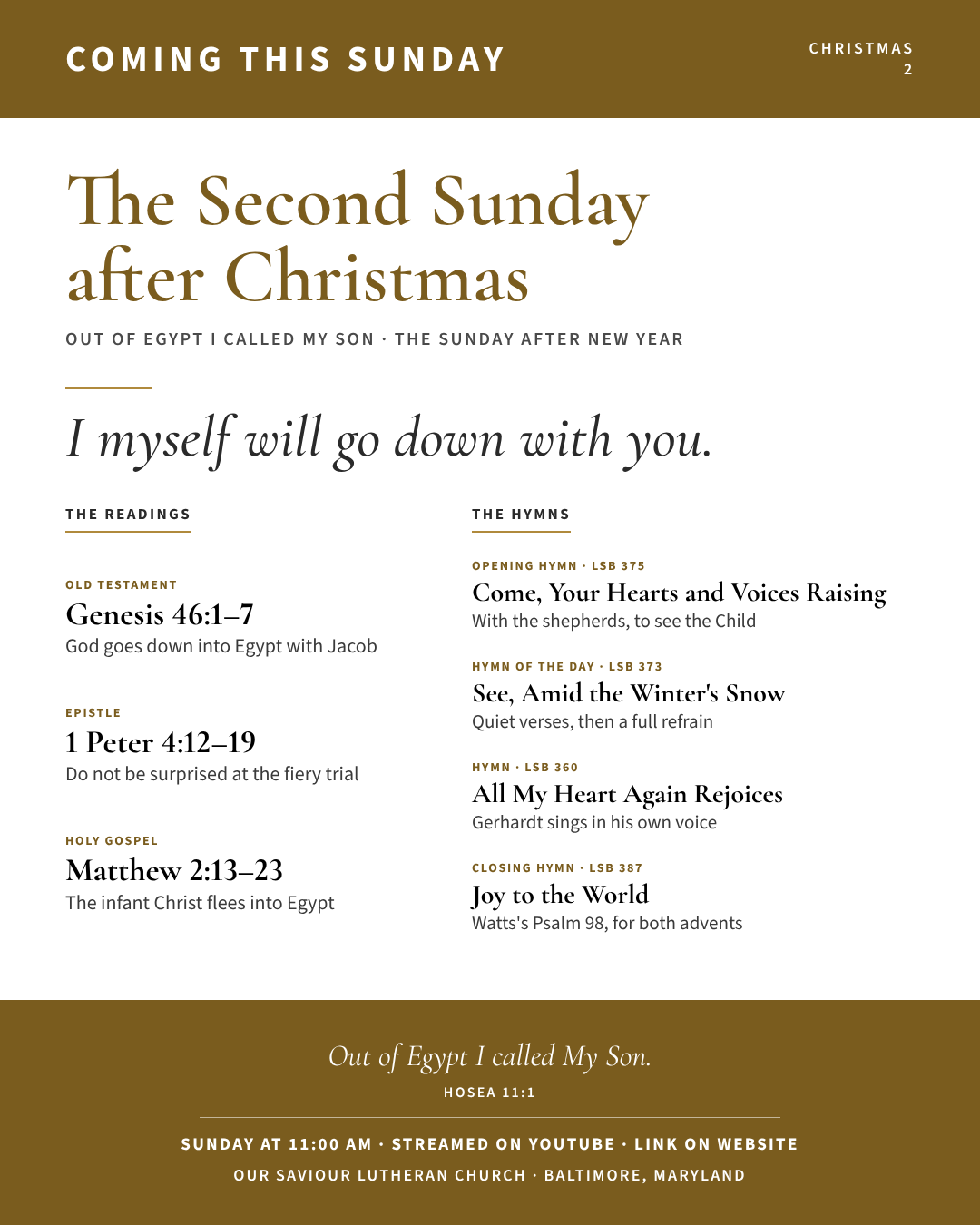
The shape of the service
The Color. White, as on Christmas Day, carrying the purity, joy, and light of the Incarnation forward.
The Old Testament. Jacob goes down into Egypt on God’s promise, “I myself will go down with you.”
The Epistle. Peter tells the baptized not to be surprised at the fiery trial, since they share Christ’s sufferings.
The Holy Gospel. The infant Christ flees into Egypt, Rachel weeps in Bethlehem, and the Holy Family settles in Nazareth.
The Hymns. Two hymns of Paul Gerhardt, a Victorian carol, and Isaac Watts’s paraphrase of Psalm 98 carry the day from the manger to Christ’s reign.
The readings at a glance
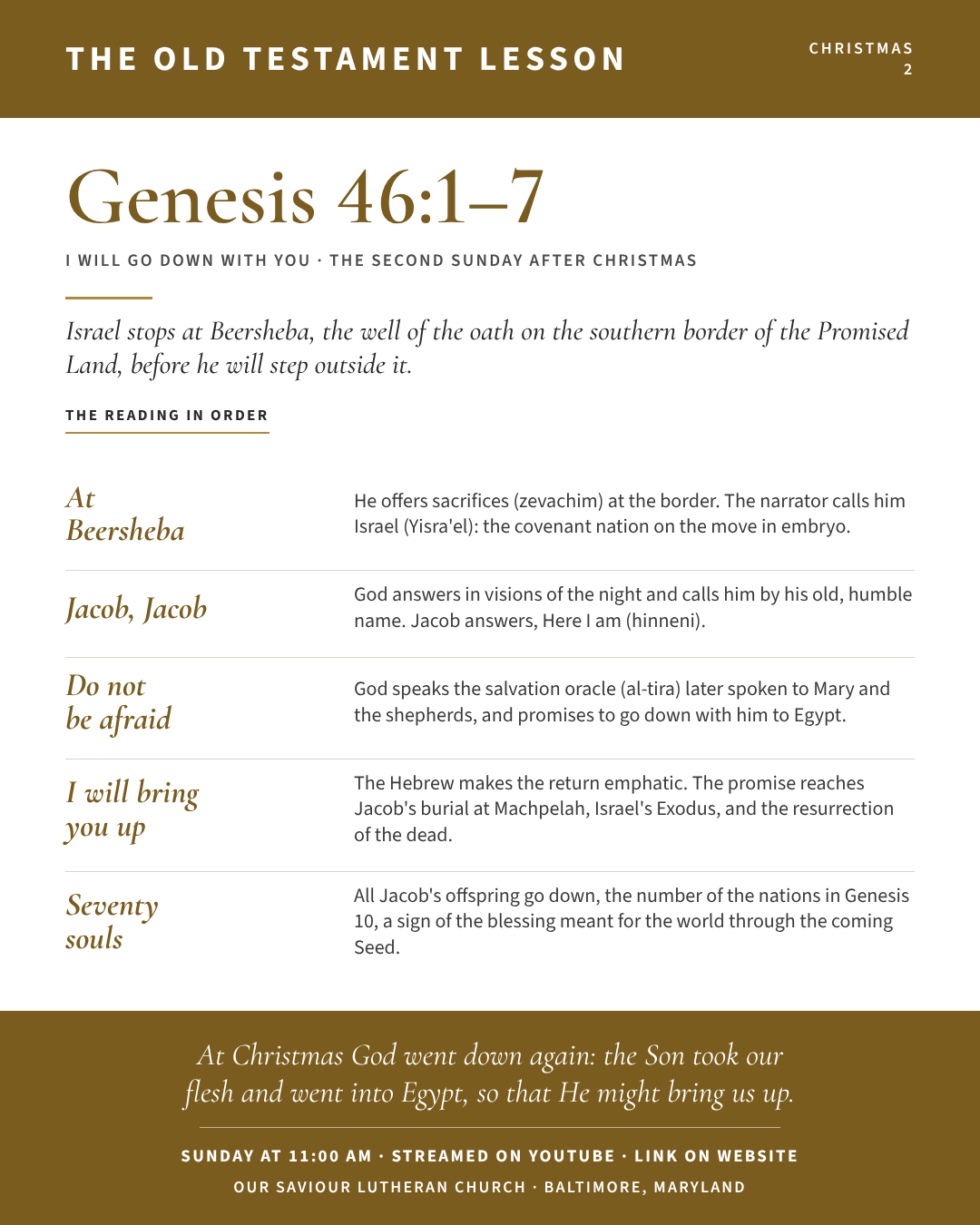
The narrator calls him Israel (Yisra’el), the covenant title, for this is the covenant nation on the move in embryo. He stops at Beersheba, the “well of the oath” on the southern border of the Promised Land, and offers sacrifices (zevachim) before he will step outside it. God answers in visions of the night and calls him by his old, humble name, “Jacob, Jacob,” and Jacob answers, “Here I am” (hinneni). God speaks the salvation oracle later spoken to Mary and to the shepherds, “Do not be afraid” (al-tira), and promises, “I myself will go down with you to Egypt.” The Hebrew makes the return emphatic: “I will most surely bring you up.” That promise reaches Jacob’s burial at Machpelah, Israel’s Exodus under Moses, and the resurrection of the dead. All Jacob’s offspring go down, seventy souls, the number of the nations in Genesis 10, a sign of the blessing meant for the world through the coming Seed. At Christmas God went down again: the Son took our flesh, went into Egypt as a refugee child, and descended into death, so that He might bring us up.
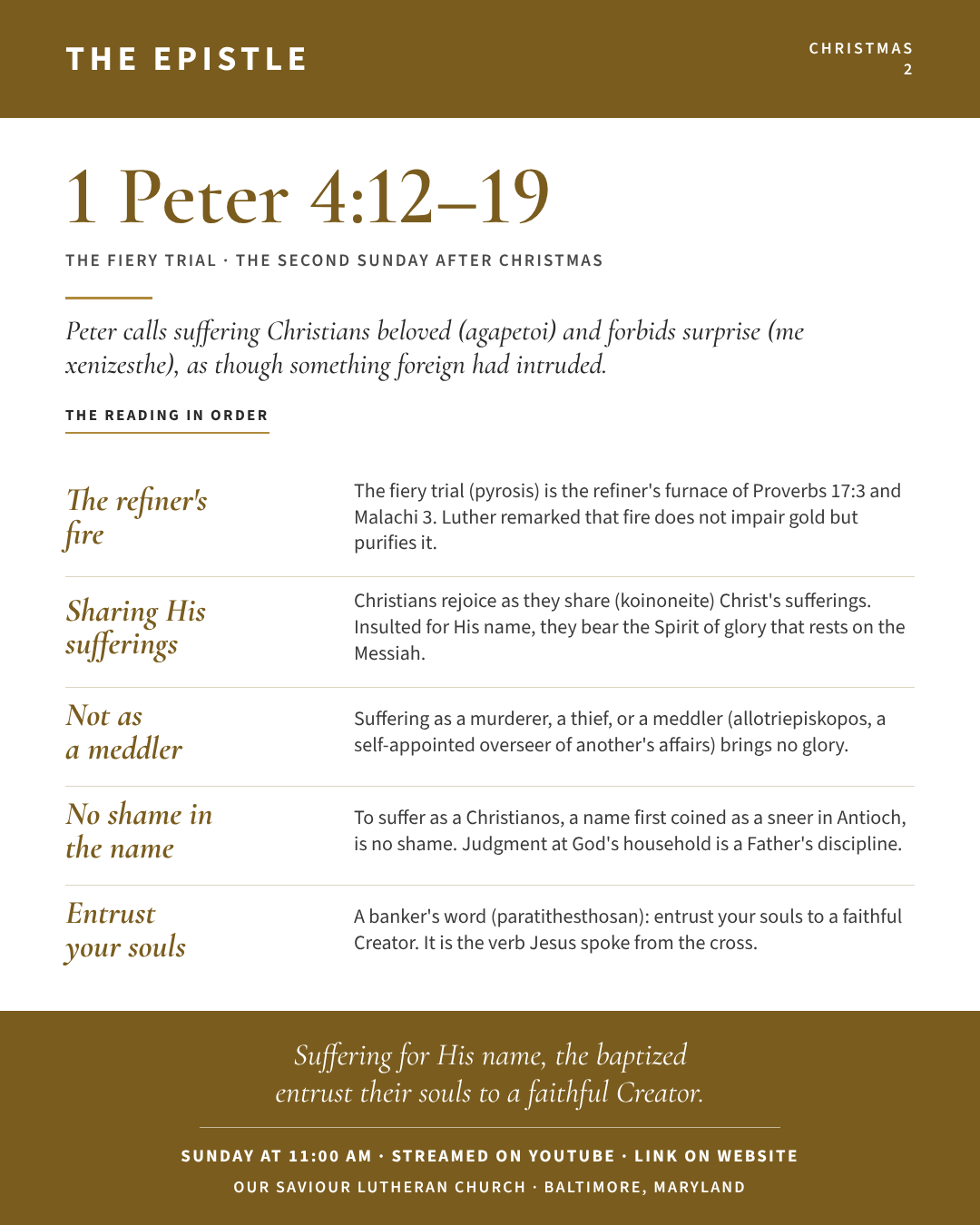
Peter calls suffering Christians “beloved” (agapetoi) and forbids surprise (me xenizesthe, from xenos, “stranger”), as though something foreign had intruded. The “fiery trial” (pyrosis) is the refiner’s furnace of Proverbs 17:3 and Malachi 3; Luther remarked that fire does not impair gold but purifies it. Christians rejoice as they share (koinoneite) Christ’s sufferings, and when they are insulted for His name, the Spirit of glory and of God rests upon them, words drawn from the Septuagint of Isaiah 11:2, where the Spirit rests on the Messiah. Peter draws a line: suffering as a murderer, a thief, or a “meddler” (allotriepiskopos, a self-appointed overseer of another’s affairs, found nowhere else in the New Testament) brings no glory. To suffer as a Christianos, a name first coined as a sneer in Antioch, is no shame. Judgment begins at the household of God, as in Ezekiel 9:6; for God’s children it is a Father’s refining discipline. The reading ends with a banker’s word: “entrust” (paratithesthosan) your souls to a faithful Creator. It is the verb Jesus spoke from the cross: “Father, into Your hands I deposit My spirit.”
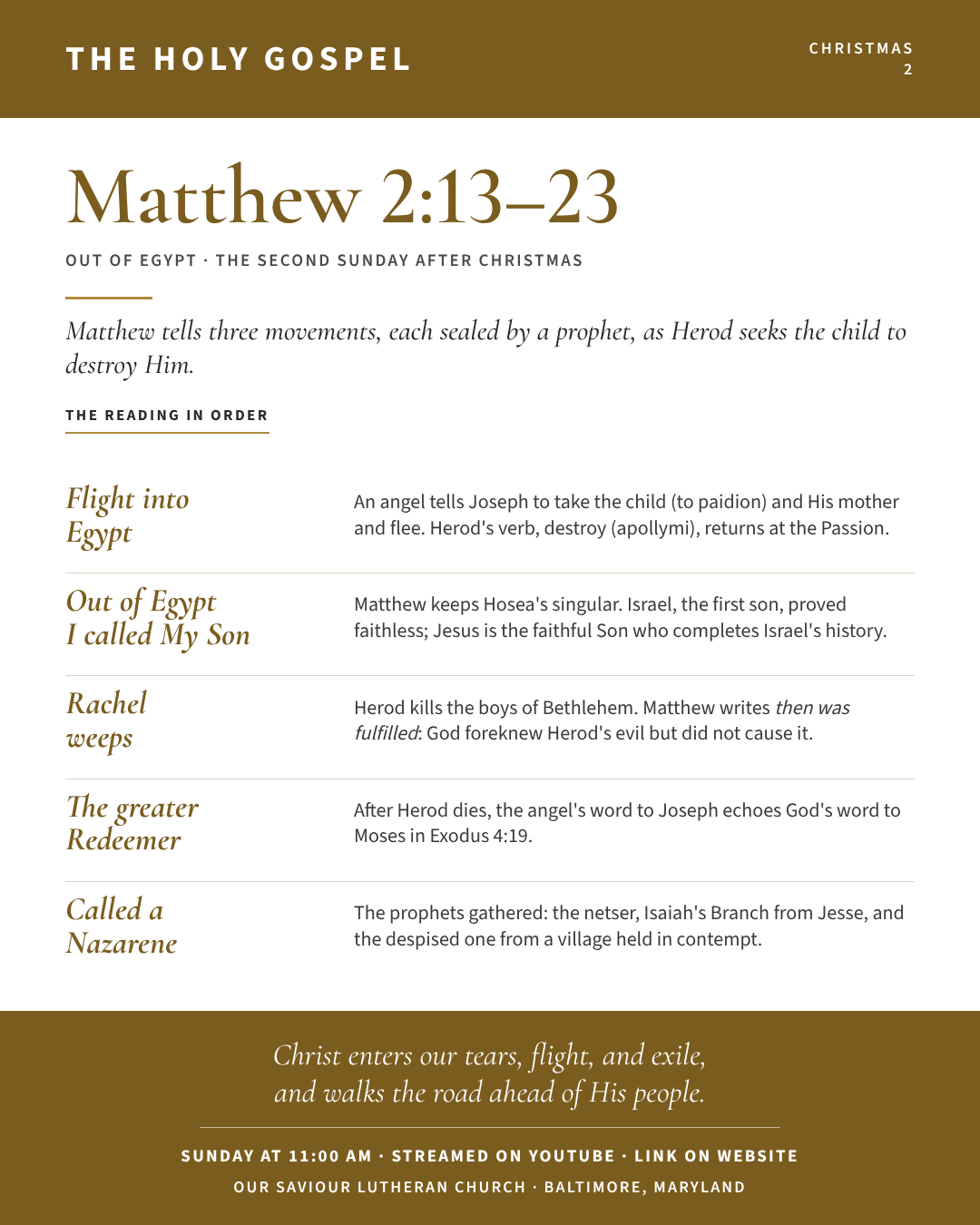
Matthew tells three movements, each sealed by a prophet. An angel tells Joseph in a dream to take “the child” (to paidion) and His mother and flee, for Herod seeks to destroy (apollymi) Him, the verb that returns at the Passion. Matthew translates Hosea 11:1 from the Hebrew, keeping the singular, “Out of Egypt I called My Son”: Israel, the first son, proved faithless; Jesus is the faithful Son who relives Israel’s history and completes it. Herod kills the boys of Bethlehem, and here Matthew writes “then was fulfilled” instead of “in order that”: God foreknew Herod’s evil but did not cause it. Rachel weeps at Ramah, yet her verse in Jeremiah 31 opens onto the promise of the New Covenant. After Herod dies, the angel’s word, “those who were seeking the child’s life are dead,” echoes God’s word to Moses in Exodus 4:19: Jesus is the greater Redeemer. The family settles in Nazareth, and “He shall be called a Nazarene” gathers the prophets: the netser, Isaiah’s Branch from Jesse, and the despised one from a village held in contempt. Christ enters our tears, flight, and exile, and walks the road ahead of His people.
The hymns and their stories