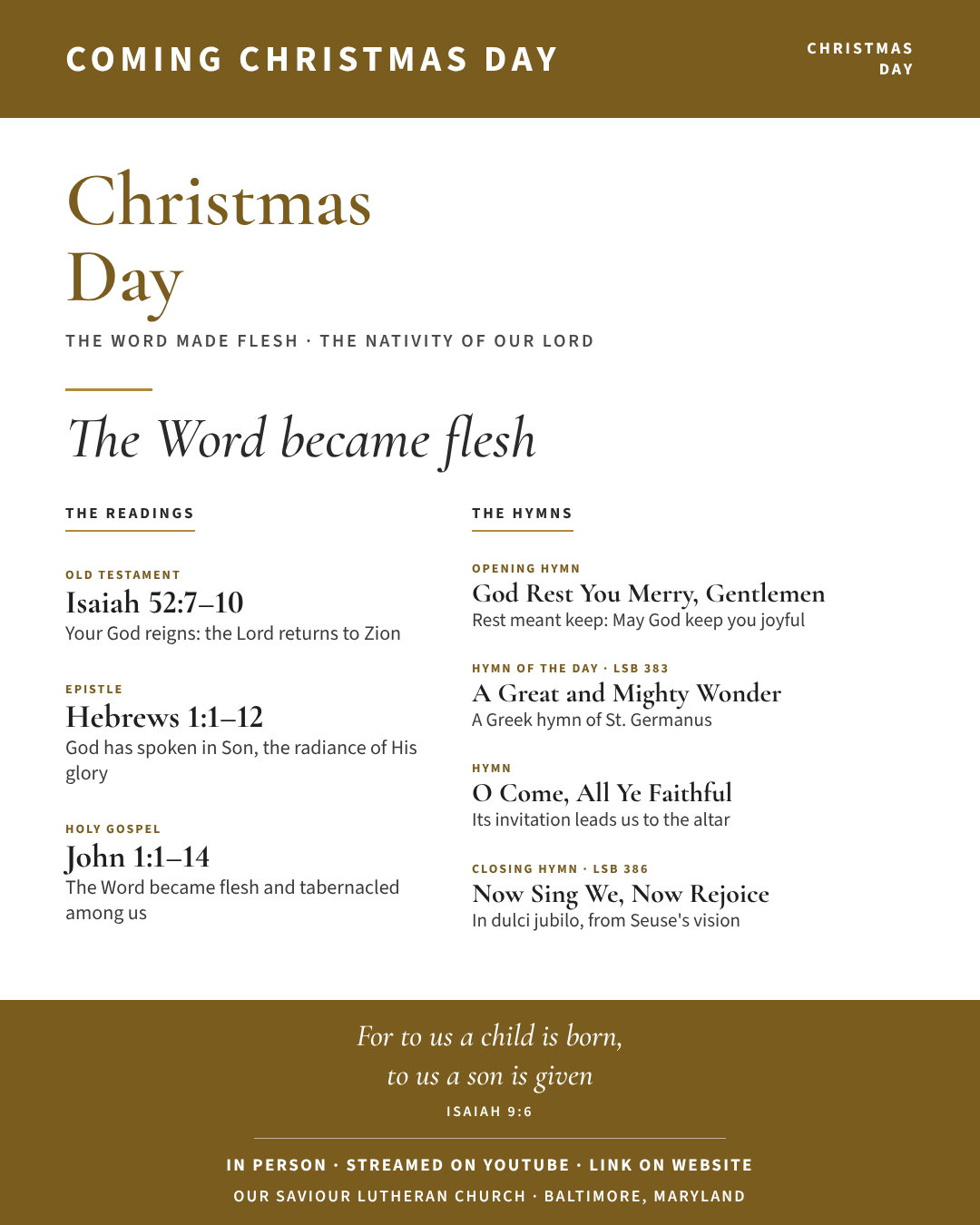
Christmas Day, the Principal Mass of the Nativity, opens the twelve days of Christmastide that run through the Eve of Epiphany, and it shares Christmas Eve’s white paraments and its Christmas Preface, which gives thanks that in the mystery of the Word made flesh God has granted a new revelation of His glory. Having been silenced throughout Advent’s penitential expectation, the Gloria in Excelsis returns in full festive voice, joining the Church on earth to the very angels who sang it first over Bethlehem’s fields. Where Christmas Eve dwells on the earthly, humble circumstances of the Savior’s birth, the propers of Christmas Day turn the eye of faith to His eternal identity: the Introit’s antiphon from Isaiah 9:6 names Him Wonderful Counselor, Mighty God, Everlasting Father, and Prince of Peace, and the Collect prays that the birth of God’s only-begotten Son in the flesh may set us free from the bondage of sin.
The Introit opens with Isaiah 9:6, “To us a child is born, to us a son is given,” joined to Psalm 98’s call to sing a new song for the salvation the Lord has worked with His own holy arm.
The Collect. asks Almighty God that the birth of His only-begotten Son in the flesh may set us free from the bondage of sin.
The Epistle. Hebrews 1:1–12, God’s final speech to us in His Son, the radiance of His glory and exact imprint of His nature, before whom the angels themselves are commanded to bow.
The Gospel. John 1:1–14, the eternal Word who was with God and was God, made flesh to tabernacle among us and reveal the Father’s glory.
The readings at a glance
Old Testament
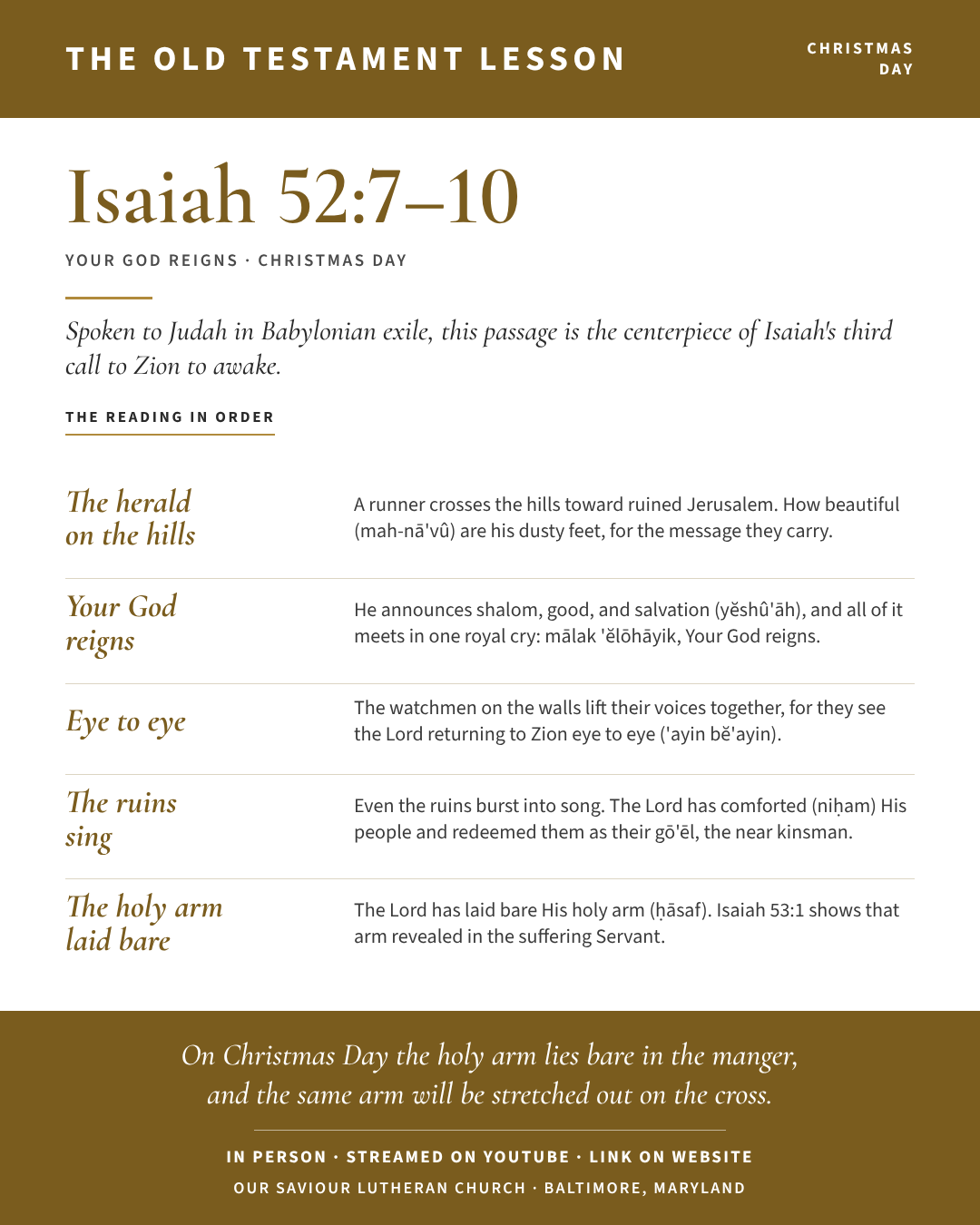
Isaiah 52:7–10
Written to captive Judah, Isaiah exclaims mah na’vu, “How beautiful,” over the dusty feet of a herald crossing the mountains, proclaiming shalom and yeshu’ah and climbing to the royal acclamation malak Elohayik, “Your God reigns.” Paul quotes this text in Romans 10:15 of every preacher of the Gospel, and watchmen on Jerusalem’s ruined walls see Yahweh’s return ayin be’ayin, eye to eye, His comfort and redemption reaching kol-afsei-arets, all the ends of the earth. Yahweh bares His holy arm, chasaf, the gesture of a warrior rolling back his sleeve for battle, yet Isaiah’s very next chapter asks to whom that arm has been revealed, since the power unveiled at Bethlehem is fulfilled not in armies but in the Servant’s vicarious suffering, the same arm stretched out on the cross.
The Old Testament: Isaiah 52:7–10.
Epistle
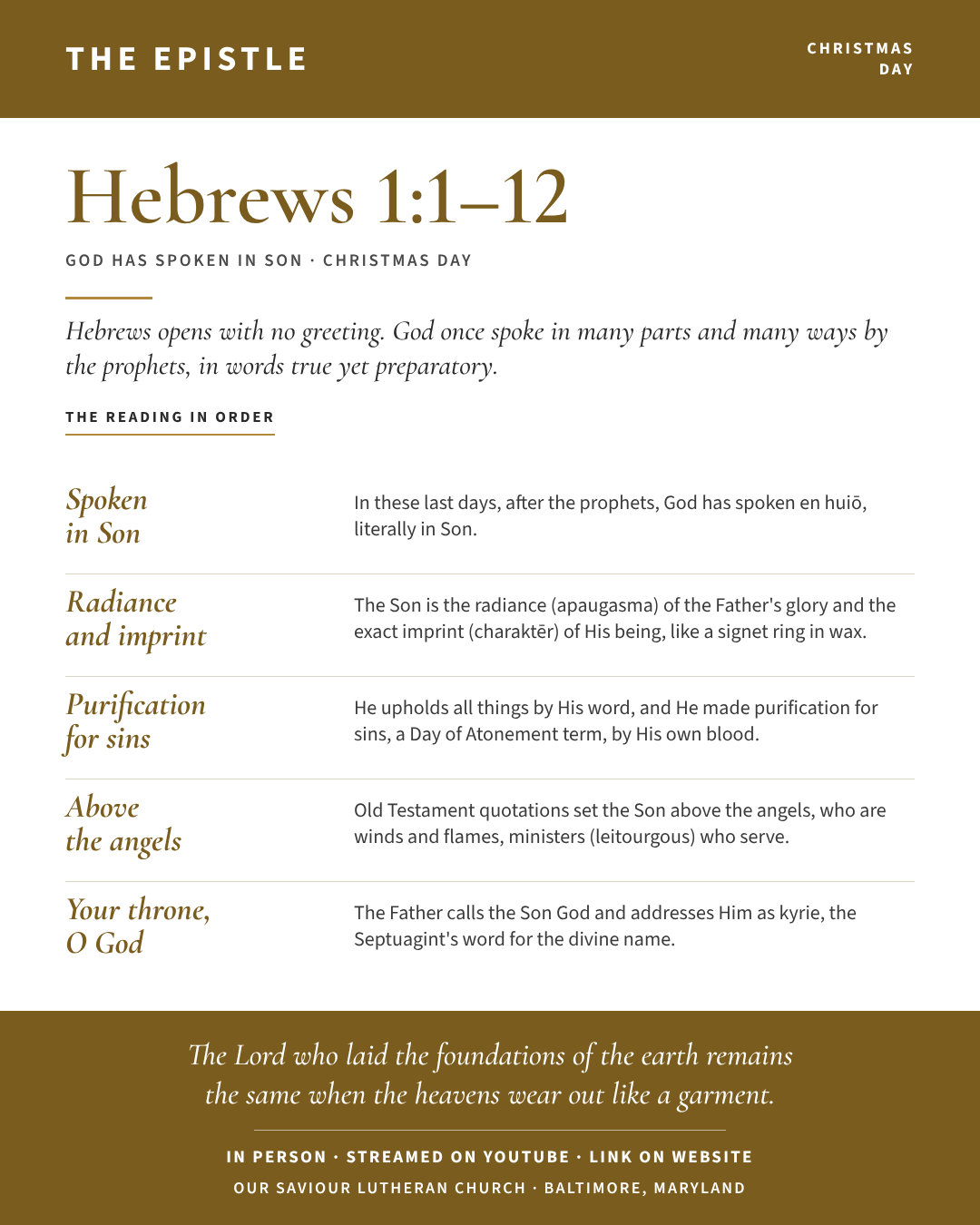
Hebrews 1:1–12
God once spoke polymeros and polytropos, in many parts and many ways, through the prophets, but has now spoken en huio, in One who is Son, the apaugasma, radiance, of His glory and the charakter, exact imprint, of His very being, who sustains all things by His word of power and, having made purification for sins, sat down at the Father’s right hand. The author strings together seven Old Testament texts to prove the Son’s superiority to the angels, climaxing in Psalm 45’s address to the Son as ho theos, O God, and in Psalm 102’s naming Him Kyrios, the covenant name of Yahweh, the one who laid the foundations of the earth and remains, ho autos, the same, when creation itself wears out like a garment.
The Epistle: Hebrews 1:1–12.
Holy Gospel
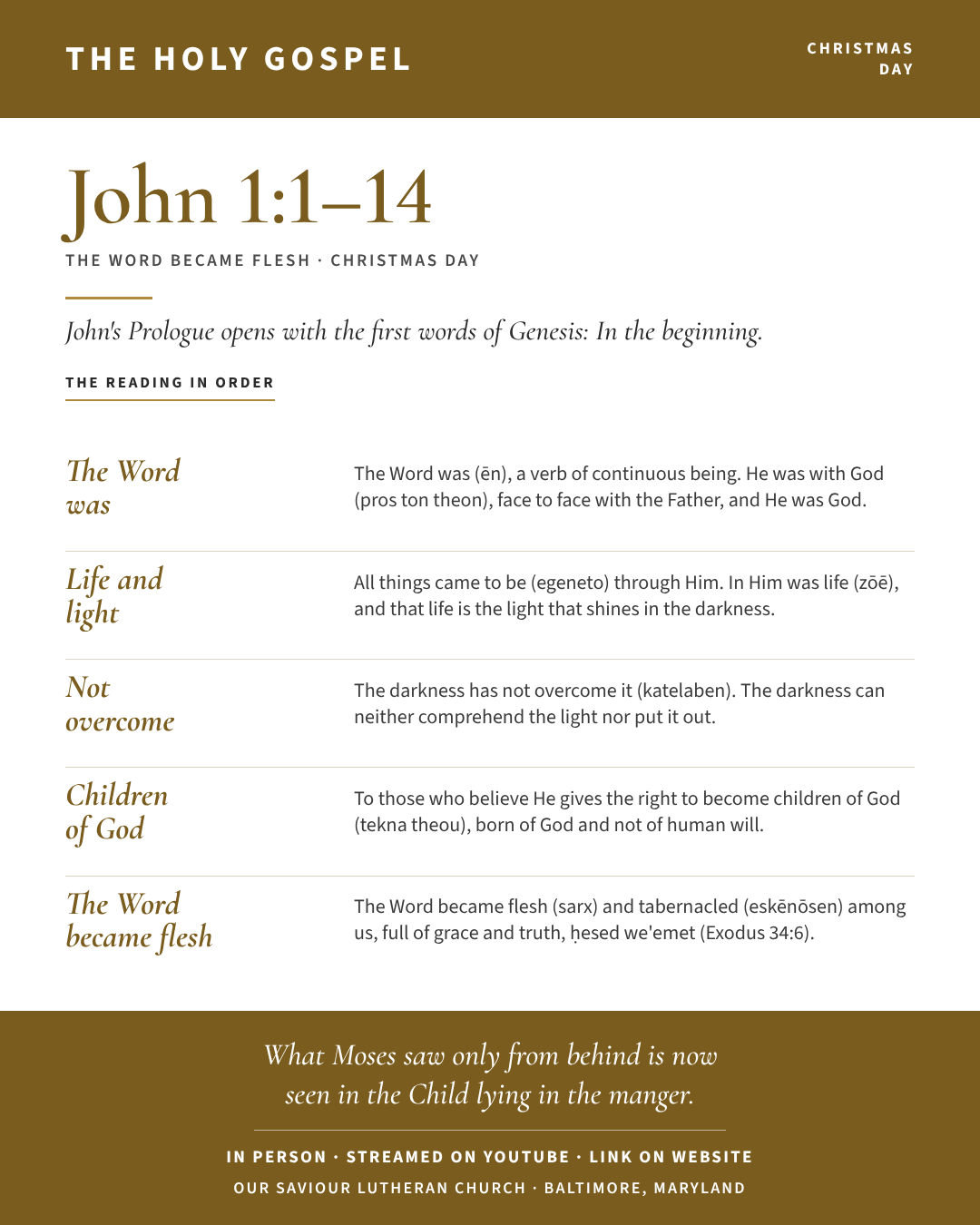
John 1:1–14
John opens en arche, in the beginning, deliberately echoing Genesis, and declares that the Logos was pros ton theon, in face-to-face communion with God, and was Himself theos, God, the anarthrous predicate preserving both His distinct personhood and His full divine nature. All things were made through Him, and in Him was zoe, that uncreated divine life that is the phos, light, of men, a light the darkness has never katelaben, mastered or extinguished. The Prologue reaches its climax when ho logos sarx egeneto, the Word became flesh and eskenosen, tabernacled, among us, and John and the other apostles beheld His doxa, glory, full of charis and aletheia, grace and truth, the very Hebrew chesed we’emet once revealed only in shadow to Moses on Sinai.
The Holy Gospel: John 1:1–14.
The hymns and their stories
Hymn
Opening Hymn: “God Rest You Merry, Gentlemen” ·
This carol carries no LSB or TLH number, since it never entered the confessional Lutheran hymnal tradition, which favored Reformation-era chorales confessing justification outright over English street balladry. Its text survives from oral carol singing and printed broadsheets of the sixteenth and seventeenth centuries, reaching its familiar fixed form only in nineteenth-century collections such as William Sandys’s Christmas Carols, Ancient and Modern of 1833. The opening words themselves preserve an older sense of English: “rest” once meant “keep” or “cause to remain,” so the line calls on God to keep the hearers joyful and at peace, with the comma properly falling after “merry” rather than after “rest.” Its familiar minor-mode tune shares a family history with the melody KINGSFOLD, both descending from eighteenth-century English broadsheet ballads such as “Gilderoy’s last Farewel.” As the Opening Hymn on Christmas Day, it brings the congregation’s own long English carol tradition into a service otherwise built from the German chorale.
Hymn of the Day
“A Great and Mighty Wonder” · LSB 383
This hymn carries the Lutheran Service Book back to eighth-century Constantinople and its Patriarch, St. Germanus, a courageous defender of icons during the iconoclastic controversy. In Orthodox use the Greek text forms two short stichera sung during the Christmas Eve Vespers procession, opening Mega kai paradoxon thauma, “A great and paradoxic wonder.” John Mason Neale translated it in 1862 for his Hymns of the Eastern Church, mistakenly crediting the text to St. Anatolius because a manuscript he consulted placed that name just after Germanus’s verse; Neale also reversed the order of the two original stichera and expanded the short Greek prose into six English stanzas. Lutheran Service Book uses Neale’s stanzas 1, 2, and 4 through 6, and adapts his third stanza into the hymn’s repeating refrain, “To God on high be glory and peace on earth to men.” Its tune, familiar from “Lo, How a Rose E’er Blooming,” first appeared in a Cologne hymnal in 1599. As the Hymn of the Day, it carries the ancient East’s own wonder at the Virgin Birth into a Western Lutheran service, its refrain echoing the very Gloria the shepherds heard.
Hymn
Hymn before Communion: “O Come, All Ye Faithful” (Adeste Fideles) ·
Modern scholarship credits both the Latin text and its tune to John Francis Wade, an English Catholic scribe who copied liturgical music for exiled Catholics around 1744, and recent research reads the hymn as a coded Jacobite birth ode as much as a Christmas carol, its regem angelorum, “King of Angels,” echoing regem anglorum, “King of the English,” and its summons to Bethlehem doubling as a call to rally behind the exiled Stuart line. Frederick Oakeley gave it its familiar English words in 1841, revised to “O come, all ye faithful” in 1852. Sung as the Opening Hymn the night before, this same hymn now does different liturgical work on Christmas Day itself: rather than gathering the congregation at the threshold of the Nativity Gospel, it leads the congregation to the altar with the same refrain, drawn from the Te Deum’s venite adoremus, now sung as the Church comes forward to adore the newborn King present in His body and blood, binding the two services of a single feast together in one continuous act of adoration.
Closing Hymn
“Now Sing We, Now Rejoice” · LSB 386
Tradition traces this hymn to a vision of the fourteenth-century Dominican mystic Heinrich Seuse, who wrote in his own autobiography that angels drew him into a heavenly dance on the eve of a feast of angels and sang “a joyous ditty about the infant Jesus” beginning In dulci jubilo, a gladness so sweet it made him forget all his sufferings. The earliest surviving manuscript, from Mainz around 1380 to 1400, preserves the hymn as a macaronic text mixing Latin and Middle High German within the same stanzas. It entered Lutheran hymnody through Wittenberg’s own 1533 hymnal and reached its familiar four-stanza form in Valentin Babst’s 1545 collection. Arthur Tozer Russell translated it into English in 1851, and it passed from The Lutheran Hymnal into Lutheran Service Book as hymn 386, its tune arranged for LSB by Richard Hillert. Its four stanzas move from the joy of Christ’s taking on our humanity, through a prayer for Him to come down since we cannot rise to Him, to thanks for the Father who gave His Son, and finally to hope for heaven itself. As the Closing Hymn on Christmas Day, it sends the congregation out still carrying the dance and the dear Name a medieval friar once heard from the angels themselves.