For unto Us a Child Is Born · Glory to God in the Highest
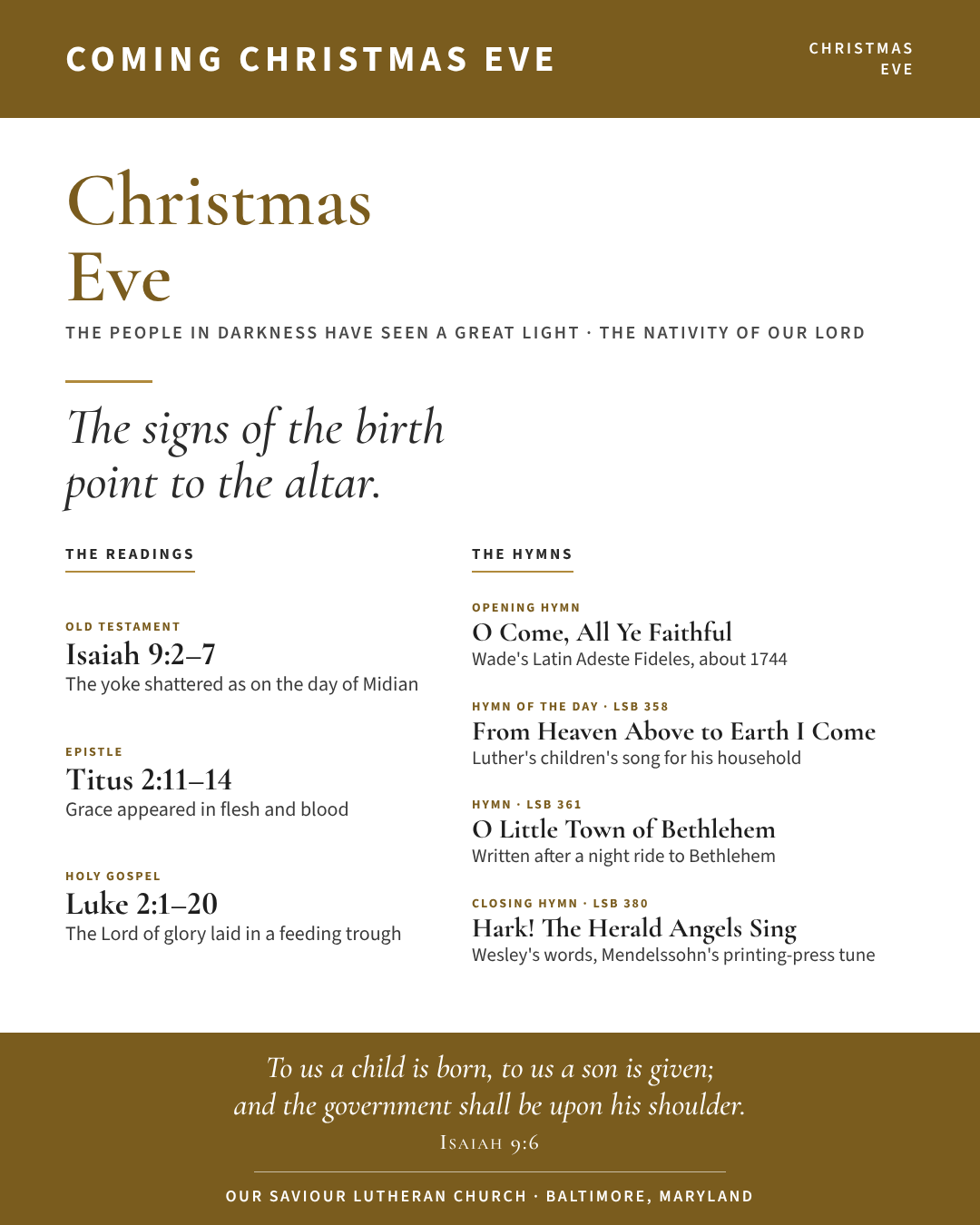
One-year lectionary · Isaiah 9:2–7 · Titus 2:11–14 · Luke 2:1–20
The Feast of the Nativity began in Rome around A.D. 336 and spread through Christendom as a sequence of distinct services across December 24 and 25: Christmas Eve, Christmas Midnight, Christmas Dawn, and Christmas Day, with Midnight and the Day itself historically taking pride of place. The liturgical color turns from Advent violet to white, marking purity, joy, and the uncreated light of the Incarnate Word, and the Introit draws its antiphon from Psalm 2:7, “The Lord said to Me, You are My Son; today I have begotten You.” Because the Lord’s Supper stands as the defining norm for every festival of the Church Year, the Christ-Mass itself, not merely a service of carols, remains the proper heart of the night. Christ was born in Bethlehem, the “House of Bread,” and laid in a feeding trough, the same signs that point the congregation to seek and find Him still in His Supper at the altar.
The Introit draws its antiphon from Psalm 2:7, “The Lord said to Me, You are My Son; today I have begotten You,” and its body from Psalm 24.
The Collect. thanks God for the yearly remembrance of the Nativity and prays that, having received Christ in joy as Redeemer, we may behold Him with confidence when He comes again as Judge.
The Epistle. Titus 2:11–14, Paul’s confession that the grace of God has appeared, teaching godly living between the manger and the Lord’s return in glory.
The Gospel. Luke 2:1–20, the census of Caesar Augustus, the birth of Christ in Bethlehem, and the angels’ announcement to the shepherds.
The readings at a glance
Old Testament
Isaiah 9:2–7
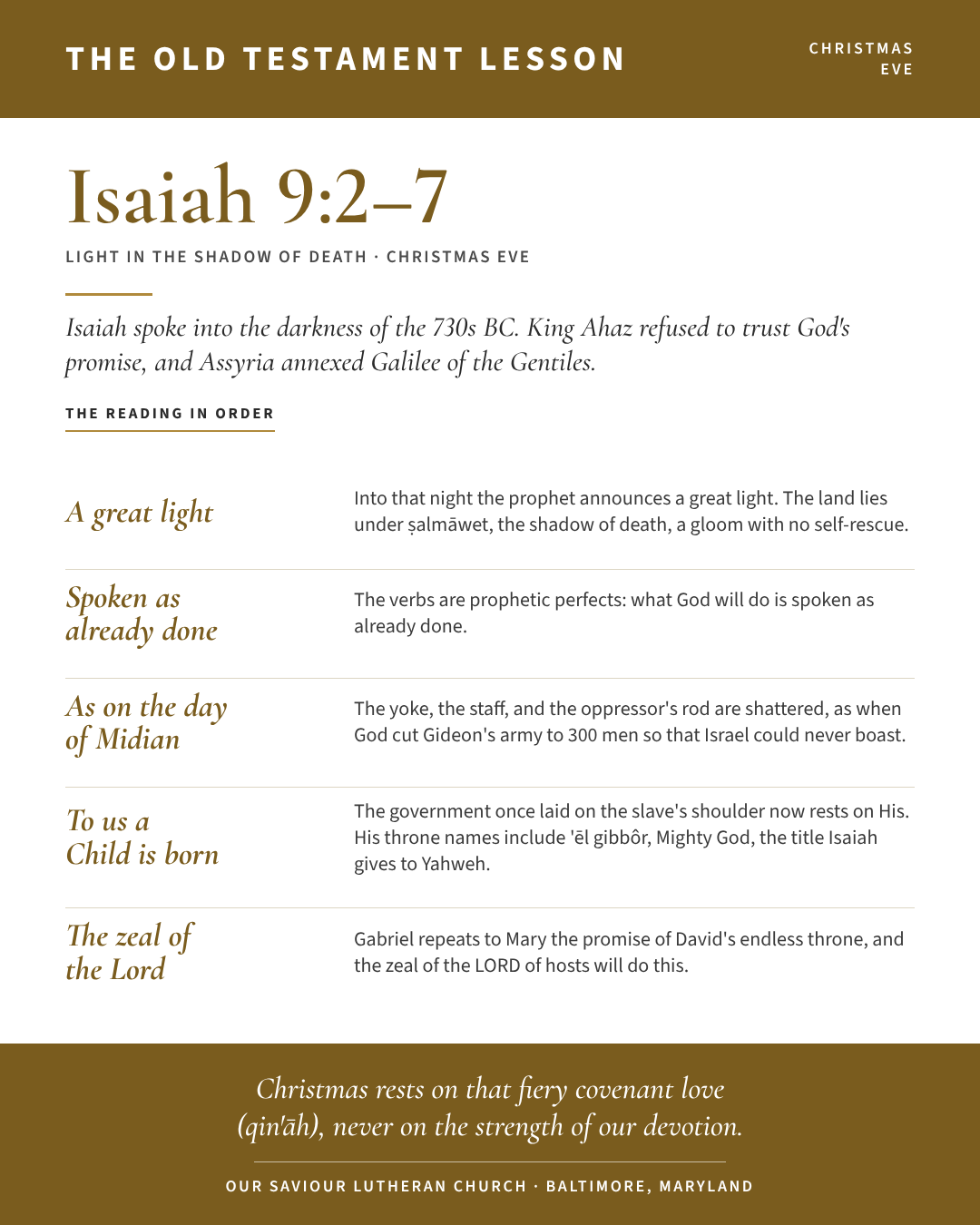
Written after Ahaz’s unbelief brought Assyrian conquest upon Galilee, Isaiah promises that the people walking in choshek, darkness, and sitting in tsalmaveth, the shadow of death, will see a great light, language Matthew applies directly to Christ’s Galilean ministry. The deliverance comes kayom midyan, as on the day of Midian, when God shrank Gideon’s army to three hundred men so that Israel could never boast of its own strength, a pattern of pure grace fulfilled when God breaks the yoke of sin not by human might but by a Child. That Child receives four throne names, Wonderful Counselor, Mighty God, Everlasting Father, and Prince of Peace, the title el gibbor, Mighty God, being reserved in Isaiah exclusively for Yahweh Himself, and Gabriel later cites this text nearly verbatim to Mary in announcing that her Son will reign on David’s throne forever.
The Old Testament: Isaiah 9:2–7.
Epistle
Titus 2:11–14
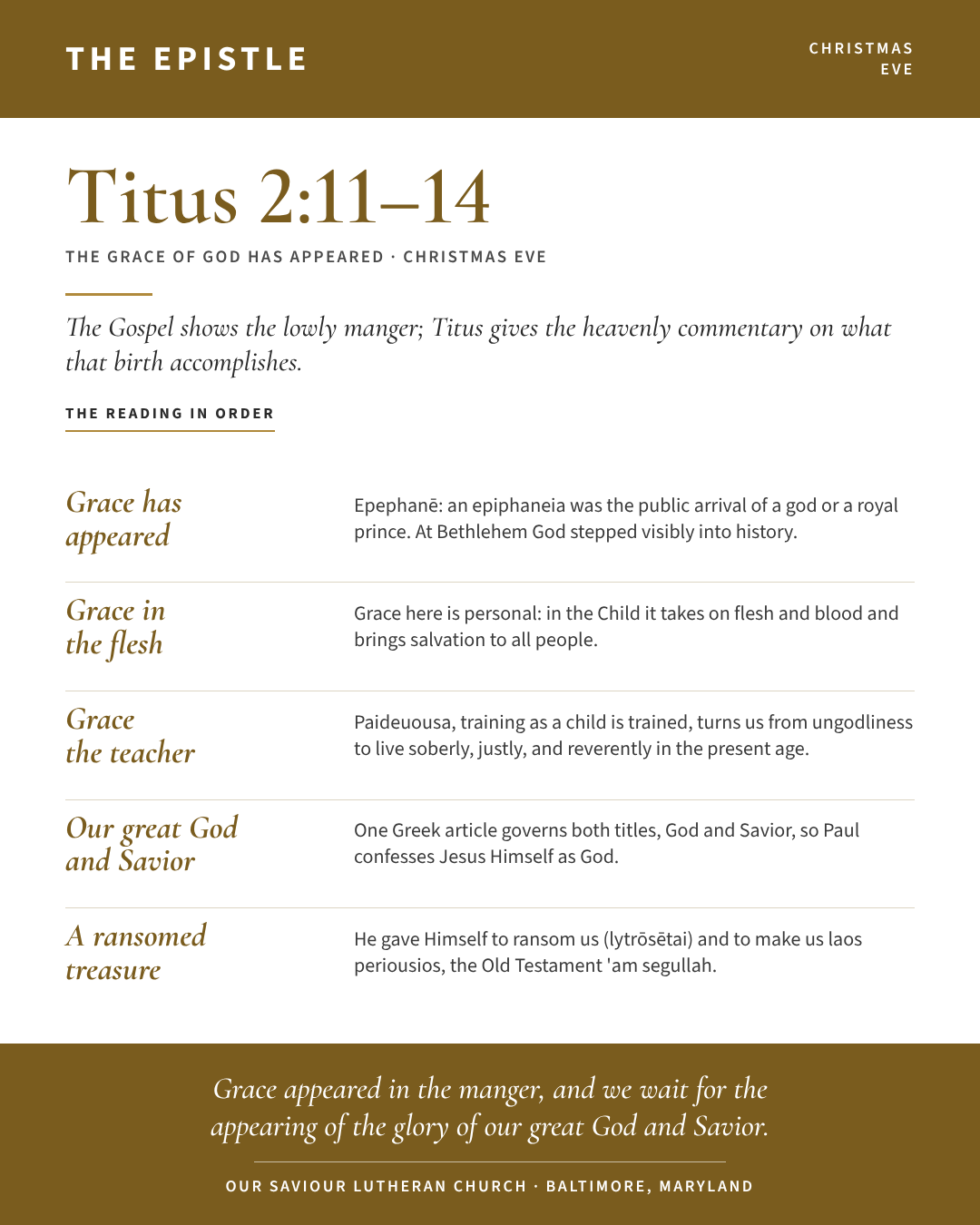
Paul declares that epephane, the grace of God has appeared, using the very word Hellenistic writers used for the visible manifestation of a god or the arrival of a prince, and that grace, now personified in the Incarnation, functions as a paideuousa, a teacher training believers to renounce ungodliness and live soberly, uprightly, and godly lives in this present age. The Church waits for a second epiphany, the appearing of the glory of “our great God and Savior Jesus Christ,” a single Greek construction (the Granville Sharp rule) that names Jesus outright as God. He gave Himself, Paul writes, to redeem us from lawlessness and purify for Himself a people for His own possession, laon periousion, the very Old Testament phrase for a king’s treasured personal property, so that Christmas becomes the moment sinners are made God’s own prized treasure.
The Epistle: Titus 2:11–14.
Holy Gospel
Luke 2:1–20
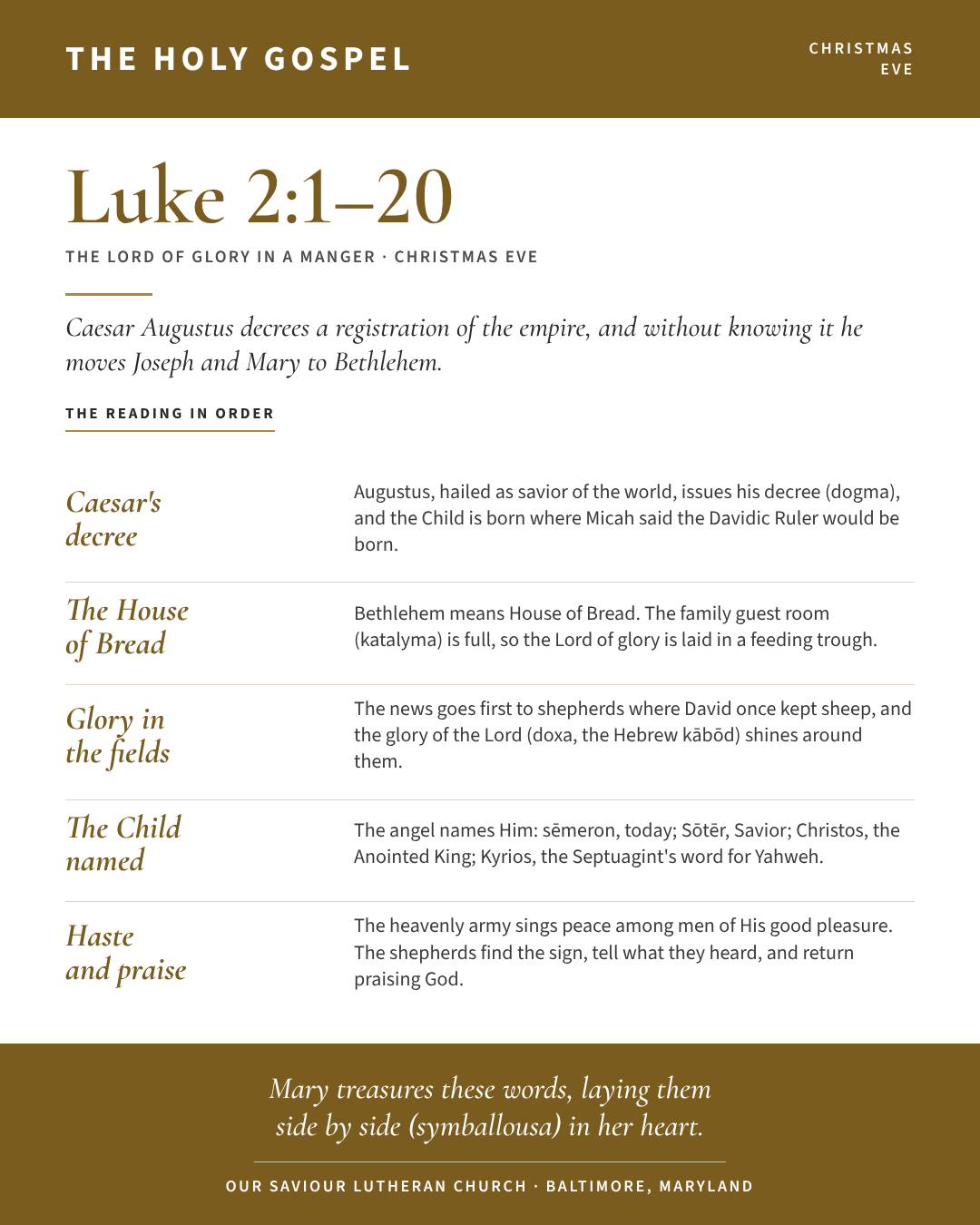
Caesar Augustus’s tax decree, issued in ignorance of the God he unknowingly serves, sends Joseph and Mary to Bethlehem, the “House of Bread,” fulfilling Micah’s prophecy and setting the newborn Christ in a feeding trough because there was no room in the katalyma, the guest room of a crowded home. An angel announces to shepherds, the lowly recipients Mary’s Magnificat had already promised, that “unto you is born today a Savior, who is Christ the Lord,” Kyrios being the very word the Greek Old Testament uses six thousand times for the name of God Himself. A heavenly host then sings Gloria in Excelsis, and while the crowd merely marvels, Mary alone is said to treasure and ponder these things in her heart, sym-ballousa, literally throwing them together, weighing Gabriel’s promise of a throne against the reality of a manger.
The Holy Gospel: Luke 2:1–20.
The hymns and their stories
Hymn
Opening Hymn: “O Come, All Ye Faithful” (Adeste Fideles) ·
For generations this carol passed for a medieval text or an anonymous continental hymn; modern scholarship instead credits both words and tune to John Francis Wade, an English Catholic scribe who copied liturgical music for exiled Catholics in Douai and London around 1744. Wade supported the Jacobite cause, the movement to restore the Catholic Stuarts to the British throne, and recent research reads Adeste Fideles as a coded Jacobite birth ode: the Latin regem angelorum, “King of Angels,” doubles as a near pun on regem anglorum, “King of the English,” and the summons to come to Bethlehem carried a second, political invitation to rally behind the exiled prince. As the Jacobite cause faded, the hymn shed its coded meaning and endured as a Christmas carol alone. Frederick Oakeley, an Anglican priest of the Oxford Movement, translated it into English in 1841 and revised the opening to “O come, all ye faithful” in 1852, and the tune long carried the name “Portuguese Hymn” for its regular performance at the Portuguese Embassy chapel in London. As the Opening hymn on Christmas Eve, it gathers the congregation’s voice before the Nativity Gospel is even read.
Hymn of the Day
“From Heaven Above to Earth I Come” · LSB 358
Martin Luther modeled this hymn’s opening on a popular German folk riddle song, Ich kumm aus frembden landen her, in which a traveling singer steps into the marketplace bearing news from distant lands. Luther turned the conceit toward heaven itself: the singer becomes the angel stepping out of the far country of heaven into the shepherds’ fields to announce the Savior’s birth. First published at Wittenberg in 1535 under the heading “A children’s song on the Nativity of Christ,” the hymn began life not in the church but in Luther’s own home, where by family tradition a boy dressed as the angel would sing the opening stanzas to the household gathered around the cradle of the infant Margaretha, and the family would answer in the stanzas that follow. Luther first let the household sing it to the tune of the old folk song, but rather than let the Gospel travel on a melody remembered from the tavern, he composed an entirely new tune of his own, published in 1539, and that tune is the one sung today. As the Hymn of the Day, it places the congregation itself in that Wittenberg front room, hearing the angel’s news proclaimed as a family’s own.
Hymn before Communion
“O Little Town of Bethlehem” · LSB 361
Phillips Brooks, a young Episcopal clergyman from Philadelphia, rode on horseback from Jerusalem to Bethlehem on Christmas Eve of 1865 during a leave of travel through the Holy Land, passing the shepherds’ fields at dusk before attending a five-hour service at the Church of the Nativity that ran past three in the morning. Three years later he wrote a carol from that memory for his own Sunday School’s Christmas program and asked his organist, Lewis Redner, for a tune the children could learn by December 27. Redner struggled all week and later recalled being “roused from sleep late in the night hearing an angel-strain whispering in my ear,” jotting down the melody in the dark and filling in the harmony the next morning before church. Neither man expected the carol to outlive that single service. Brooks’s original fourth stanza, calling Christ “Son of the Undefiled,” drew complaints that it leaned toward the Roman doctrine of the Immaculate Conception, and it was quietly dropped from later printings. Sung before Communion, its meditation on the little town that once received the infant Lord now turns the congregation to receive that same Lord at the altar.
Closing Hymn
“Hark! The Herald Angels Sing” · LSB 380
Charles Wesley never wrote the line everyone sings. His 1739 original opened “Hark how all the Welkin rings, ‘Glory to the King of Kings,’” welkin being an old word for the vault of heaven; it was the revivalist George Whitefield who altered it in 1753 to “Hark! The herald angels sing, Glory to the newborn King,” a change Wesley resented, since he disliked editors touching his verse. When a later hymnal tried to restore his original wording in 1904, the attempt provoked such resistance that it hurt the book’s sales. The tune began life entirely apart from the hymn, composed in 1840 by Felix Mendelssohn for a secular cantata marking the four hundredth anniversary of Gutenberg’s printing press. Mendelssohn was explicit that the music should never carry sacred words, writing to his publisher that it needed “a national and merry subject” instead. He died in 1847 never knowing otherwise; nine years later the English organist William Cummings set Wesley’s words to it anyway, and the pairing endured. As the Closing hymn, it sends the congregation into the night still singing the very angelic proclamation just read from the Gospel.