The Epiphany of Our Lord
The Light of the Nations · Wednesday, January 6, 2027
The Epiphany of Our Lord takes its name from the Greek epiphaneia, “manifestation.” Before December 25 became the date of Christmas in fourth-century Rome, January 6 was the Church’s chief feast of Christ, and the East still keeps it as Theophany. That one ancient feast celebrated the nativity, the visit of the Magi, the Baptism in the Jordan, and the first miracle at Cana all at once. Once the West kept the Nativity on December 25, Epiphany became a “Christmas of the Gentiles,” centered on the Magi as the moment Christ was first revealed to the nations. The Sundays that follow unfold, one at a time, the other manifestations the ancient feast held together, until the season ends on the mountain of the Transfiguration. The color is white. Parish custom keeps the Christmas greens through the octave, and in the nativity display the shepherds give way to the Magi: the day’s turn from Israel’s shepherds to the wise men of the nations, enacted in miniature.
Lectionary Primer PDF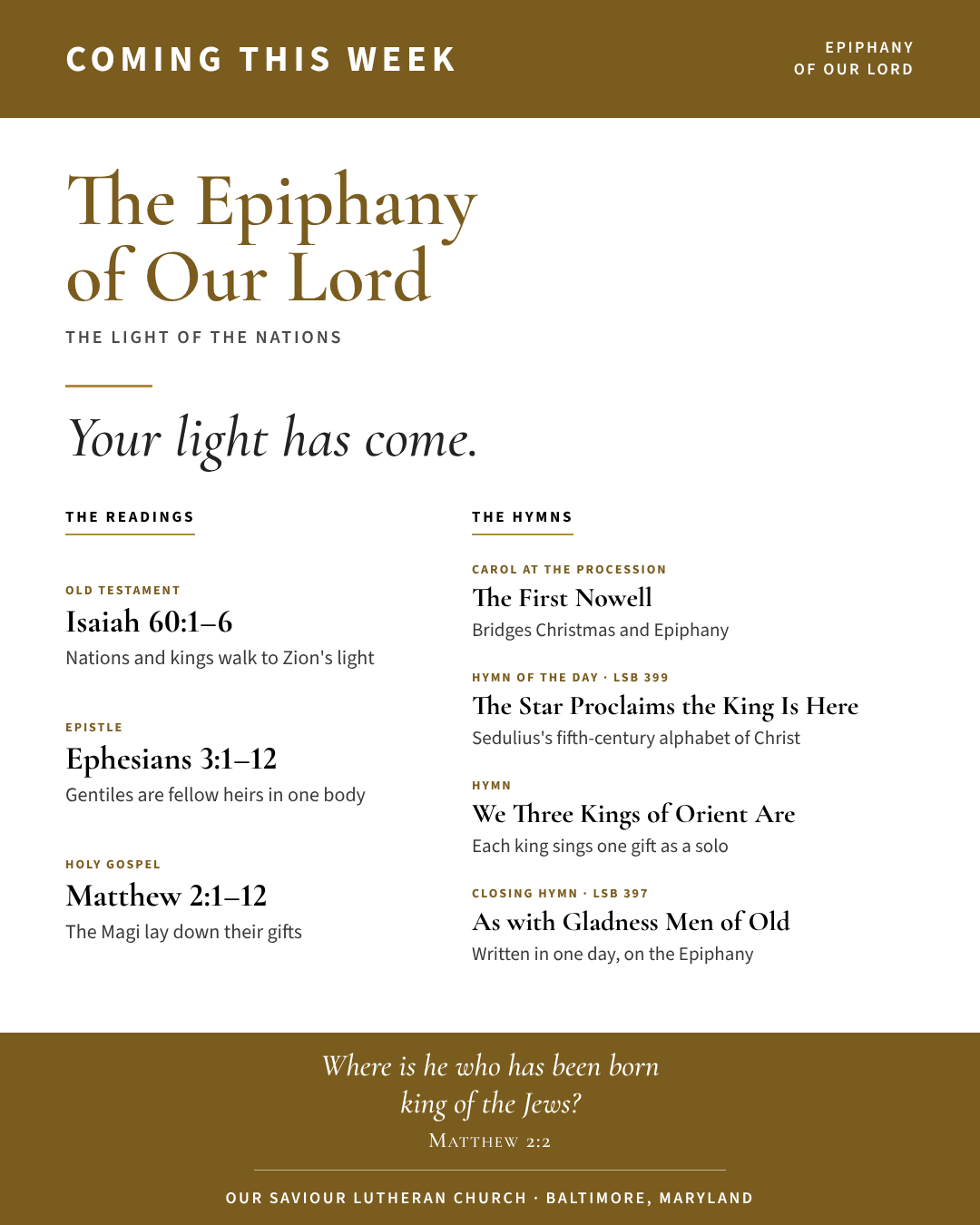
The shape of the service
The Collect prays that as God made known His Son to the Gentiles by the leading of a star, He would lead us, who know Him by faith, to enjoy in heaven the fullness of His divine presence.
The Gradual and Verse. Psalm 117 praises God’s steadfast love among all nations, and the Verse sings the Magi’s own question from Matthew 2:2: “Where is he who has been born king of the Jews?”
The Proper Preface confesses that what was hidden from before the foundation of the world God has now made known to the nations in His Son, the same mystery St. Paul announces in the Epistle.
The Nunc Dimittis is the Post-Communion Canticle. Simeon’s song of “a light to lighten the Gentiles” is sung by people who have just received that Light in the Sacrament.
The readings at a glance
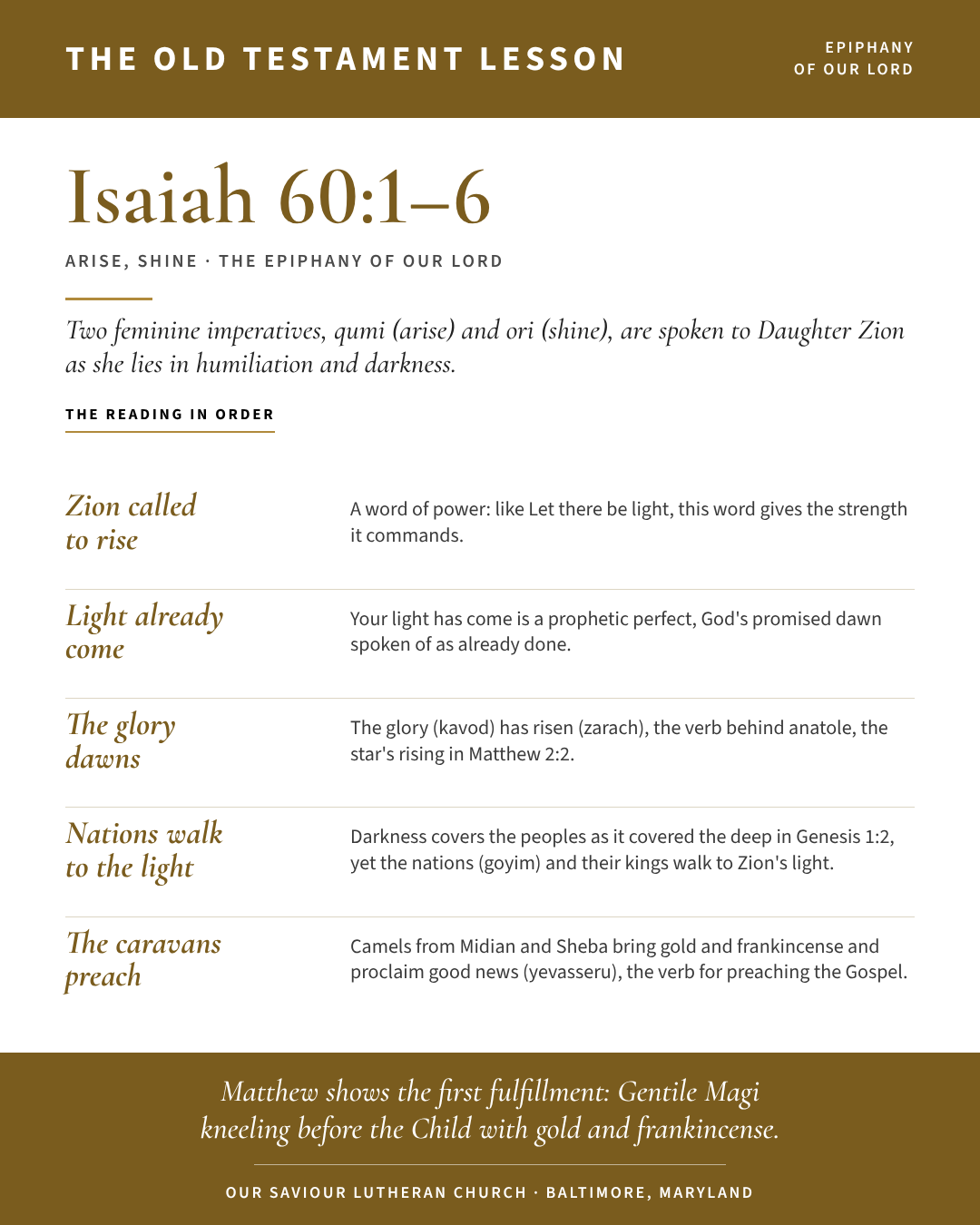
Two feminine imperatives open the reading, qumi (“arise”) and ori (“shine”), spoken to Daughter Zion as she lies in humiliation and darkness. They are a word of power, not advice: like “Let there be light,” this word gives the strength it commands. “Your light has come” is a prophetic perfect, God’s promised dawn spoken of as already done. The glory (kavod, God’s weight and unveiled presence) “has risen” (zarach), a verb for God’s own dawning; the Greek Old Testament renders it with the verb behind anatole, the “Dawn” of Luke 1:78 and the star’s “rising” in Matthew 2:2. Darkness covers the peoples as it once covered the deep in Genesis 1:2, yet the nations (goyim) and their kings walk to Zion’s light. Camels from Midian and Sheba arrive with gold and frankincense, and the caravans “proclaim good news” (yevasseru), the Hebrew verb for preaching the Gospel. Matthew shows the first fulfillment: Gentile Magi kneeling before the Child with gold and frankincense of their own.
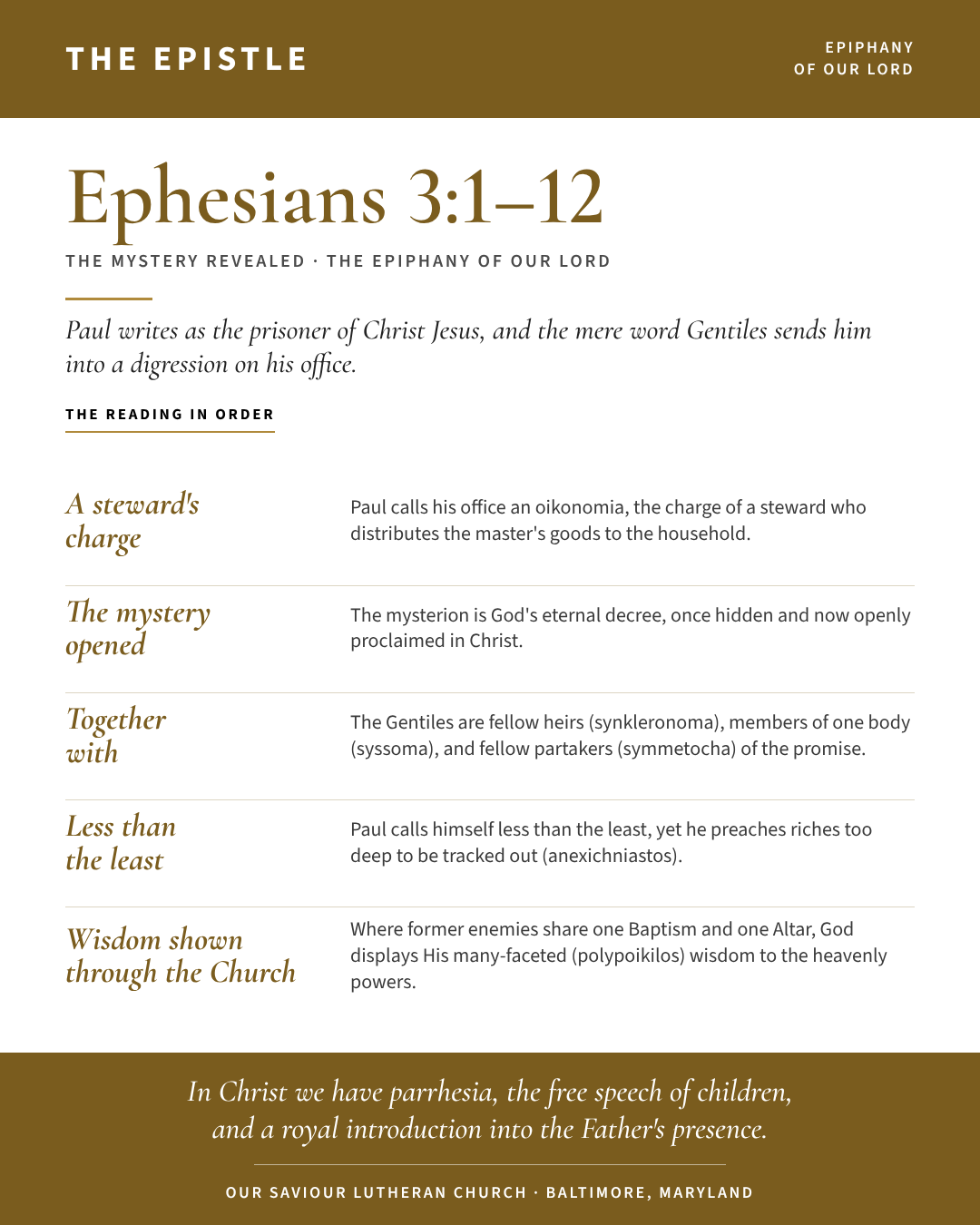
Paul writes as “the prisoner of Christ Jesus,” bound by no emperor but by his Lord, and the mere word “Gentiles” sends him into a digression on his office. He calls it an oikonomia, the charge of a steward who distributes the master’s goods to the household. Those goods are a mysterion: not a secret rite for an elite circle, as in the pagan cults, but God’s eternal decree, once hidden and now openly proclaimed in Christ. Verse 6 states it with words built on syn-, “together with”: the Gentiles are fellow heirs (synkleronoma), members of one body (syssoma), and fellow partakers (symmetocha) of the promise. Paul takes the superlative elachistos, “least,” and adds a comparative ending to call himself less than the least, yet he preaches riches that are anexichniastos, too deep to be tracked out. Through the Church, where former enemies share one Baptism and one Altar, God displays His many-faceted (polypoikilos) wisdom even to the powers in the heavenly places. In Christ we have parrhesia, the free speech of children, and prosagoge, a royal introduction into the Father’s presence.
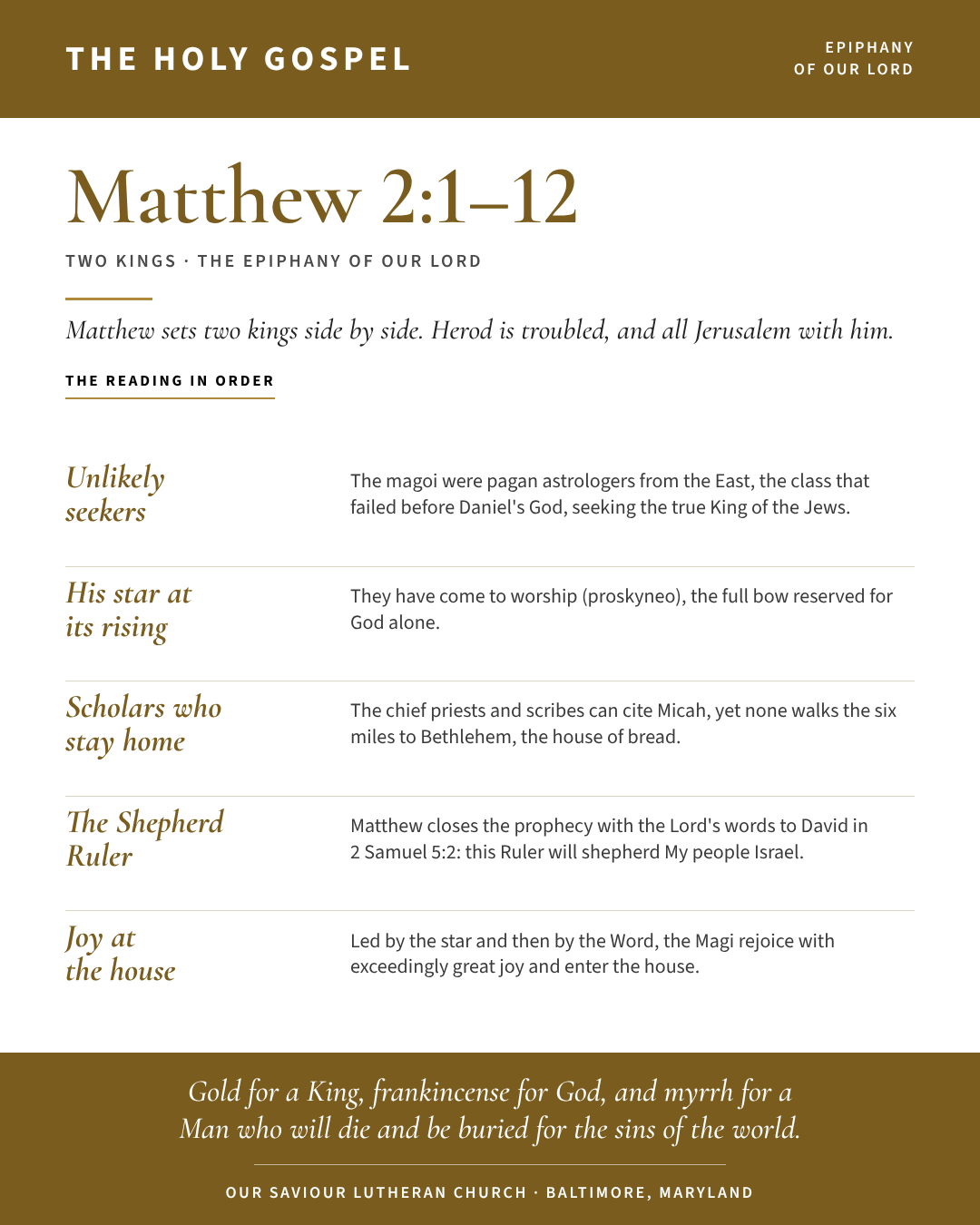
Matthew sets two kings side by side. Herod, an Idumean placed on the throne by the Roman Senate, is “troubled,” and all Jerusalem with him. The magoi were neither kings nor pious philosophers but pagan astrologers from the East, the very class that failed before Daniel’s God, and these unlikely men come seeking the true King of the Jews. They saw “His star at its rising,” and they have come to worship (proskyneo), the full bow reserved for God alone. The chief priests and scribes can cite Micah, yet none walks the six miles to Bethlehem, the “house of bread.” Matthew closes the prophecy with the Lord’s words to David in 2 Samuel 5:2: this Ruler “will shepherd My people Israel.” Led by the star and then by the Word, the Magi rejoice with exceedingly great joy, enter the house, and lay down gold for a King, frankincense for God, and myrrh for a Man who will die and be buried for the sins of the world.
The hymns and their stories