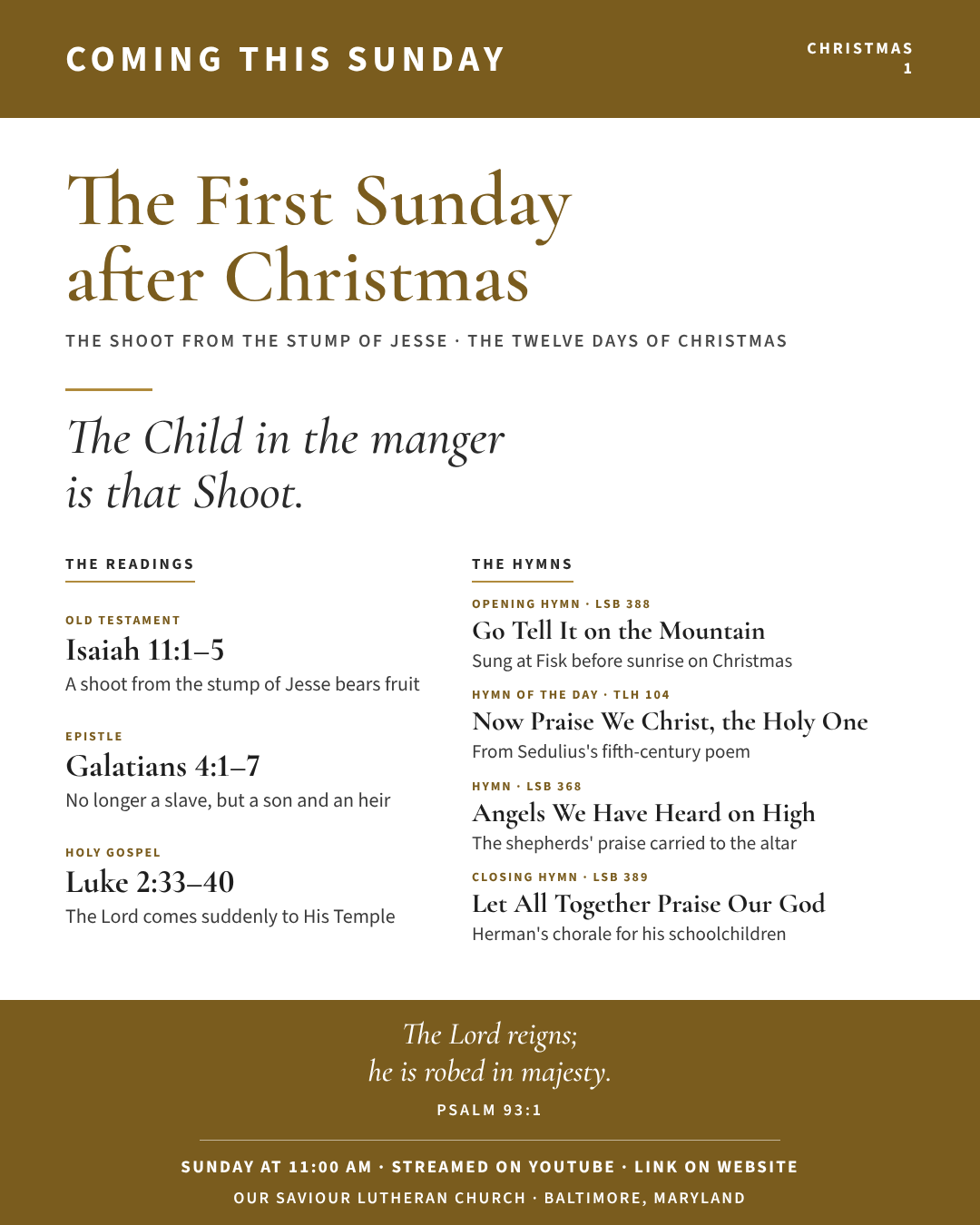
Falling within the Twelve Days of Christmas between the Nativity and the Feast of the Circumcision and Name of Jesus on January 1, this Sunday still wears white and still prays the Christmas Preface, but it turns the Church’s eye from the manger itself to what the Incarnation accomplishes. Lutheran theology names this shift the mirabile commercium, the wondrous exchange: God, who wonderfully created human nature, has yet more wondrously restored it by taking that nature upon Himself. The Collect prays exactly this, that God who wonderfully created us has in the Incarnation of His Son yet more wondrously restored our human nature, and asks that we may ever be alive in Him who made Himself like us. The Gospel’s account of Simeon and Anna in the Temple, forty days after the Nativity, gives the day its own connection to the Nunc Dimittis sung after Communion, joining Simeon’s sight of the Christ Child to the congregation’s own reception of that same Lord in the Sacrament.
The Introit draws its antiphon from Psalm 93:5, 2, “Your decrees are very trustworthy... Your throne is established from of old; You are from everlasting,” confessing the eternal majesty of the Son now come in the flesh.
The Collect. confesses that God, who wonderfully created us, has in the Incarnation of His Son yet more wondrously restored our human nature.
The Epistle. Galatians 4:1–7, God sending forth His Son in the fullness of time, born of a woman and born under the Law, to redeem us into the full standing of sons and heirs.
The Gospel. Luke 2:33–40, the infant Jesus presented in the Temple, Simeon’s prophecy of the sword that will pierce Mary’s own soul, and the testimony of the prophetess Anna.
The readings at a glance
Old Testament
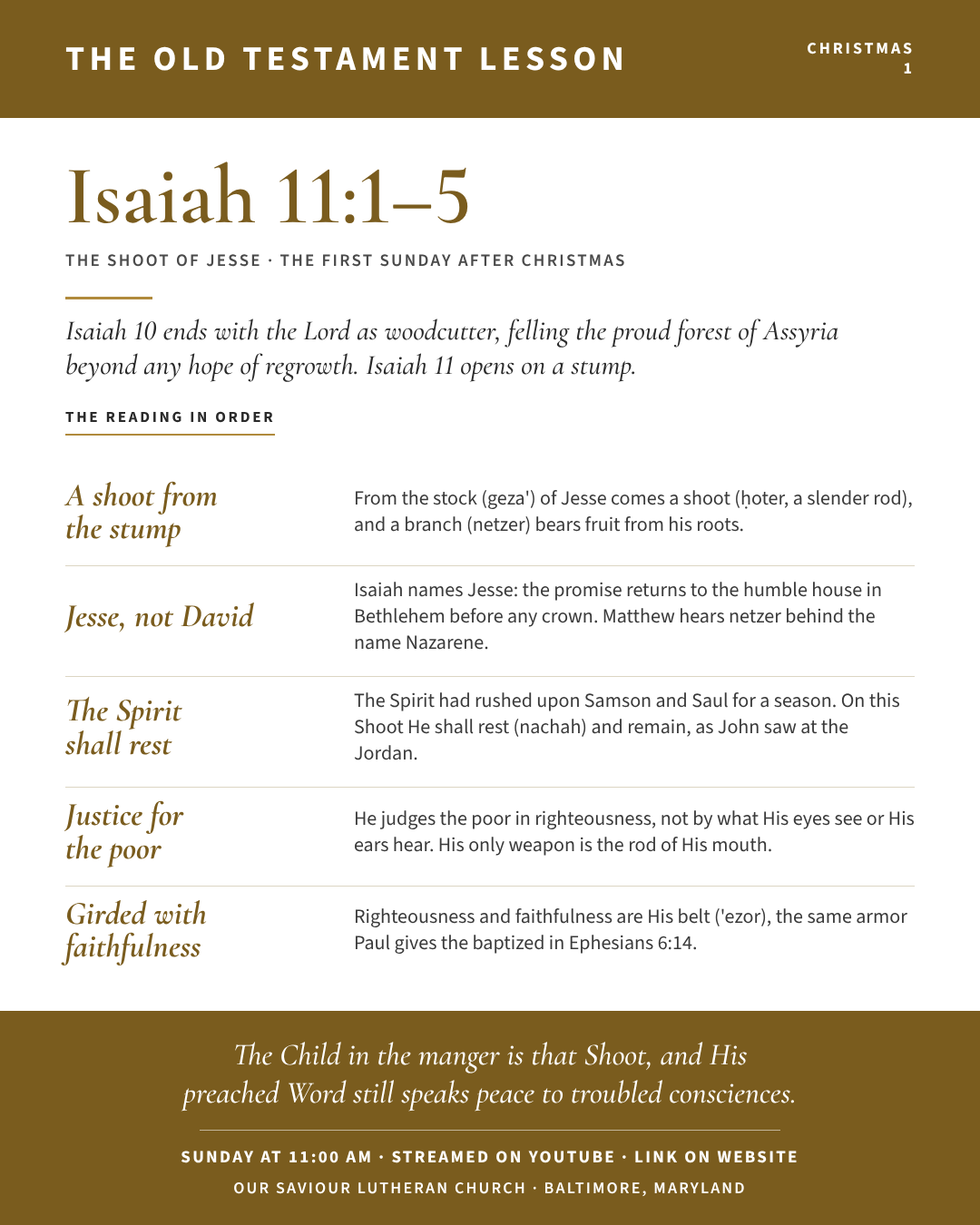
Isaiah 11:1–5
After Yahweh fells Assyria like a forest in Isaiah 10, a choter, a slender shoot, comes forth not from David but from Jesse, David’s father, a deliberate return to the humble, pre-royal roots of the dynasty. The Spirit of Yahweh will nachah, rest permanently, upon Him, the sixfold gifts of wisdom, understanding, counsel, might, knowledge, and the fear of Yahweh fulfilled at His Baptism in the Jordan. This King will not judge lemar’eh enayo, by what His eyes see, but will strike the earth beshevet piv, with the rod of His mouth, a Word-weapon Paul echoes of the lawless one in 2 Thessalonians 2:8, and He will gird Himself with tsedeq, righteousness, and ‘emunah, faithfulness, as a warrior’s belt, the very armor Paul later hands to every baptized Christian in Ephesians 6:14.
The Old Testament: Isaiah 11:1–5.
Epistle
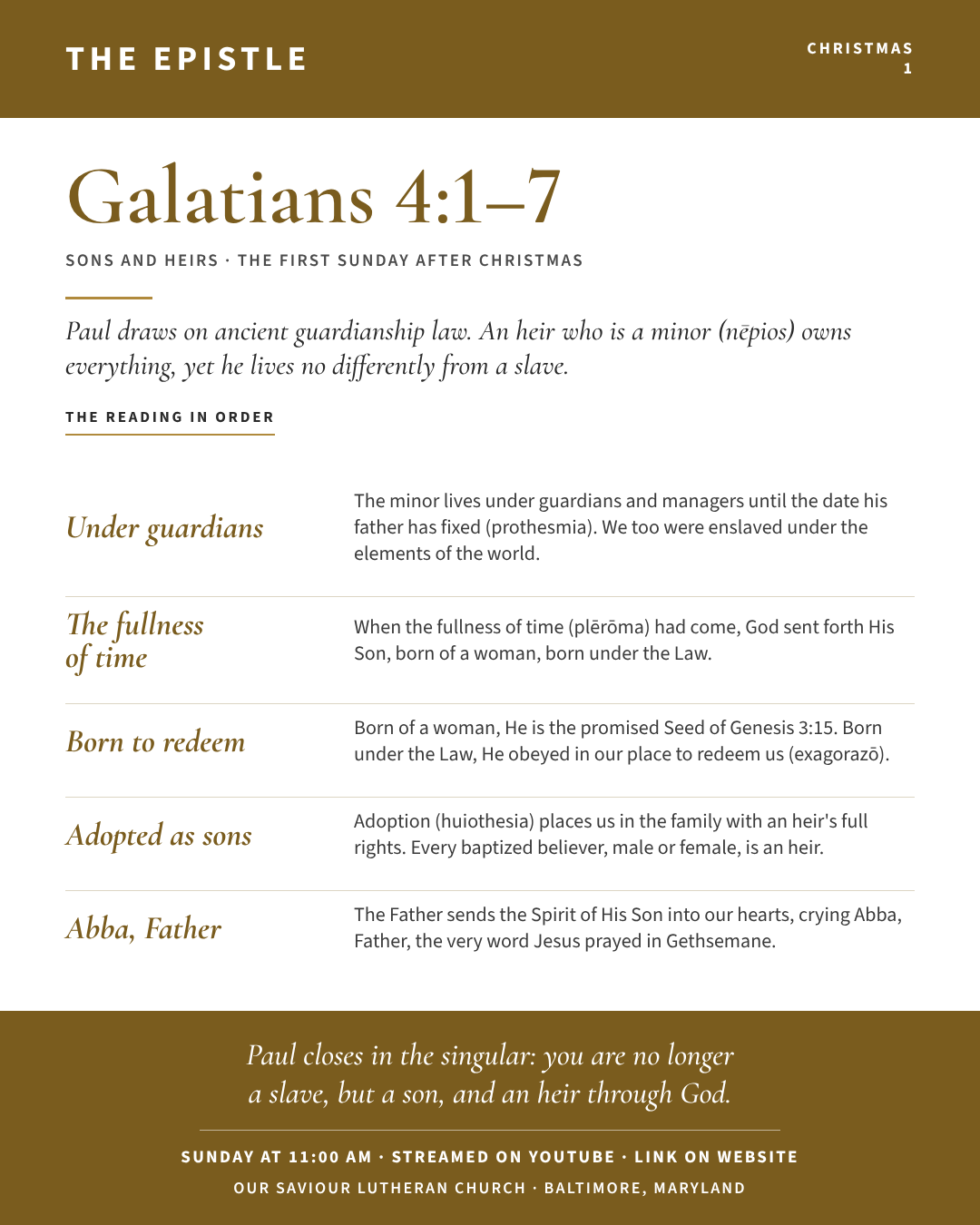
Galatians 4:1–7
Paul compares humanity before Christ to a nepios, a legal minor, technically master of the whole estate yet no better than a slave while under guardians until the father’s appointed prothesmia, deadline. That deadline arrived hote de elthen to pleroma tou chronou, “when the fullness of time came,” and God sent forth His Son, born of a woman and born under the Law, hina exagorase, in order to buy back, those held captive by it. The purpose is huiothesia, adoption as sons, a legal term that in Greco-Roman law severed the adoptee entirely from his former status and installed him as full heir, and the Spirit of that same Son now cries Abba, Father, from within the believer’s own heart, so that Paul can say to each one personally, “you are no longer a slave but a son, and if a son, then an heir through God.”
The Epistle: Galatians 4:1–7.
Holy Gospel
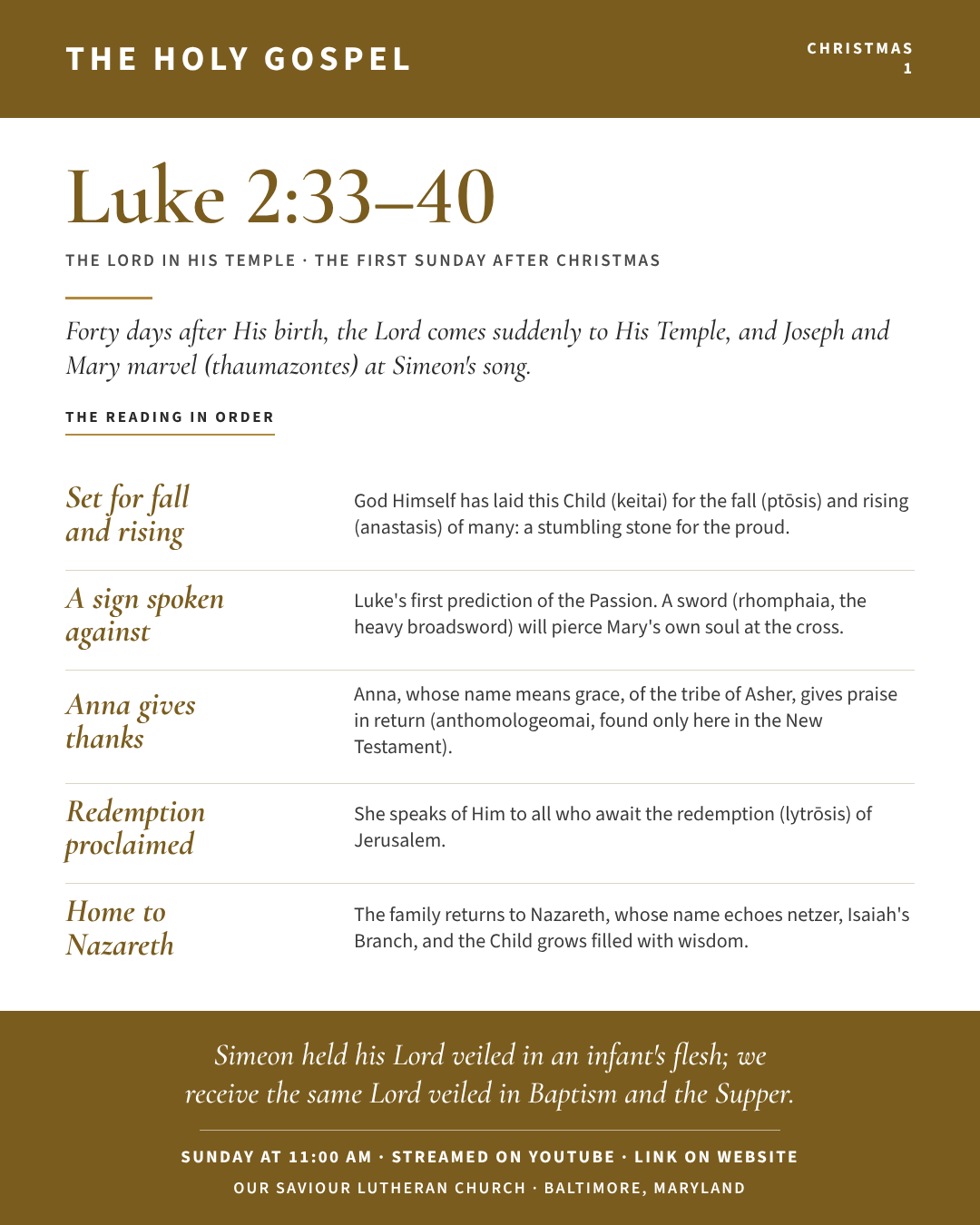
Luke 2:33–40
Forty days after Bethlehem, Joseph and Mary bring the infant Jesus to the Temple, where Simeon blesses them and then turns to Mary alone to prophesy that this Child is set eis ptosin kai anastasin, for the falling and rising of many in Israel, and for a semeion antilegomenon, a sign that will be opposed. A rhomphaia, a great two-edged sword, will pierce Mary’s own soul, foretelling both her grief at the cross and the Word’s power to lay bare hidden dialogismoi, inner thoughts. The prophetess Anna, of the long-exiled tribe of Asher, arrives at that very hour to give antiphonal praise and becomes the first woman in Jerusalem to speak of the Child to all awaiting redemption, and the family returns to Nazareth, itself named for the netzer, the Branch, of Isaiah’s own prophecy.
The Holy Gospel: Luke 2:33–40.
The hymns and their stories
Opening Hymn
“Go Tell It on the Mountain” · LSB 388
This spiritual grew out of the nineteenth-century African American oral tradition and was preserved above all at Fisk University in Nashville, where students would rise before dawn on Christmas morning to walk from building to building singing it together. Its refrain is of anonymous, unrecorded folk origin, but its familiar Christmas stanzas were written no later than 1925 by John Wesley Work II, who devoted much of his life alongside his brother to preserving African American spirituals; earlier singers had often substituted unrelated wandering verses, since the original words had little to do with the Nativity even though the song was already sung as a Christmas plantation carol. Work’s son, John Wesley Work III, published his father’s definitive Christmas text in his 1940 collection, American Negro Songs and Spirituals. The tune, built on a pentatonic scale, remains an anonymous folk creation despite occasional claims of later authorship. As the Opening Hymn on the First Sunday after Christmas, it sends the congregation out on the shepherds’ own errand, to go tell it on the mountain that Jesus Christ is born.
Hymn
Hymn of the Day: “Now Praise We Christ, the Holy One” ·
This hymn traces to the fifth-century Roman poet Coelius Sedulius, whom Luther called Christianissimus poeta, “a most Christian poet,” and his twenty-three-stanza abecedarian poem on the life of Christ, A solis ortus cardine, each stanza beginning with a successive letter of the Latin alphabet. Medieval breviaries drew the poem’s first seven stanzas, on the Nativity, into the office of Lauds for Christmas Day, and Luther translated those seven stanzas into German in 1524 as Christum wir sollen loben schon, adapting the melody directly from the old Gregorian chant. Luther defended this method of translation in his 1525 tract Against the Heavenly Prophets, insisting that text and tune alike ought to grow out of the translator’s own mother tongue rather than become, in his words, “an imitation, in the manner of the apes.” Richard Massie rendered Luther’s German into English in 1854 under this title, and The Lutheran Hymnal carried it as hymn 104. Lutheran Service Book represents the same underlying Latin original under a different English title, “From East to West, from Shore to Shore” (LSB 385); a bulletin using the older Massie title and one using the LSB title are the same hymn family, not two different hymns.
Hymn before Communion
“Angels We Have Heard on High” · LSB 368
This carol descends from the anonymous French folk song Les anges dans nos campagnes, first published in 1842 in ten stanzas with the refrain “Gloria in excelsis Deo,” though a 1932 dissertation speculated the original might date to around 1800. Its English translator remains unidentified; the text first appeared in four stanzas in the 1860 London hymnal Holy Family Hymns as “The Angels we have heard on high,” and a later 1862 collection dropped the opening “The” so the meter would better fit the tune. Both early printings carried a fourth stanza addressing Mary and Joseph directly, which Lutheran Service Book omits, keeping only the first three. Its tune, GLORIA, is a French folk melody standardized for American use in a 1937 harmonization by Edward Shippen Barnes. Structured as a dialogue in which the shepherds are asked why they sing and then invite their questioners to come see the newborn King, the hymn carries the shepherds’ own Gloria from Bethlehem’s fields straight to the altar, where the congregation now comes, as the shepherds once came, to see for itself what the angels made known.
Closing Hymn
“Let All Together Praise Our God” · LSB 389
Nicolaus Herman, cantor and schoolmaster at Joachimsthal in Bohemia, wrote this hymn for his own students at the urging of his pastor and friend Johann Mathesius, a close confidant of Luther. Its first two stanzas appeared around 1550 to 1555 in a small Leipzig collection made for Herman’s schoolchildren, and in the single surviving copy of that first printing the typesetter accidentally substituted the ending of an entirely different hymn in a different meter after the second stanza. Herman corrected the error and expanded the text to eight stanzas in his own 1560 collection of the church year’s Gospels. The English text sung today is a composite spanning more than a century: August Crull translated the second stanza in 1889, and F. Samuel Janzow translated the remaining stanzas and added a new seventh for the Missouri Synod’s 1969 Worship Supplement. Herman also composed the tune himself, and the hymnologist Fred Precht praised its word-painting: a rising leap of a fifth on the opening “Lobt Gott” and a matching high note landing on both “alle,” all, and “hochsten,” highest. Grounded in Luke 2:20, where the shepherds return praising God, it sends the congregation out from the First Sunday after Christmas in that same posture, giving thanks and speaking of the Child as Simeon and Anna once did in the Temple.