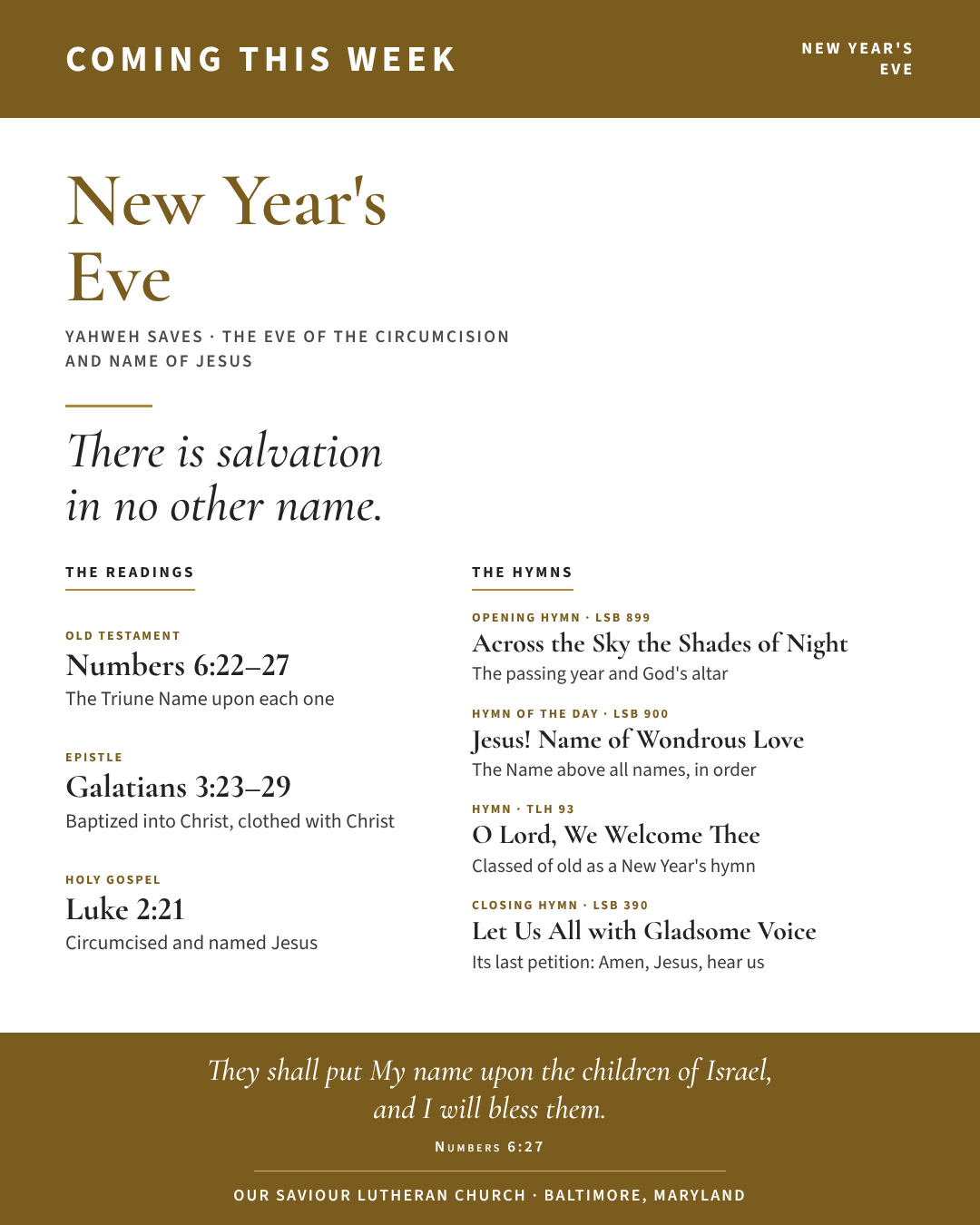
December 31, traditionally called Silvesterabend, keeps vigil for the eighth day of Christmas, the Feast of the Circumcision and Name of Jesus on January 1, the day the infant Christ submitted to the Mosaic Law and received the name Gabriel had announced before His conception. The liturgical color remains white and the Christmas Preface continues, since the feast still belongs to the Nativity’s own octave. Lutheran Service Book’s Altar Book permits a congregation to observe the evening either with propers built around the turning of the calendar year, drawn from Psalm 90’s prayer to “number our days that we may get a heart of wisdom,” or with the full propers of the Circumcision and Name of Jesus itself, and it notes that alternating between the two from year to year is entirely proper. OSLC’s readings for the night, Numbers 6:22–27, Galatians 3:23–29, and Luke 2:21, follow this second pattern, binding the closing of the civil year to the placing of the divine Name upon God’s people.
The Introit draws its antiphon from Psalm 40:16, “May all who seek You rejoice and be glad in You,” with psalmody from Psalm 40:6–8.
The Collect. prays that the Lord, who made His beloved Son subject to the Law and caused Him to shed His blood on our behalf, would grant us the true circumcision of the Spirit.
The Epistle. Galatians 3:23–29, the Law as a custodian holding us until Christ came, and Baptism as the putting on of Christ Himself as sons and heirs.
The Gospel. Luke 2:21, the eighth-day circumcision of the infant Jesus and the giving of the name announced by Gabriel before His conception.
The readings at a glance
Old Testament
Numbers 6:22–27
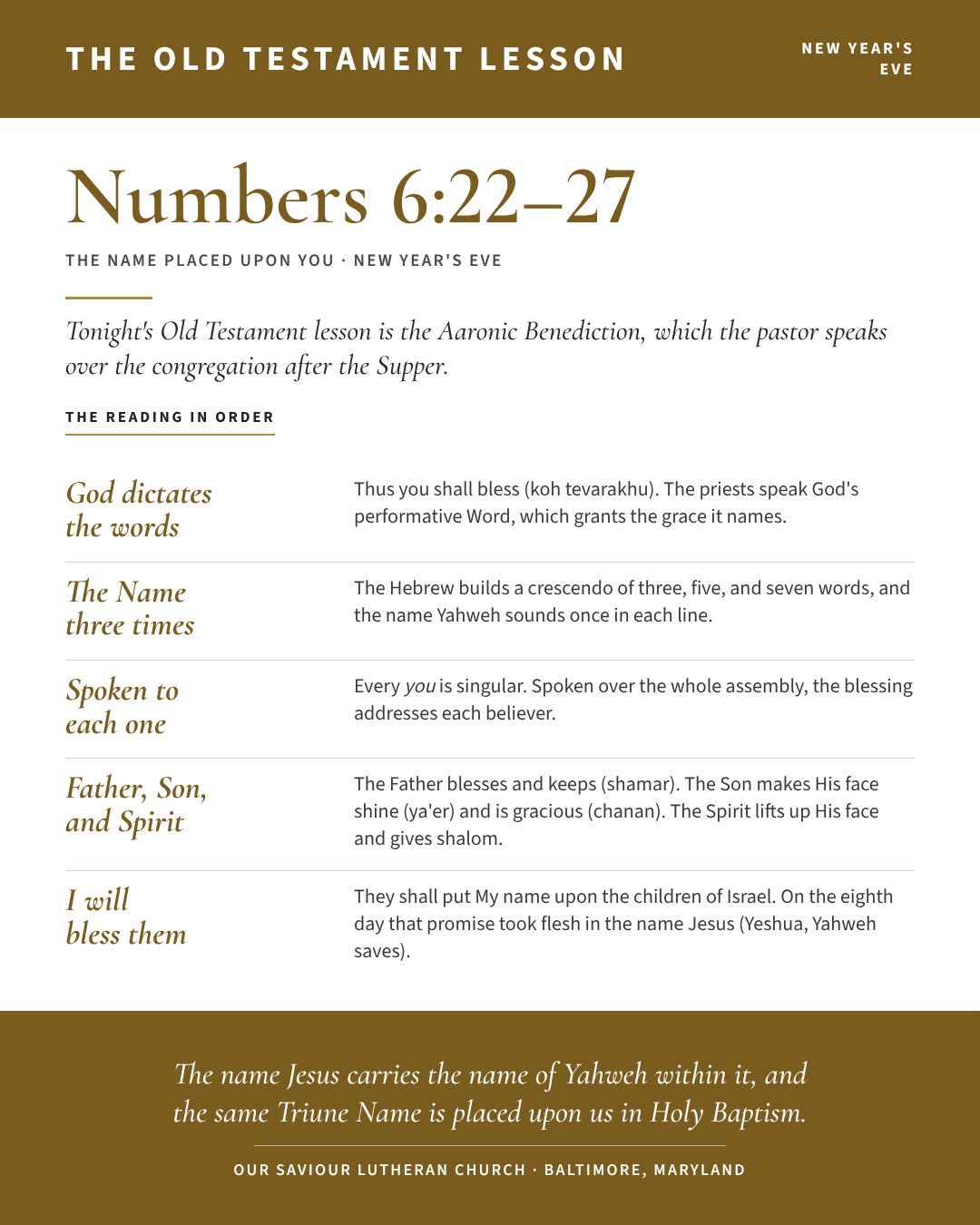
The Aaronic Benediction builds in Hebrew as a rhythmic crescendo of three, five, and seven words, the name Yahweh invoked once in each of its three lines, a pattern Christian exegesis has long read as an adumbration of the Trinity, even though every pronoun addressed to Israel is grammatically singular, God blessing each believer by name rather than as an anonymous crowd. The priests do not generate the blessing by their own holiness; God dictates the very words, and the closing verse states outright, “They shall put My name upon the children of Israel, and I will bless them.” That placing of the divine Name reaches its incarnation when the infant Jesus receives His name on the eighth day, His own Hebrew name, Yeshua, embedding the Tetragrammaton within it, so that “Yahweh saves” becomes a Person rather than only a formula.
The Old Testament: Numbers 6:22–27.
Epistle
Galatians 3:23–29
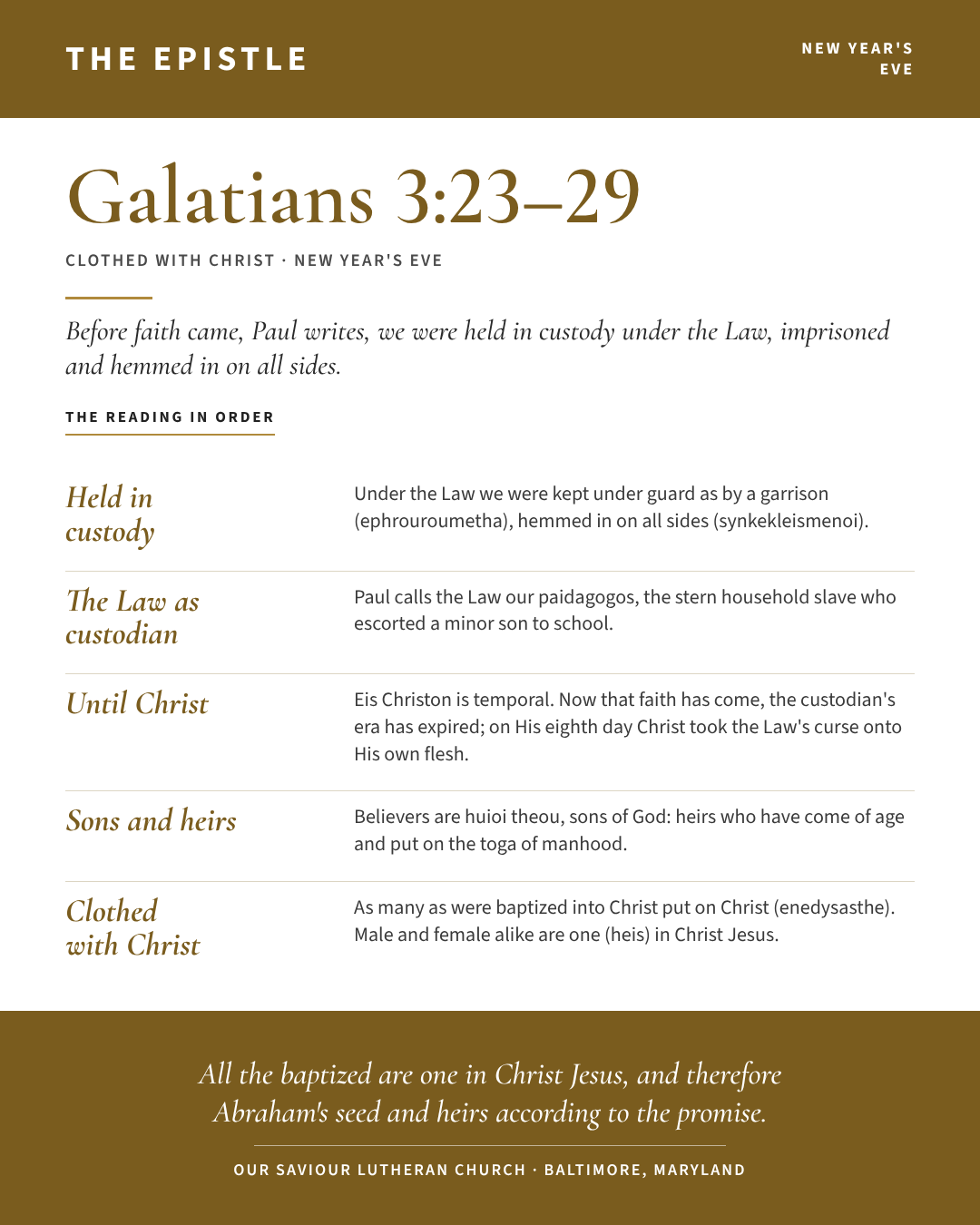
Before faith came, Paul writes, we were ephrouroumetha, kept under armed guard, by the Law, which served as a paidagogos, the stern household slave who escorted, supervised, and disciplined a minor son until his father’s appointed day. Christ submitted to that very custodian on His own eighth day, and since faith has come we are no longer under it: all, Jew and Greek alike, are huioi theou, sons of God, through faith, and as many as were baptized eis Christon have enedysasthe, put on Christ, as a garment, the true circumcision made without hands. In that Baptism the old distinctions of Jew and Greek, slave and free, male and female lose their power to divide, since all who belong to Christ are heis, one, in Him, and so are Abraham’s promised seed and heirs.
The Epistle: Galatians 3:23–29.
Holy Gospel
Luke 2:21
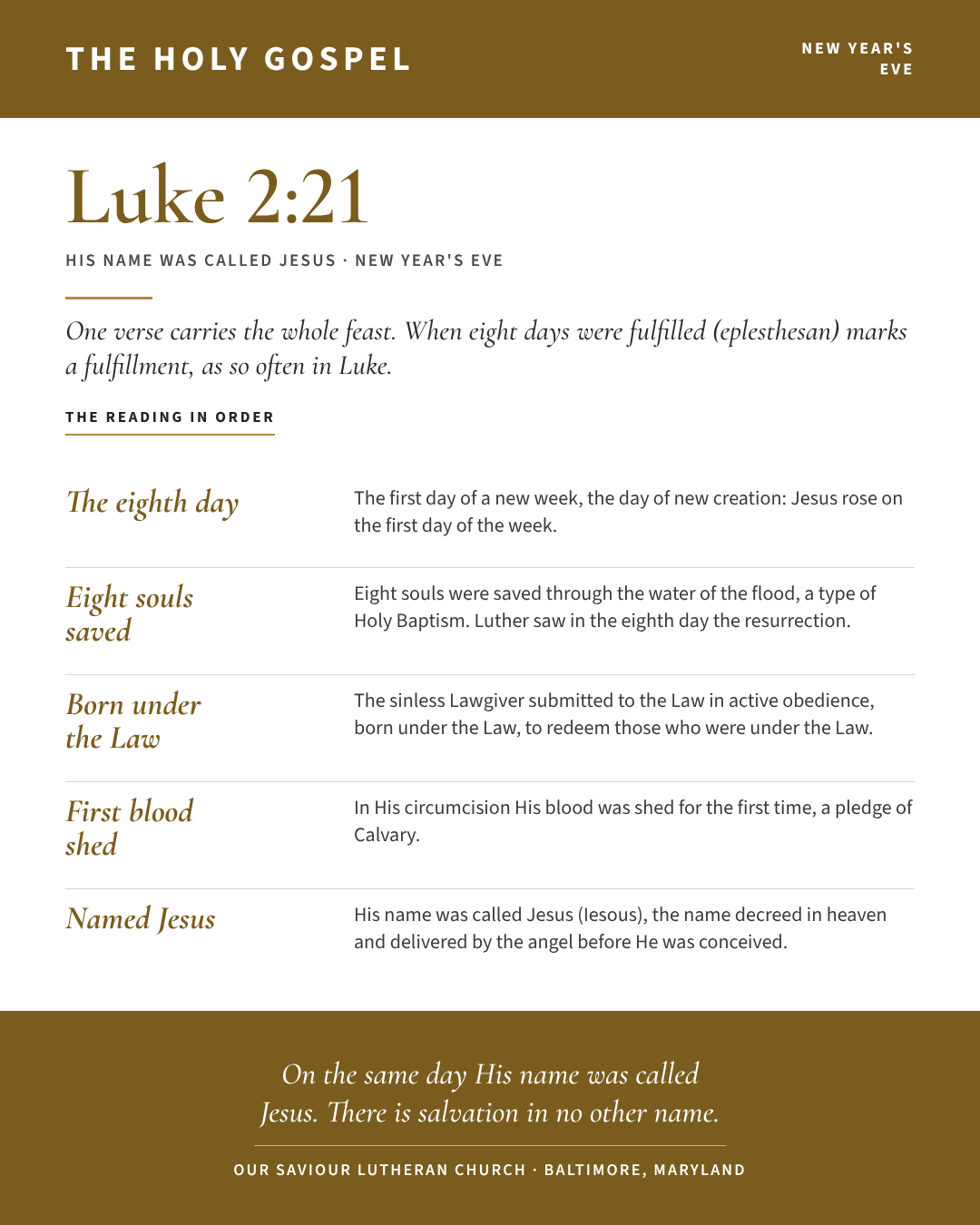
On the eighth day, counted inclusively from His birth, the infant Jesus was circumcised, shedding the first drops of His blood in a rite that pledged Calvary from the crib, and eklethe to onoma autou Iesous, His name was called Jesus, the very name Gabriel had pronounced before He was even conceived. The eighth day carries its own theology: creation was completed in seven days, so an eighth day signals new creation, the same day on which Christ would later rise from the dead, and Luther himself observed that circumcision fell on the eighth day because that day points to the resurrection, when believers are perfectly circumcised, cleansed in flesh and soul from all depravity forever.
The Holy Gospel: Luke 2:21.
The hymns and their stories
Opening Hymn
“Across the Sky the Shades of Night” · LSB 899
James Hamilton, an English clergyman, wrote this hymn directly in English, so it needed no translator to reach Lutheran hymnals. It first appeared in 1880 in Godfrey Thring’s A Church of England Hymn Book, placed in that collection’s “Old and New Year” section under the heading “New Year’s Eve” and prefaced with Psalm 134:2–3, “Ye that by night stand in the house of the Lord.” More than a dozen hymnals adopted it before 1900. The Lutheran Hymnal carried it in 1941 as hymn 110, and Lutheran Service Book selected stanzas 1, 2, and 6 of Hamilton’s original six, renumbered as stanzas 1, 2, and 5, while hymnologist Gregory Wismar supplied an entirely new fourth stanza for the 2006 hymnal. Set to the sixteenth-century German chorale tune ALLEIN GOTT IN DER HÖH, the hymn contrasts the fleeting darkness of the passing year, “this trembling planet,” with the fixed light of God’s altar. As the Opening Hymn, it moves the congregation from that trembling darkness toward the confident song that will carry them across the threshold of the new year.
Hymn of the Day
“Jesus! Name of Wondrous Love” · LSB 900
William Walsham How, later a Church of England bishop, earned the nickname the “poor man’s bishop” for choosing to serve the poverty of East London over the prestigious posts offered him at Manchester and Durham, and colleagues also called him the “omnibus bishop” for riding public buses rather than a bishop’s private carriage. He published this hymn in 1854 in Psalms and Hymns, a collection he edited with Thomas Baker Morrell in hopes the Church of England might one day adopt an official hymnal of its own. Composed in English, it needed no translation, and Lutheran Service Book retains all six of How’s original stanzas, with a new fourth stanza on the circumcision itself added by Gregory Wismar, the same hymnologist who supplied the added stanza in the Opening Hymn. Its tune, GOTT SEI DANK, first appeared in a 1750 Stuttgart hymnal edited by Johann Georg Christian Stötzel, who may have had a hand in the melody himself, though it remains formally anonymous. Moving in sequence from the wonder of the Name, through Gabriel’s announcement, to the circumcision and the Name’s saving power, it stands as the Hymn of the Day on the very feast that gives Jesus His name.
Hymn before Communion
“O Lord, We Welcome Thee” · TLH 93
The commentaries confirm this hymn’s standing as The Lutheran Hymnal’s number 93 but do not establish whether or under what title it carries forward into Lutheran Service Book; Scott may wish to confirm its current numbering before this insert goes to print. Its German original, Ich freue mich in dir, was written by Caspar Ziegler in 1648 at the close of the Thirty Years’ War and set to Johann Crüger’s tune “Nun danket alle Gott” from that same year. Grounded in Isaiah 9:6, its four stanzas move from welcoming the newborn Savior, who conceals His majesty to become our “Brother dear,” through the mystery of His descent to dwell among a fallen race, to the saving power of His Name, “sweet and gentle name... it pierces hearts of stone,” and finally to a prayer of total trust, “to Thee alone we cling.” German hymnals of the mid-seventeenth century classified it simply as a New Year’s hymn, and its pairing of Christmas joy with new-year confidence makes it a fitting hymn before Communion on the night the octave of the Nativity gives way to the Feast of the Circumcision and Name of Jesus.
Closing Hymn
“Let Us All with Gladsome Voice” · LSB 390
This hymn descends from the German Lasst uns alle fröhlich sein, attributed to Urban Langhans and first printed at Wittenberg in 1611 within Johann Forster’s pastoral manual Hohe Festagsschreinlein, a resource organized around the church year that supplied sermons, texts, devotions, and hymns for each high feast. Catherine Winkworth translated it into English in 1863 for The Chorale Book for England, and Lutheran Service Book keeps her four stanzas with one notable change: its closing line restores the German original’s direct petition, “Amen, Jesus, hear us,” in place of Winkworth’s broader “Grant us now a glad New Year, and a blessed ending.” The tune, of unidentified authorship, first appeared in print in a 1632 Dresden hymnal, and the harmonization sung today was arranged in 1849 by Fridrich Layriz. The hymn sets Christ’s willing entry into “this vale of tears” against the eternal riches He bestows, and its final prayer that He remain among His people sends the congregation from the sanctuary on New Year’s Eve still trusting the Name that has stood at the center of the whole service to hear them still.