Septuagesima
The Lord of the Vineyard · The First Sunday of Pre-Lent
Septuagesima opens Pre-Lent, the three "Gesima" Sundays (Septuagesima, Sexagesima, and Quinquagesima) that stand between the Epiphany season and Lent. Its Latin name counts about seventy days before Easter. The paraments change to green, set apart from the white of Epiphany and the violet of Lent, while the Proper Preface of Epiphany is kept. Two songs of joy now fall silent until Easter: the Gloria in Excelsis is omitted, and the Alleluia is laid aside, so that from Septuagesima to Holy Saturday a Tract takes the place of the Verse. The Collect of the Day sets the tone of these weeks: "O Lord, graciously hear the prayers of Your people that we who justly suffer the consequence of our sin may be mercifully delivered by Your goodness to the glory of Your name." Every reading speaks of a gift that no one earned: water from a rock for a grumbling people, and a full day's wage for men who worked a single hour.
Lectionary Primer PDF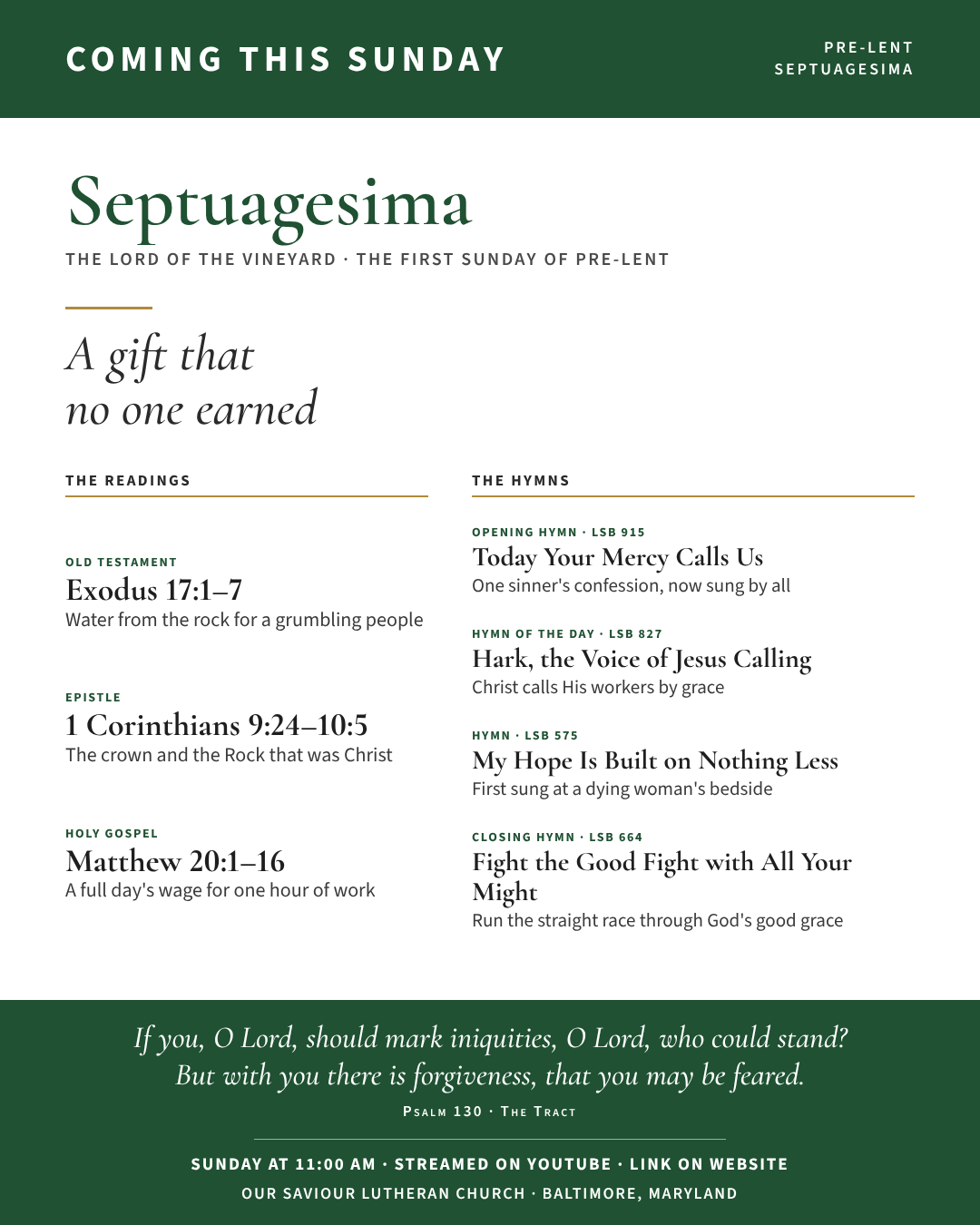
The shape of the service
The Introit (Psalm 18) begins in distress. "The cords of Sheol entangled me; the snares of death confronted me. In my distress I called upon the Lord; from his temple he heard my voice."
The Gradual (Psalm 9) answers. "The Lord is a stronghold for the oppressed, a stronghold in times of trouble."
The Tract (Psalm 130) replaces the Alleluia Verse: "If you, O Lord, should mark iniquities, O Lord, who could stand? But with you there is forgiveness, that you may be feared."
The Readings. Israel tests the Lord at Massah and Meribah, St. Paul warns the Corinthians that the Sacraments are no license for false security, and Jesus tells of the laborers in the vineyard, where the wage is grace.
The readings at a glance
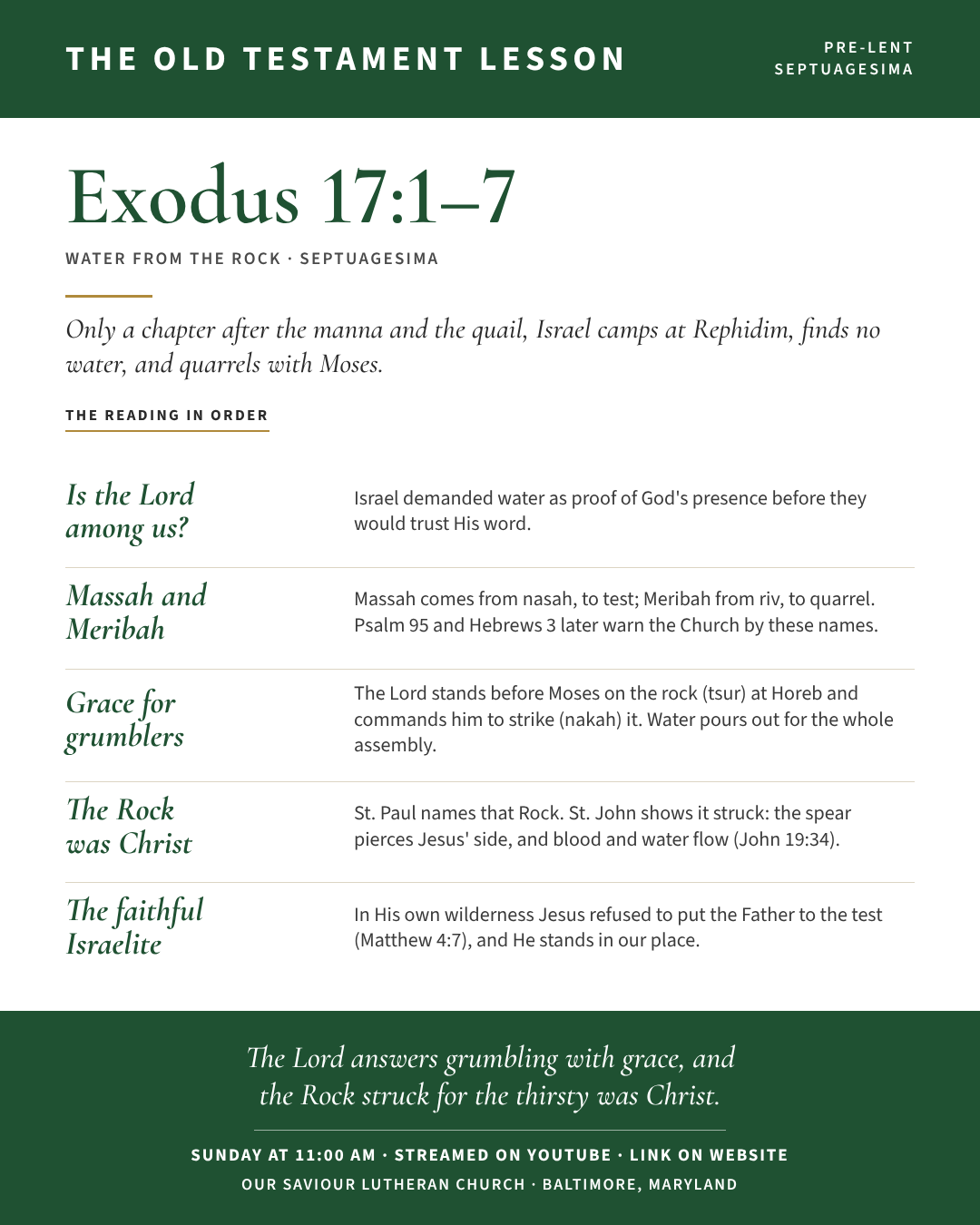
Only a chapter after the manna and the quail, Israel camps at Rephidim, finds no water, and quarrels with Moses. Their question exposes the sin: "Is the Lord among us or not?" They demanded water as proof of God's presence before they would trust His word. The place took two names: Massah, from nasah ("to test"), and Meribah, from riv ("to quarrel, contend"). The Greek Old Testament renders them peirasmos ("testing") and parapikrasmos ("provocation"), the words Psalm 95 and Hebrews 3 later use to warn the Church: "Today, if you hear His voice, do not harden your hearts." The Lord answers grumbling with grace. He stands before Moses on the rock (tsur) at Horeb and commands him to strike (nakah) it with his staff, and water pours out for the whole assembly. St. Paul names that Rock: it "was Christ." St. John shows the Rock struck, when the soldier's spear pierces Jesus' side and blood and water flow (John 19:34). In His own wilderness Jesus refused to put the Father to the test (Matthew 4:7, quoting Deuteronomy 6:16), the faithful Israelite who stands in our place.
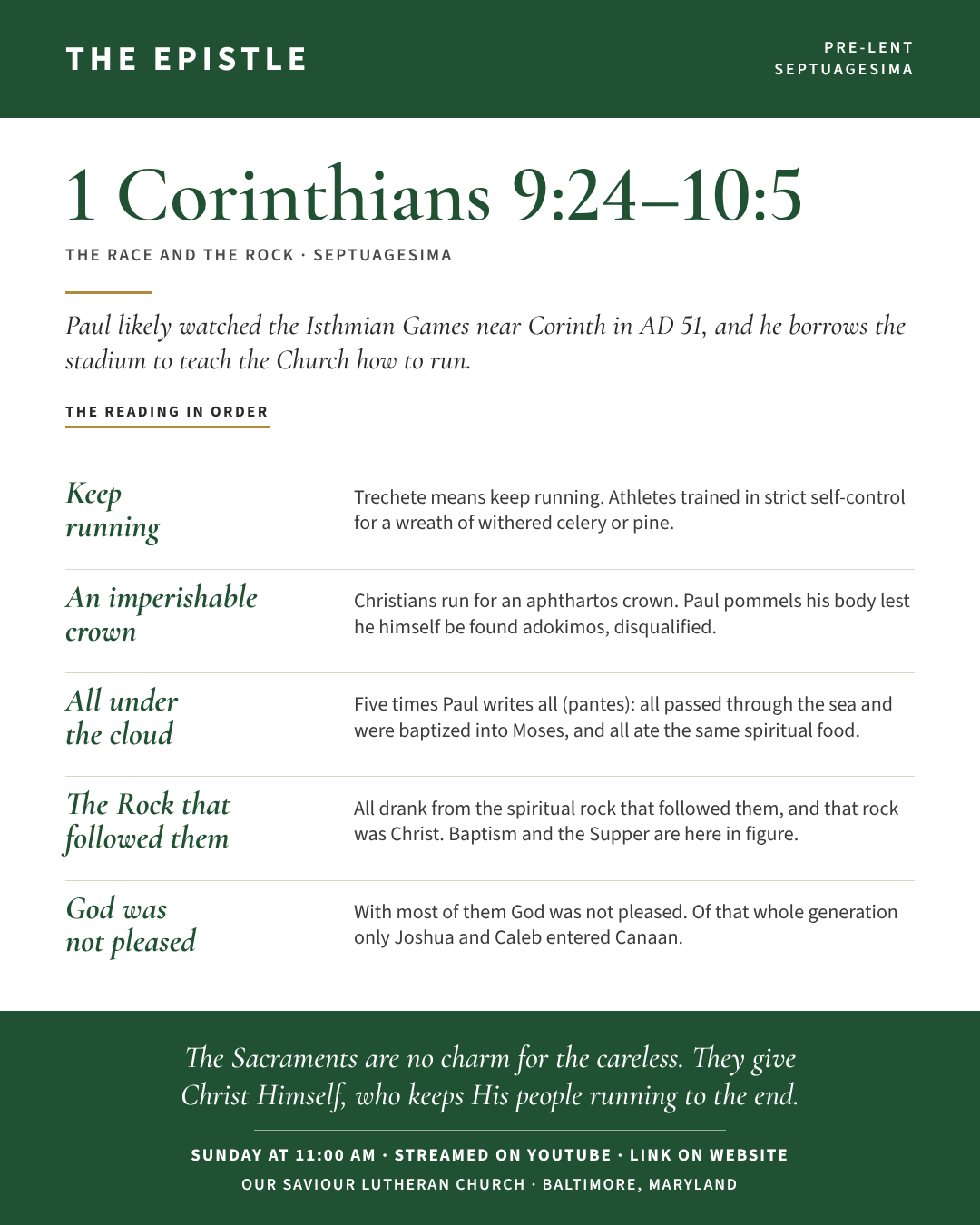
Paul likely watched the Isthmian Games, held about ten miles from Corinth in the spring of AD 51, and he borrows the stadium: "So run that you may win!" The verb trechete means "keep running." Every contestant (agonizomenos, the root of our word "agony") trained ten months in strict self-control for a wreath of withered celery or pine; Christians run for an imperishable (aphthartos) crown. Paul pommels his body (hypopiazo, literally "to give a black eye") lest after preaching to others he himself be found adokimos, "disqualified." He then turns to Israel. Five times he writes "all" (pantes): all were under the cloud, all passed through the sea and were baptized into Moses, all ate the same spiritual food, and all drank from "the spiritual rock which followed them, and that rock was Christ." Jewish legend told of a well-rock that rolled along with the camp; Paul names the One who truly followed them. Baptism and the Supper are here in figure. Still, "with most of them God was not pleased": of that whole generation only Joshua and Caleb entered Canaan. The Sacraments are no charm for the careless. They give Christ Himself, who keeps His people running to the end.
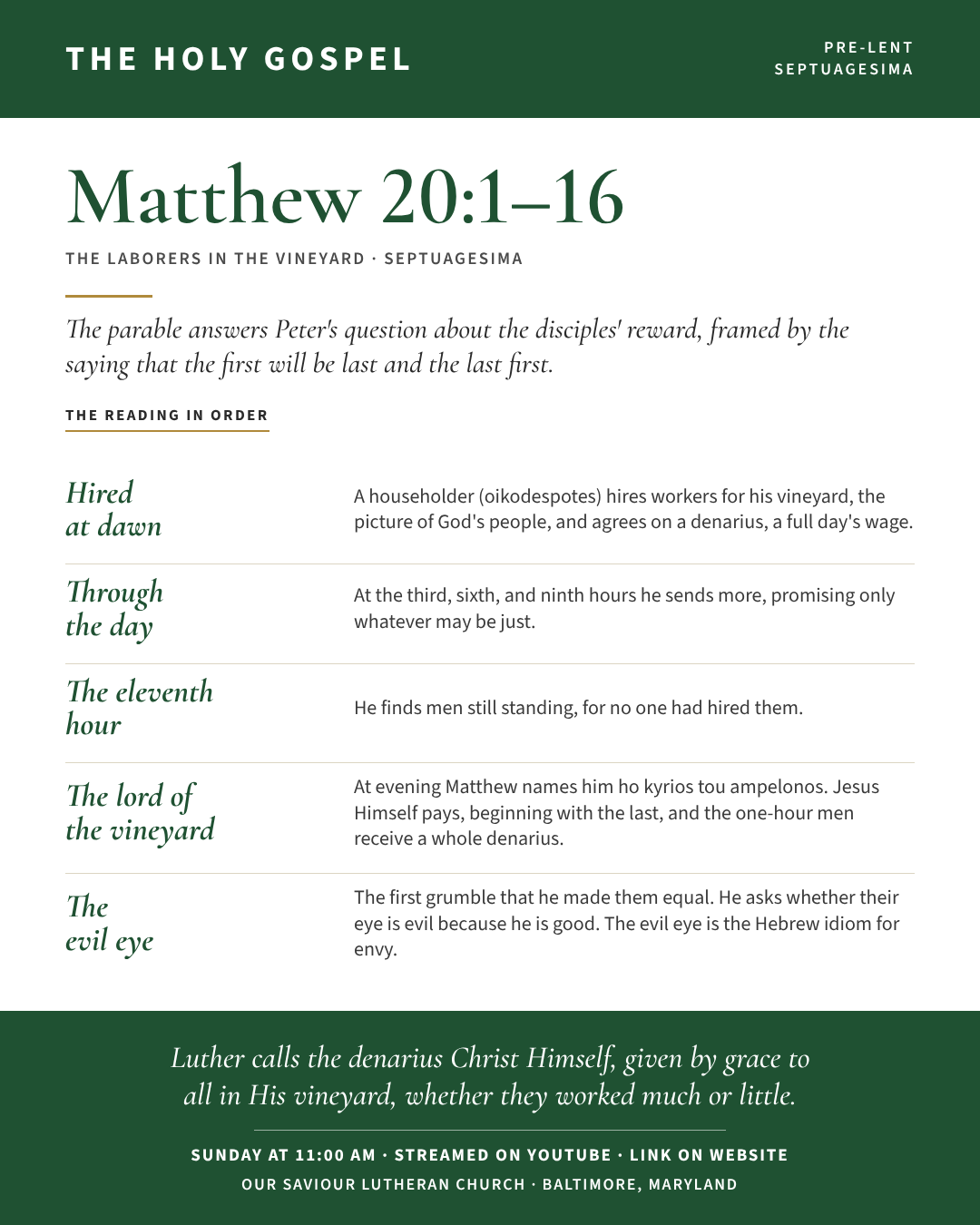
The parable opens with "for" (gar): it answers Peter's question, "What then will there be for us?" (19:27), framed by the saying that the first will be last and the last first. A householder (oikodespotes) goes out at dawn to hire workers for his vineyard, the Old Testament picture of God's people (Isaiah 5), and agrees on a denarius, a full day's wage. At the third, sixth, and ninth hours he sends more, promising only "whatever may be just." At the eleventh hour he finds men still standing: "no one hired us." At evening Matthew stops calling him householder and names him "the lord of the vineyard" (ho kyrios tou ampelonos): Jesus Himself pays the wages, beginning with the last. The one-hour men receive a whole denarius. The first grumble, "you made them equal to us." The lord answers, "Friend, I am not treating you unjustly.... Or is your eye evil because I am good?" The "evil eye" (ophthalmos poneros) is the Hebrew idiom for envy. Luther calls the denarius Christ Himself, with forgiveness of sins and eternal life, given by grace to all in His vineyard, whether they worked much or little.
The hymns and their stories