2026 — Lectionary primer

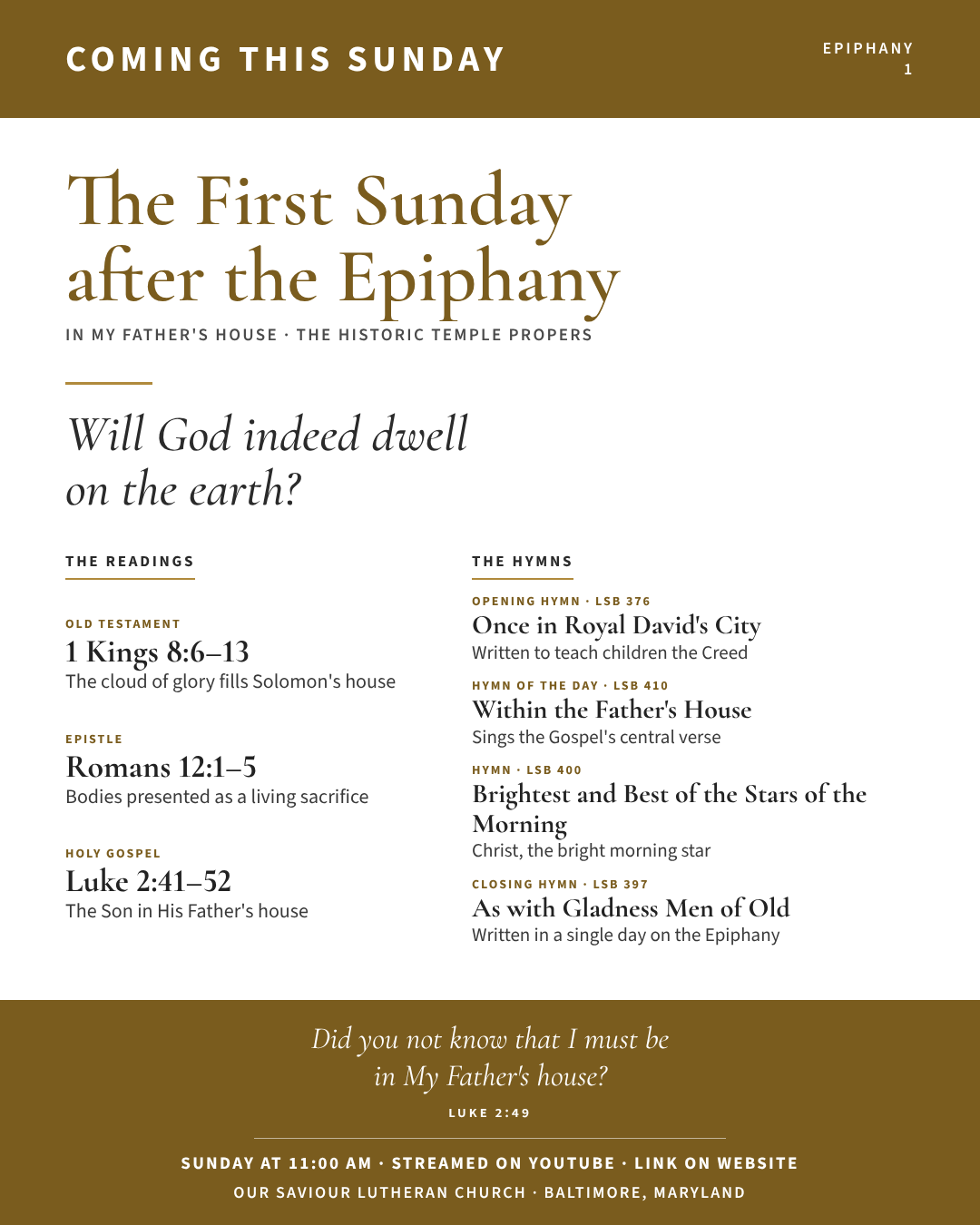
The First Sunday after the Epiphany

In My Father's House · The Historic Temple Propers

One-year lectionary  ·  1 Kings 8:6–13  ·  Romans 12:1–5  ·  Luke 2:41–52

The early Church kept several manifestations, or epiphanies, of Christ in this season: the visit of the Magi, the Baptism of Jesus in the Jordan, and His first miracle at the wedding in Cana. In the traditional Western rite, kept in The Lutheran Hymnal and offered as an option in Lutheran Service Book, the First Sunday after the Epiphany heard the account of the twelve-year-old Jesus in the Temple, while the Baptism of Our Lord belonged to the Octave of the Epiphany on January 13. The Three-Year Lectionary later made this Sunday the Baptism of Our Lord in all three series. Our Saviour keeps both in view over the years. When the Epiphany falls on a Wednesday through a Saturday, as it does this year, the historic Temple propers stand. The day wears white, the color of a festival of Christ's glory and revelation.

Lectionary Primer PDF
Coming this Sunday: The First Sunday after the Epiphany
Coming this Sunday: The First Sunday after the Epiphany.

The shape of the service

The Introit (In excelso throno) sets the tone with Isaiah 6:1 and Revelation 19:6, "I saw the Lord sitting upon a throne, high and lifted up," with Psalm 100. It is the same throne-room glory that filled Solomon's Temple.

The Gradual and Verse. Psalm 72:18, 3, with Psalm 100:1–2a for the Verse.

The Collect (LSB L13) asks that we "perceive and know what things [we] ought to do" and receive "grace and power faithfully to fulfill the same." The Epistle answers with a mind renewed to discern the will of God.

The Hymn of the Day, "Within the Father's House," sings the Gospel's central verse, Luke 2:49.

The readings at a glance

Old Testament
1 Kings 8:6–13

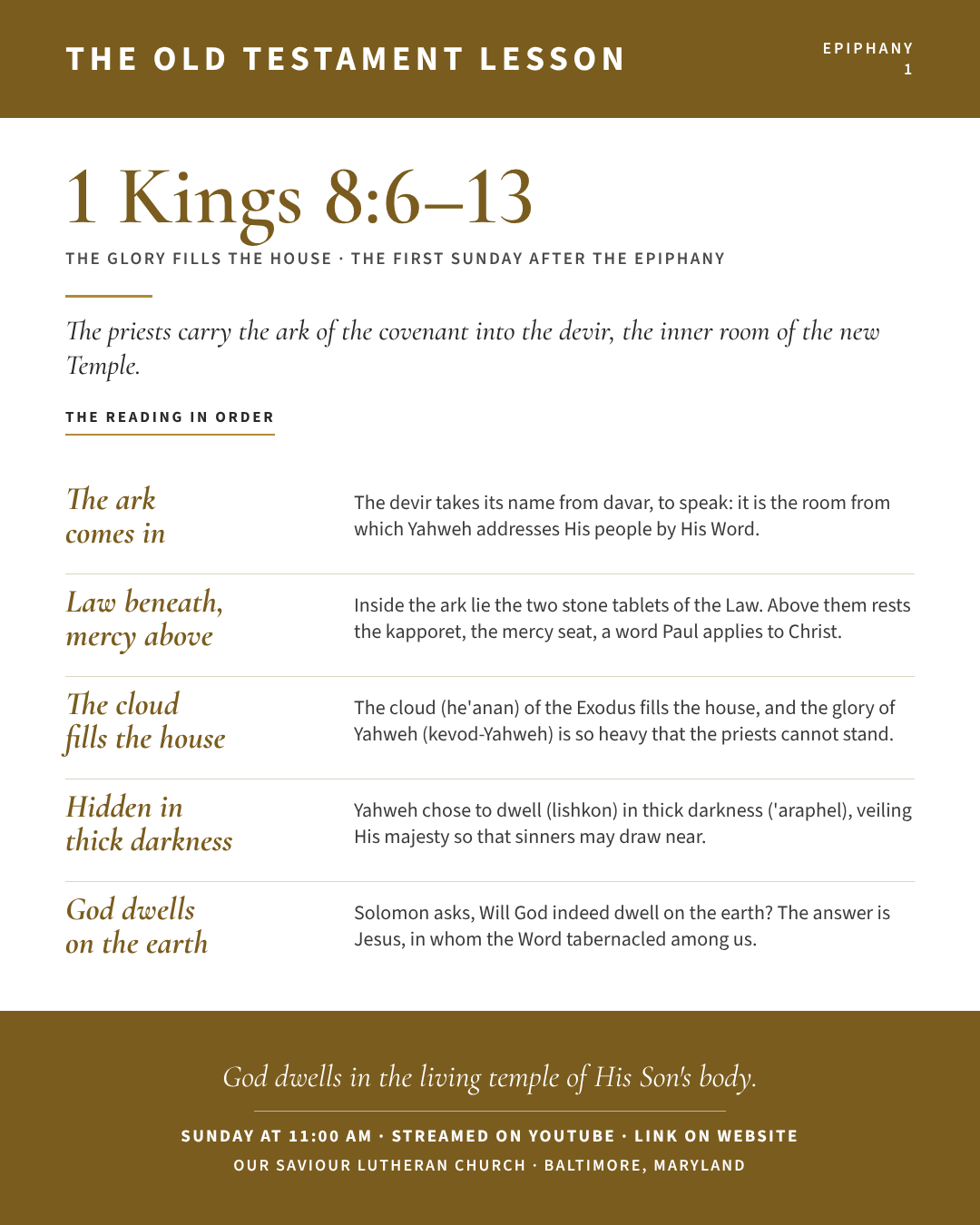
The priests carry the ark of the covenant ('aron berit-Yahweh) into the devir, the inner room of the new Temple. The word comes from davar, "to speak": it is the room from which Yahweh addresses His people by His Word. Inside the ark lie only the two stone tablets of the Law, which accuse and demand perfection. Above them rests the kapporet, the mercy seat, where the blood of atonement was sprinkled; the Septuagint calls it hilasterion, and Paul applies that very word to Christ (Romans 3:25). The moment the priests come out, the cloud (he'anan) of the Exodus fills the house, and the glory of Yahweh (kevod-Yahweh, from a root meaning "heavy") weighs so heavily that the priests cannot stand to minister. Solomon confesses that Yahweh chose to dwell (lishkon, from shakan, the root behind the Shekinah) in thick darkness ('araphel), veiling His majesty so that sinners may draw near without being consumed. His own question, "Will God indeed dwell on the earth?" (8:27), finds its answer in Jesus. God dwells in the living temple of His Son's body, and St. John writes that the Word "tabernacled among us, and we beheld His glory" (John 1:14).
The Old Testament for The First Sunday after the Epiphany: 1 Kings 8:6–13
The Old Testament: 1 Kings 8:6–13.
Epistle
Romans 12:1–5

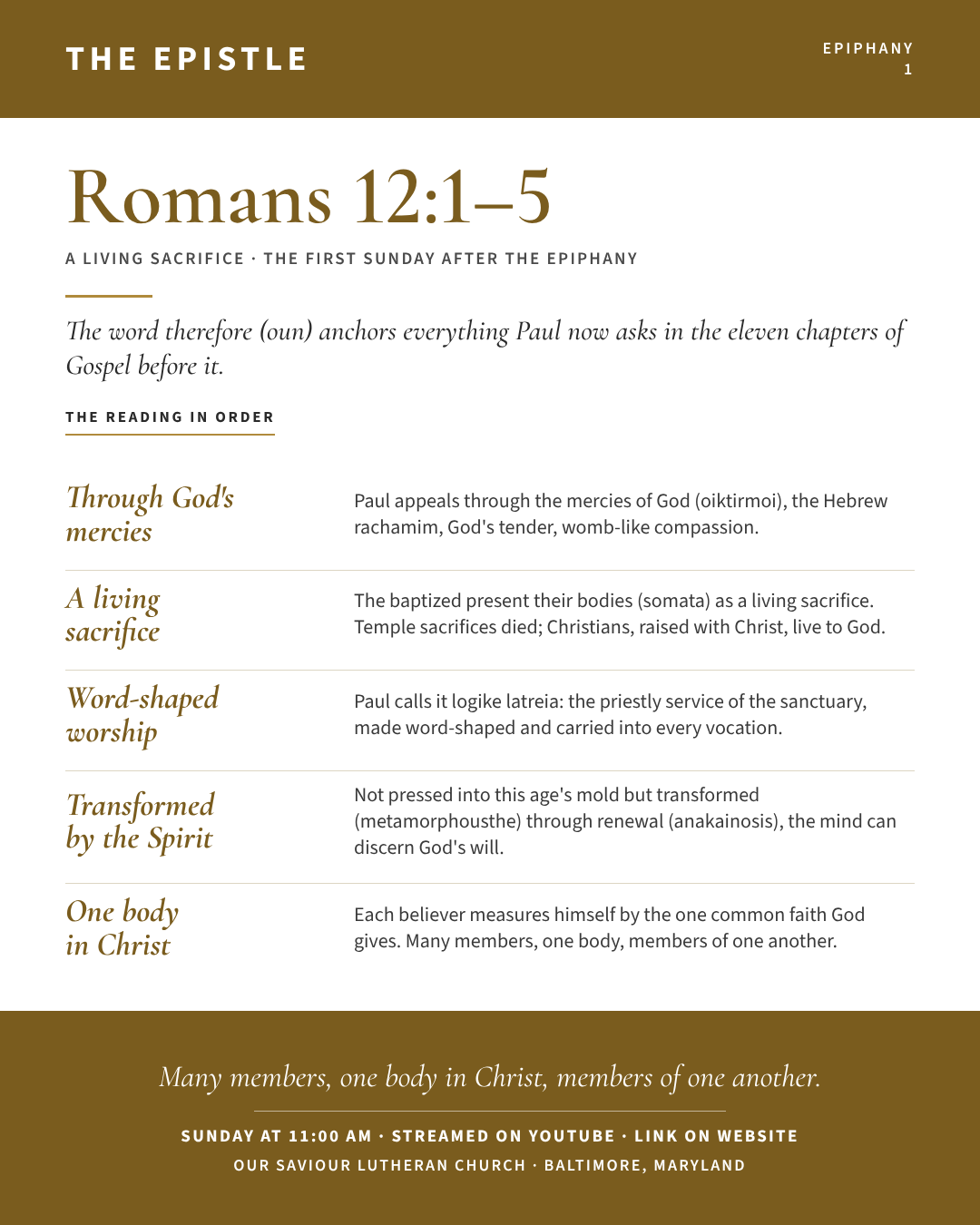
The word "therefore" (oun) anchors everything Paul now asks in the eleven chapters of Gospel before it. He appeals "through the mercies of God" (oiktirmoi, the Hebrew rachamim, God's tender, womb-like compassion). The baptized present their bodies (somata) as a sacrifice that is living (zosan): Temple sacrifices died on the altar, while Christians, buried and raised with Christ, live to God. Paul calls this their logike latreia. Latreia is the priestly service of the sanctuary; logike makes it "word-shaped" worship carried into every vocation. Believers are not to be pressed into the mold of this age (syschematizesthe) but transformed (metamorphousthe, the verb of the Transfiguration). The verb is passive: the Holy Spirit does the work, through the renewal (anakainosis) that Titus 3:5 ties to the washing of regeneration. The renewed mind can test and discern (dokimazein, a term from the refining of metals) the will of God. No one thinks too highly of himself; each measures himself by the one common faith God gives. Many members, one body in Christ, members of one another.
The Epistle for The First Sunday after the Epiphany: Romans 12:1–5
The Epistle: Romans 12:1–5.
Holy Gospel
Luke 2:41–52

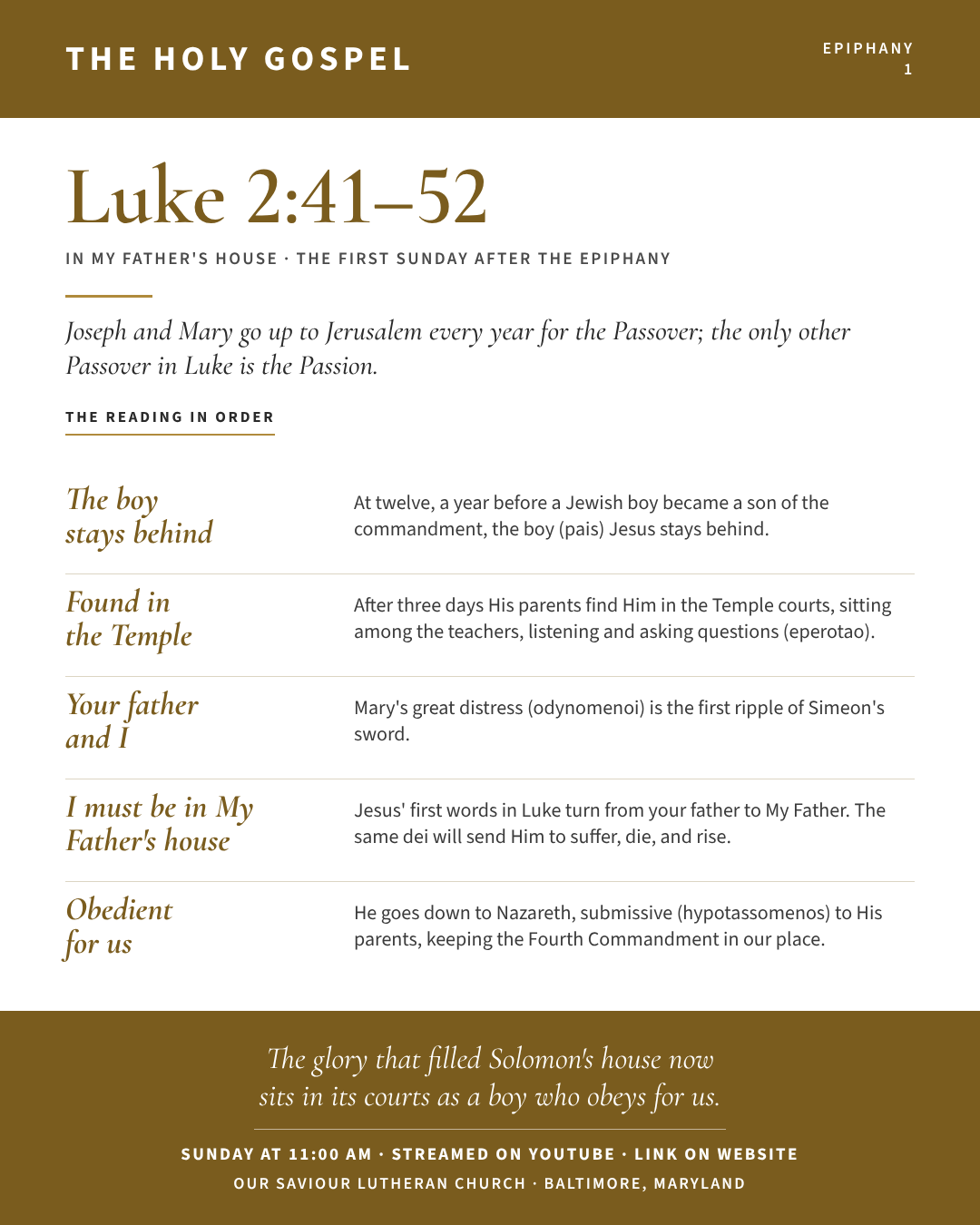
Joseph and Mary go up to Jerusalem every year for the Passover; the only other Passover in Luke is the Passion. At twelve, a year before a Jewish boy became a "son of the commandment," the boy (pais) Jesus stays behind. After three days His parents find Him in the Temple courts, sitting among the teachers as a student, listening and asking questions (eperotao). Mary's words, "Your father and I have been searching for You in great distress" (odynomenoi), are the first ripple of Simeon's sword. Jesus' first words in Luke turn from "your father" to "My Father": "Did you not know that I must (dei) be in My Father's house?" The same dei will send Him to suffer, die, and rise (9:22), and the three days of loss echo the third day of Easter. He then goes down to Nazareth and is submissive (hypotassomenos) to His parents, keeping the Fourth Commandment in our place, and keeps advancing (proekopten, "cutting a path forward") in wisdom and stature. The glory that filled Solomon's house now sits in its courts as a boy who obeys for us.
The Holy Gospel for The First Sunday after the Epiphany: Luke 2:41–52
The Holy Gospel: Luke 2:41–52.

The hymns and their stories

Opening Hymn
"Once in Royal David's City"  ·  LSB 376
Cecil Frances Alexander published this hymn in 1848, under her maiden initials "C. F. H.," in Hymns for Little Children. The whole collection had one pastoral purpose: to teach children the Apostles' Creed and the Catechism in simple, picturesque language. This hymn explains the article "conceived by the Holy Spirit, born of the Virgin Mary." The same collection gave the Church "All Things Bright and Beautiful" and "There Is a Green Hill Far Away." The hymn reached the world through King's College, Cambridge, where it opens the Festival of Nine Lessons and Carols each Christmas Eve; in a nod to its origin, a single boy chorister sings the first stanza alone. Alexander wanted young singers to see that their Savior shares our life: He was "little, weak, and helpless" and knew "tears and smiles like us." Her original text carried a moralizing stanza telling children to be "mild, obedient, good as He." Lutheran Service Book omits it, so the hymn stays fixed on Christ's incarnation and His promise to lead His children home, where they will shine like stars. The tune IRBY was composed in 1849 by Henry J. Gauntlett.
Hymn of the Day
"Within the Father's House"  ·  LSB 410
James Russell Woodford wrote this hymn for the Epiphany season, and it appeared in 1863. It is built on the Gospel's central verse, where Jesus answers Mary and Joseph, "Did you not know that I must be in My Father's house?" The opening lines set the theme at once: "Within the Father's house / The Son has found His home." Woodford rose to be Bishop of Ely and an honorary chaplain to Queen Victoria. As learned as the doctors who marveled at the boy in the Temple, he made the opposite point in his hymn: human intellect cannot unravel the mystery of the Incarnation, and God must reveal Himself in Christ. Long before he wore a bishop's mitre, Woodford served as a young clergyman in the poor coal-mining district of Bristol. A stanza omitted from modern hymnals joined those two worlds: whether one is a scholar in the Temple or an unlearned miner, the mystery of Christ stays hidden until it is revealed by faith. The tune FRANCONIA is a German melody of about 1720, arranged by William Henry Havergal for his Old Church Psalmody of 1847.
Hymn
"Brightest and Best of the Stars of the Morning"  ·  LSB 400
Reginald Heber wrote this hymn in 1811 as rector of Hodnet, Shropshire, years before he became Bishop of Calcutta. He had set himself the goal of writing a hymn for every Sunday and festival, drawn from the appointed lessons and collects, and he wrote this one for the Epiphany. In the nineteenth century critics accused him of addressing, even worshiping, a literal star. The image works on two levels. It recalls the star that led the Wise Men, and it names Christ Himself, who says in Revelation 22:16, "I am the root and the descendant of David, the bright morning star." Heber first wrote "sons of the morning," the reading kept in The Lutheran Hymnal; later hymnals, ours included, changed it to "stars." The hymn sets Christ's majesty as "Maker and Monarch and Savior of all" beside His lowliness among the "beasts of the stall." The fourth stanza carries the Gospel: "Vainly with gifts would His favor secure." Echoing Psalm 51:17, Heber teaches that God values "the heart's adoration" and "the prayers of the poor" above gold. The tune MORNING STAR, by James P. Harding (1892), was first paired with these words in 1894.
Closing Hymn
"As with Gladness Men of Old"  ·  LSB 397
William Chatterton Dix was a young layman in his early twenties, a marine insurance agent by trade, when a sudden and severe illness confined him to bed. On the day of the Epiphany he read the festival Gospel of the Wise Men (Matthew 2:1–12), and he wrote this entire hymn that same day, finishing it by evening. Editors named the tune DIX in his honor, adapted from an 1838 composition by Conrad Kocher, but Dix disliked the music. Once the pairing became popular he remarked, "I dislike it, but now nothing will displace it." His first text placed the Wise Men at a "manger bed." Matthew 2:11, however, says that they found Jesus in a house, so the 1875 Hymns Ancient and Modern changed the lines to "lowly bed" and "cradle, rude and bare." The first three stanzas pair Scripture with prayer in an "as ... so" pattern: as the Magi followed the star, so may we be led by Christ; as they hurried to His bed, so may we "seek Thy mercy-seat"; as they offered their gifts, so may we bring our costliest treasures.