The Transfiguration of Our Lord
Glory on the Holy Mountain · The Last Sunday after the Epiphany
In the Western Roman rite and the English Sarum Use, the Transfiguration was kept as a fixed feast on August 6. Lutheran tradition moved the principal celebration to the last Sunday after the Epiphany, the Sunday before Septuagesima, where it closes the season of revealed glory. The Baptism of Our Lord opens the Epiphany season by revealing Jesus in human humility as the Father's beloved Son; the Transfiguration closes it by revealing His uncreated divine glory shining through His human flesh on the holy mountain. Moses and Elijah, the Law and the Prophets, speak with Him about His "exodus" (exodos), His death in Jerusalem (Luke 9:31). The Lord who displays His majesty on the mountaintop descends into the valley of suffering to die for the sins of the world.
Lectionary Primer PDF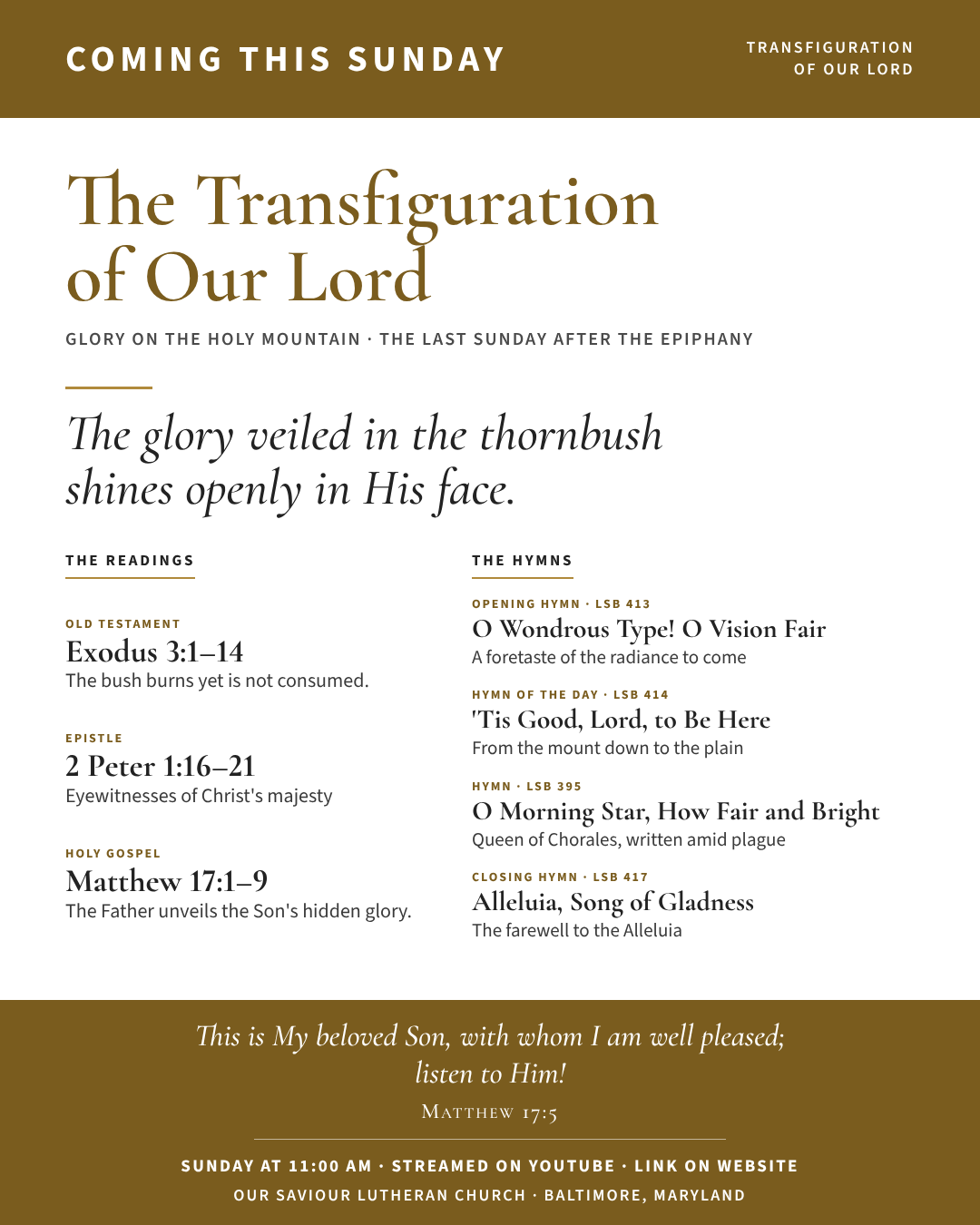
The shape of the service
The Color. White, for the uncreated radiance of Christ's divine nature.
The Collect prays. "O God, in the glorious transfiguration of Your beloved Son You confirmed the mysteries of the faith by the testimony of Moses and Elijah. In the voice that came from the bright cloud You wonderfully foreshowed our adoption by grace. Mercifully make us co-heirs with the King in His glory."
The Proper Preface confesses that Christ at His transfiguration revealed His glory to His disciples "that they might be strengthened to proclaim His cross and resurrection and with all the faithful look forward to the glory of life everlasting."
Farewell to the Alleluia. This is the last Sunday on which the congregation sings or speaks "Alleluia" until Easter morning; the closing hymn bids it farewell.
The readings at a glance
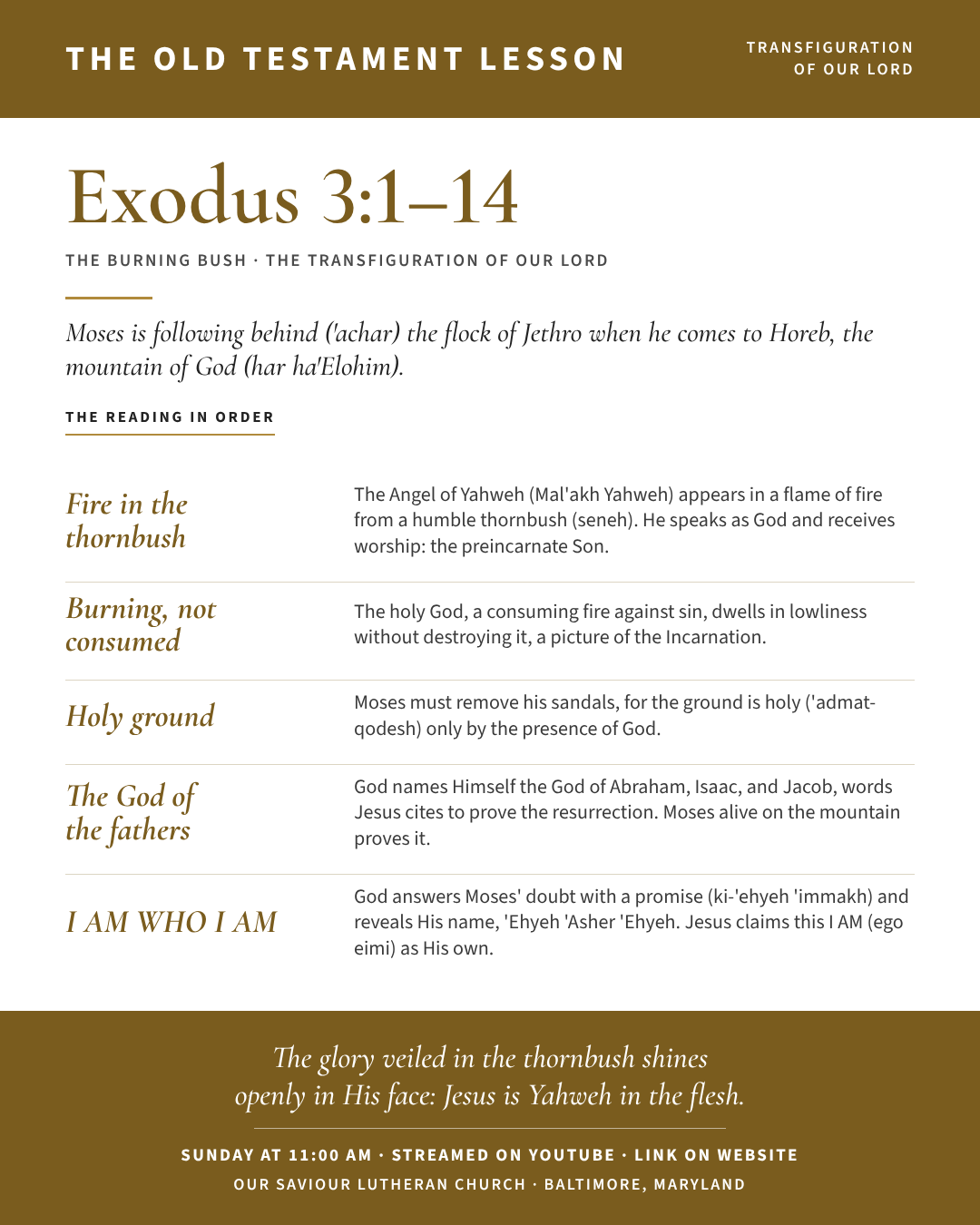
Moses is following "behind" ('achar) the flock of Jethro when he comes to Horeb, "the mountain of God" (har ha'Elohim), There "the Angel of Yahweh" (Mal'akh Yahweh) appears to him in a flame of fire from a humble thornbush (seneh). This Angel is no created being: He speaks as God and receives worship, an appearance of the preincarnate Son. The bush burns yet is not consumed. The holy God, a consuming fire against sin, dwells in lowliness without destroying it, a picture of the Incarnation. Moses must remove his sandals, for the ground is holy ('admat-qodesh) only by the presence of God. God names Himself the God of Abraham, Isaac, and Jacob, words Jesus cites to prove the resurrection; Moses alive on the mountain proves it. To Moses' "Who am I?" God answers with a promise, "Certainly I will be with you" (ki-'ehyeh 'immakh), and then reveals His name, "I AM WHO I AM" ('Ehyeh 'Asher 'Ehyeh). Jesus claims this "I AM" (ego eimi) as His own (John 8:58). The glory veiled in the thornbush shines openly in His face: Jesus is Yahweh in the flesh.
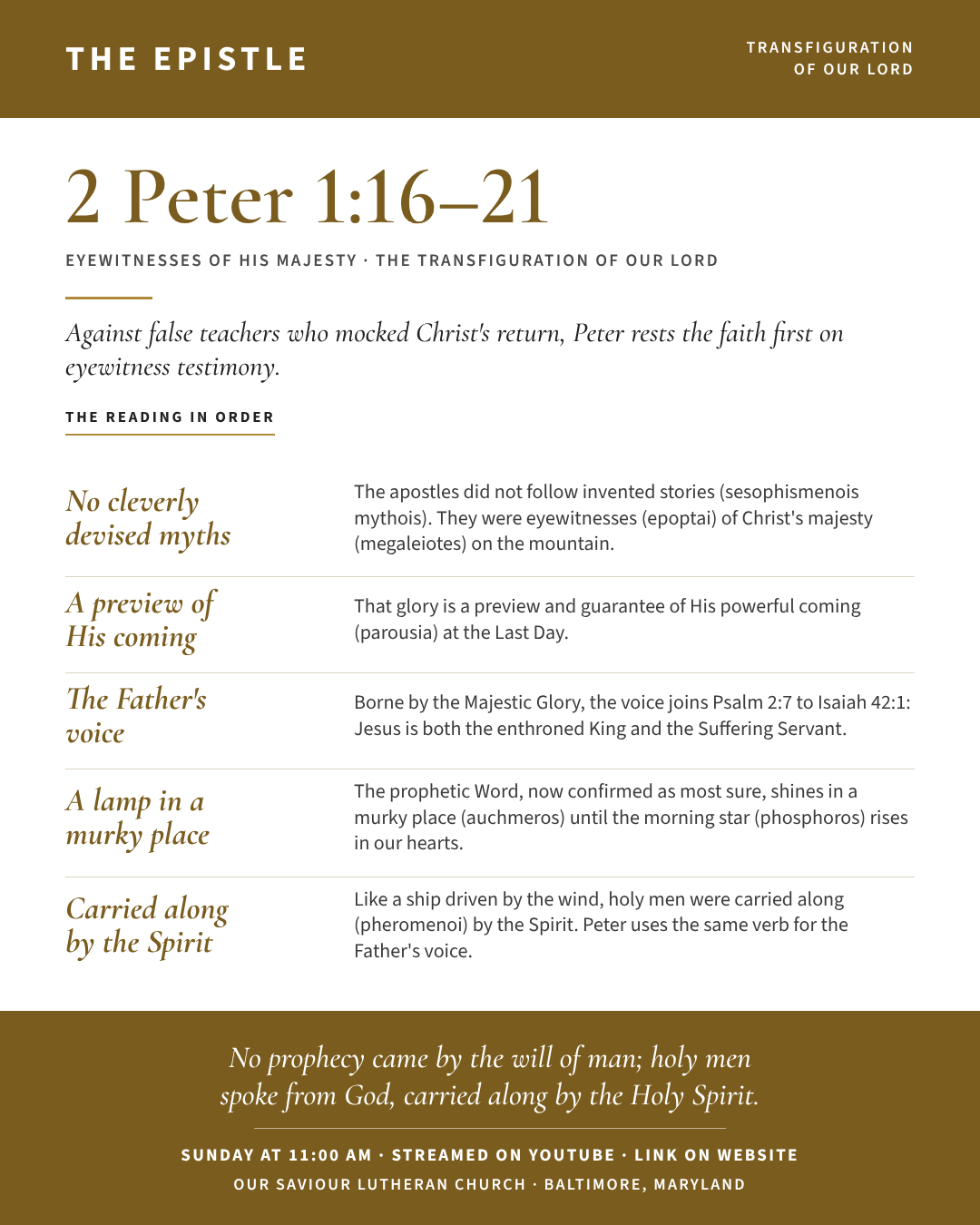
Against false teachers who mocked Christ's return, Peter rests the faith first on eyewitness testimony. The apostles did not follow "cleverly devised myths" (sesophismenois mythois); they were "eyewitnesses" (epoptai) of Christ's majesty (megaleiotes) on the mountain, and that glory is a preview and guarantee of His powerful coming (parousia) at the Last Day. They heard the Father's voice, borne by "the Majestic Glory," joining Psalm 2:7 ("You are my Son") to Isaiah 42:1 ("my chosen one"): Jesus is both the enthroned King and the Suffering Servant. His second foundation is "the prophetic Word," now confirmed as most sure, a lamp shining in a murky place (auchmeros) until the day dawns and the morning star (phosphoros) rises in our hearts, the title Jesus claims in Revelation 22:16. No prophecy came by the will of man; holy men spoke from God as they were "carried along" (pheromenoi) by the Holy Spirit, like a ship driven by the wind (Acts 27:15). Peter uses the same verb for the Father's voice: Scripture has the same source as the voice on the mountain.
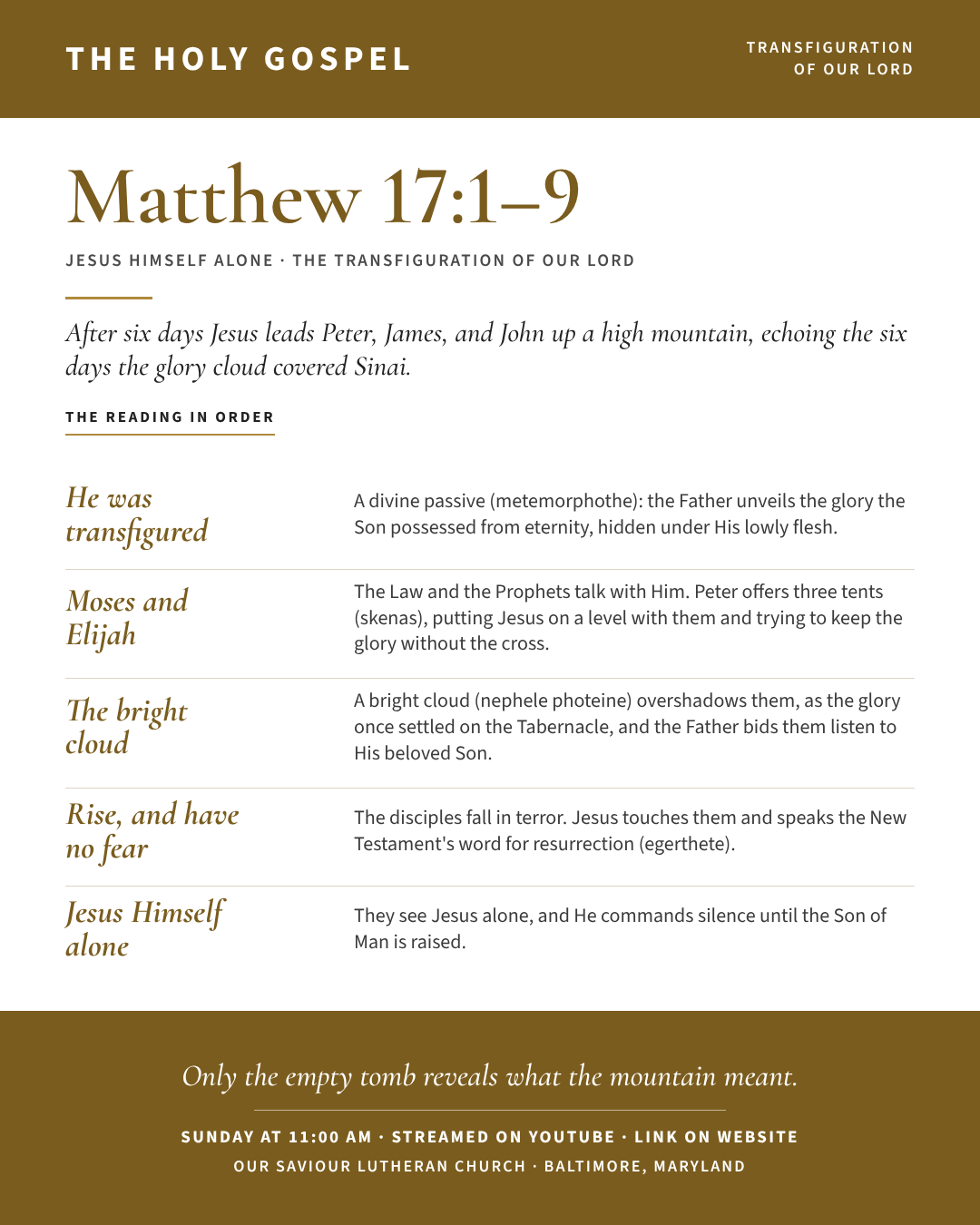
"After six days" Jesus leads Peter, James, and John up a high mountain, echoing the six days the glory cloud covered Sinai before God called Moses (Exodus 24:16). He "was transfigured" (metemorphothe), a divine passive: the Father unveils the glory the Son possessed from eternity, hidden under His lowly flesh. Moses and Elijah, the Law and the Prophets, talk with Him. Peter offers to build three tents (skenas) (Feast of Tabernacles), and so puts Jesus on a level with Moses and Elijah while trying to keep the glory without the cross. A bright cloud (nephele photeine) overshadows them, as the glory once settled on the Tabernacle, and the Father speaks: "This is My beloved Son, with whom I am well pleased; listen to Him!" (compare Deuteronomy 18:15). The disciples fall in terror; Jesus touches them and says, "Rise (egerthete), and have no fear," using the New Testament's word for resurrection. They see "Jesus Himself alone." His command of silence holds until the Son of Man is raised, for only the empty tomb reveals what the mountain meant.
The hymns and their stories