Why Is He Still on It?
Lutherans kept the body on the cross. Here is the reason, and here is what to look for in the figure.
Is it an idol?
No, and the question is old enough to have an answer. In 1522, while Luther was in hiding, Andreas Karlstadt stripped the churches of Wittenberg on the argument that the First Commandment forbids the making of images. Luther answered in 1525 that the commandment forbids images that are worshiped, not images that teach. God Himself commanded the cherubim over the ark, the pomegranates on the temple, and the bronze serpent lifted in the wilderness.
“Images for memorial and witness, such as crucifixes and images of saints, are to be tolerated.”Luther, Against the Heavenly Prophets, 1525 · AE 40:91
Nobody prays to the figure in our lobby. It is a witness, and it points away from itself.
Why not an empty cross?
An empty cross tells the truth about Sunday and hides the truth about Friday. Paul did not preach a shape. He preached “Christ crucified, a stumbling block to Jews and folly to Gentiles” (1 Corinthians 1:23).
The resurrection did not erase the wounds. The risen Lord shows them to Thomas and keeps them still, and the One seated on the throne in Revelation is described as a Lamb standing, as though it had been slain (Revelation 5:6). A corpus is not morbidity. It is the price, left visible.
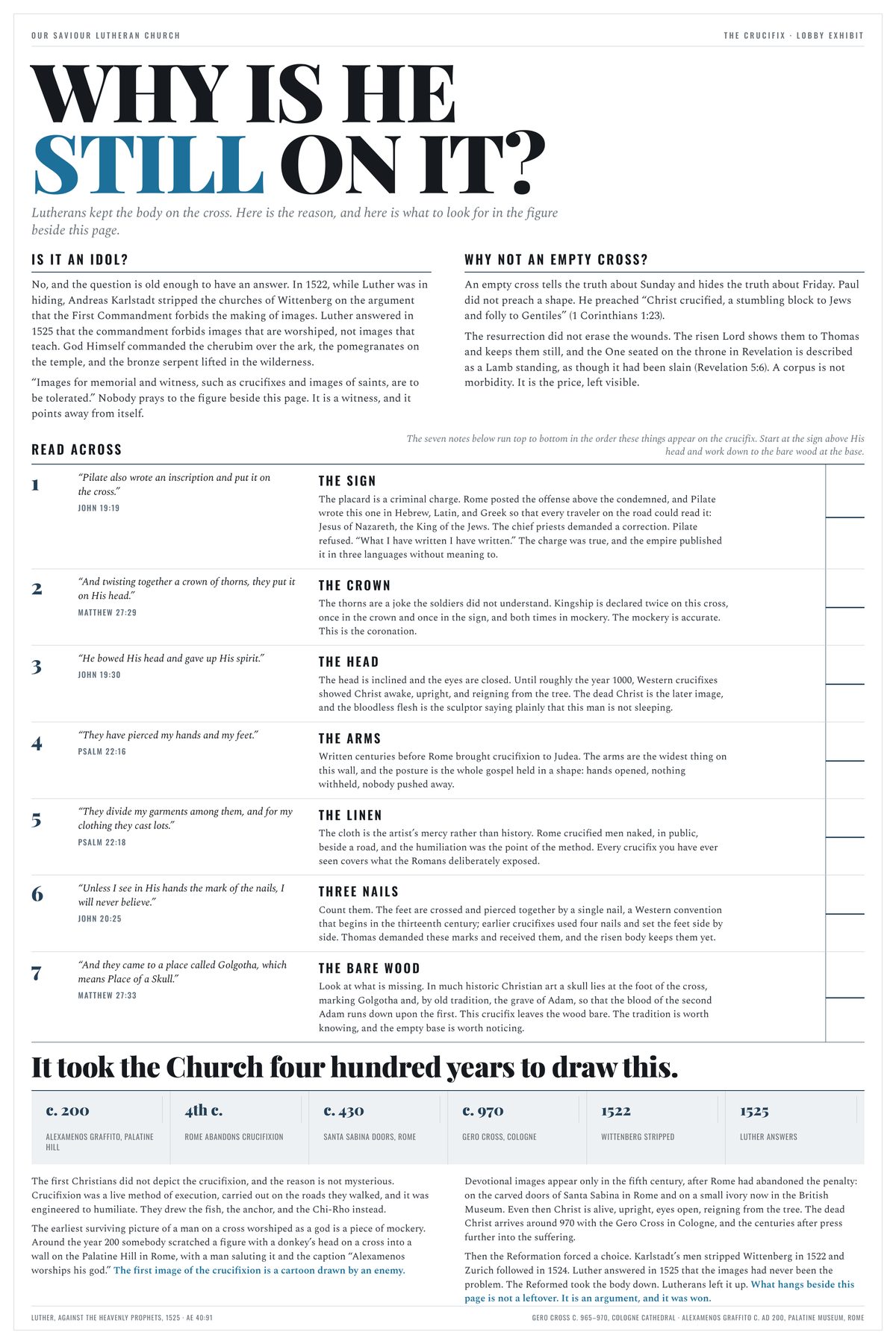
Read the crucifix
The seven notes run top to bottom in the order these things appear on the crucifix. Start at the sign above His head and work down to the bare wood at the base.
- 1
The sign
“Pilate also wrote an inscription and put it on the cross.”John 19:19
The placard is a criminal charge. Rome posted the offense above the condemned, and Pilate wrote this one in Hebrew, Latin, and Greek so that every traveler on the road could read it: Jesus of Nazareth, the King of the Jews. The chief priests demanded a correction. Pilate refused. “What I have written I have written.” The charge was true, and the empire published it in three languages without meaning to.
- 2
The crown
“And twisting together a crown of thorns, they put it on His head.”Matthew 27:29
The thorns are a joke the soldiers did not understand. Kingship is declared twice on this cross, once in the crown and once in the sign, and both times in mockery. The mockery is accurate. This is the coronation.
- 3
The head
“He bowed His head and gave up His spirit.”John 19:30
The head is inclined and the eyes are closed. Until roughly the year 1000, Western crucifixes showed Christ awake, upright, and reigning from the tree. The dead Christ is the later image, and the bloodless flesh is the sculptor saying plainly that this man is not sleeping.
- 4
The arms
“They have pierced my hands and my feet.”Psalm 22:16
Written centuries before Rome brought crucifixion to Judea. The arms are the widest thing on this wall, and the posture is the whole gospel held in a shape: hands opened, nothing withheld, nobody pushed away.
- 5
The linen
“They divide my garments among them, and for my clothing they cast lots.”Psalm 22:18
The cloth is the artist’s mercy rather than history. Rome crucified men naked, in public, beside a road, and the humiliation was the point of the method. Every crucifix you have ever seen covers what the Romans deliberately exposed.
- 6
Three nails
“Unless I see in His hands the mark of the nails, I will never believe.”John 20:25
Count them. The feet are crossed and pierced together by a single nail, a Western convention that begins in the thirteenth century; earlier crucifixes used four nails and set the feet side by side. Thomas demanded these marks and received them, and the risen body keeps them yet.
- 7
The bare wood
“And they came to a place called Golgotha, which means Place of a Skull.”Matthew 27:33
Look at what is missing. In much historic Christian art a skull lies at the foot of the cross, marking Golgotha and, by old tradition, the grave of Adam, so that the blood of the second Adam runs down upon the first. This crucifix leaves the wood bare. The tradition is worth knowing, and the empty base is worth noticing.
It took the Church four hundred years to draw this
The first Christians did not depict the crucifixion, and the reason is not mysterious. Crucifixion was a live method of execution, carried out on the roads they walked, and it was engineered to humiliate. They drew the fish, the anchor, and the Chi-Rho instead.
The earliest surviving picture of a man on a cross worshiped as a god is a piece of mockery. Around the year 200 somebody scratched a figure with a donkey’s head on a cross into a wall on the Palatine Hill in Rome, with a man saluting it and the caption “Alexamenos worships his god.” The first image of the crucifixion is a cartoon drawn by an enemy.
Devotional images appear only in the fifth century, after Rome had abandoned the penalty: on the carved doors of Santa Sabina in Rome and on a small ivory now in the British Museum. Even then Christ is alive, upright, eyes open, reigning from the tree. The dead Christ arrives around 970 with the Gero Cross in Cologne, and the centuries after press further into the suffering.
Then the Reformation forced a choice. Karlstadt’s men stripped Wittenberg in 1522 and Zurich followed in 1524. Luther answered in 1525 that the images had never been the problem. The Reformed took the body down. Lutherans left it up. What hangs in our lobby is not a leftover. It is an argument, and it was won.
Luther, Against the Heavenly Prophets, 1525 (AE 40:91). Gero Cross, c. 965–970, Cologne Cathedral. Alexamenos graffito, c. AD 200, Palatine Museum, Rome.