Who Is Like the Beast?
A fourteenth-century illuminator painted everything John saw: the dragon on his throne, the power handed over, seven heads, ten horns, a head that bled and lived, one body made of three empires, and a crowd that bowed. This page reads the picture and the text together.
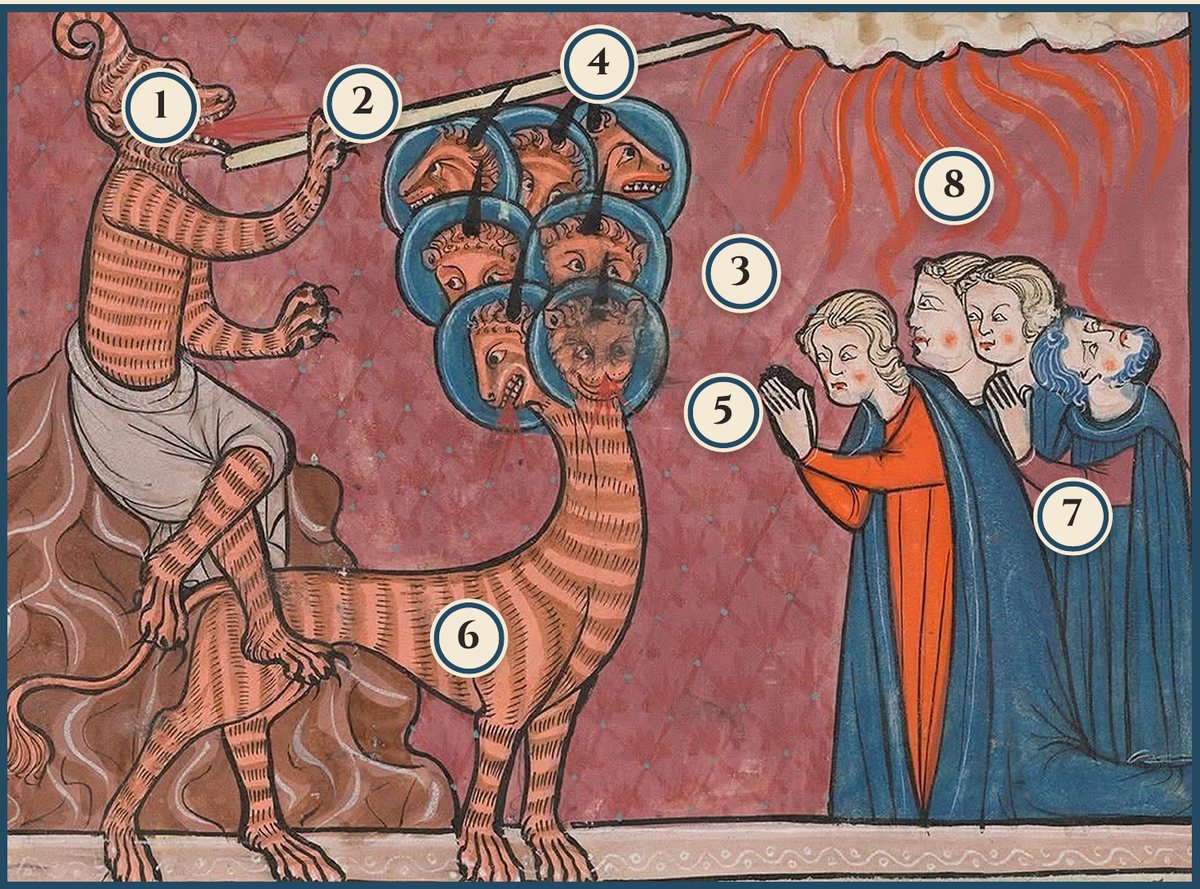
Reading the picture
- 1
The dragon on his throne
Satan, the great red dragon of chapter 12, sits enthroned on a rock: horned, striped, clawed, breathing fire. He wears the beast’s own colors, since the beast is his creature. “The dragon gave to it his power and his throne and great authority” (13:2).
- 2
The staff: power handed over
The painter turns that sentence into a gesture. A rod passes from the dragon’s mouth and claws to the horns of the beast. Everything the beast will do, it does on loan.
- 3
Seven heads
Six lion-maned heads and one dark head, each in a blue roundel. Seven is completeness: the beast claims a totality of rule. John saw “names of blasphemy” on the heads (13:1); the painter leaves the roundels bare, as a coin leaves room for a title.
- 4
Ten horns
Black spikes rise from the heads, ten in all. A horn in Scripture is strength that pushes and gores (Deut. 33:17; Dan. 7:24). This manuscript paints no crowns; many others set diadems on the horns, exactly where John placed them. The section below explains why that placement matters.
- 5
The wounded head
Blood runs from the mouths of the lowest heads, and the dark head is drawn as damaged, “as if it had been slain unto death” (13:3). The wound has healed; the head still lives. Here is the counterfeit resurrection.
- 6
One body, three empires
One striped, cat-like body on heavy clawed feet: a leopard’s body, a bear’s feet, lions’ mouths (13:2). Daniel’s three earlier beasts have been absorbed into one.
- 7
“The whole earth marveled after the beast”
Four figures press forward with hands raised in prayer. They are not fleeing; they are worshiping. Their cry is the parody at the heart of the passage: “Who is like the beast?” (13:4).
- 8
Fire from the cloud
Flame falls from heaven over the worshipers. The painter most likely reaches ahead to 13:13, where the second beast “makes fire come down from heaven” to seal the deception. Signs and wonders attend the state that claims to be god.
1And I saw a beast coming up out of the sea, having ten horns and seven heads, and upon its horns ten diadems, and upon its heads names of blasphemy. 2And the beast which I saw was like a leopard, and its feet were like those of a bear, and its mouth like the mouth of a lion. And the dragon gave to it his power and his throne and great authority.
3And one of its heads was as if it had been slain unto death, and its wound of death was healed. And the whole earth marveled after the beast, 4and they worshiped the dragon, because he had given the authority to the beast, and they worshiped the beast, saying, “Who is like the beast, and who is able to make war with it?”
Revelation 13:1–4Out of the sea Revelation 13:1
The sea in Revelation is more than water. It is the old chaos, the boiling home of Leviathan and Rahab, the realm set against God. It answers to the abyss (ἄβυσσος), the prison of demons, from which the beast is elsewhere said to rise (11:7; 17:8).
Isaiah 57:20–21 calls the wicked “the tossing sea,” which cannot rest and keeps casting up mire and dirt. Daniel’s four beasts came up out of that same sea (Dan. 7:3).
Geography sharpens the point. John on Patmos, looking west across the Aegean, faced Rome. The tyranny of his own day was rising out of the water toward the seven churches.
Where the crowns sit Revelation 12:3 against 13:1
The Dragon
Rev. 12:3 · seven heads, ten hornsDiadems on the headsThe head plans. Satan is the mind behind the scheme, the source of every stratagem against the church.
The Beast
Rev. 13:1 · seven heads, ten hornsDiadems on the hornsThe horn strikes. Earthly rulers carry out what the dragon devises, holding a delegated and time-limited authority.
Same anatomy, one reversal, and the reversal tells the story: “his power and his throne and great authority” (13:2). The intelligence is Satan’s; the muscle is the state’s. God permits the horns their crowns for a season, and no longer.
Names of blasphemy Revelation 13:1
Blasphemy is the arrogant claiming of what belongs to God alone. Roman emperors took divine titles on coins and inscriptions across Asia Minor, the very province of the seven churches.
Every Christian in Asia handled these coins. The names on the beast’s heads were in their pockets.
Daniel 7, read backward Revelation 13:2: “like a leopard, feet like a bear, mouth like a lion”
Lion
Daniel 7:4 · BabylonA lion with eagle’s wings. The devouring mouth: an empire that consumed Jerusalem and carried Judah into exile.
Bear
Daniel 7:5 · Medo-PersiaA bear raised up on one side, ribs in its teeth. Heavy, crushing, brute weight of numbers.
Leopard
Daniel 7:6 · GreeceA leopard with four wings and four heads. Speed: Alexander took the known world in a decade, and it split four ways at his death.
Fourth beast
Daniel 7:7 · RomeUnnamed, terrifying, with iron teeth and ten horns. John lives inside this one. It is the empire on whose coins the blasphemous names are stamped.
John’s beast
Revelation 13:2 · leopard, bear, lionDaniel looked forward and named the beasts in order. John stands in the fourth empire and looks back, so he names them in reverse. The three fallen empires are not gone; the beast has swallowed them. It has the speed of Greece, the weight of Persia, and the mouth of Babylon. It is not one empire but the sum of every empire that sets itself against God.
The sacred copier Revelation 5:6 against 13:3
| The Lamb (5:6) | The beast (13:3) |
|---|---|
| ὡς ἐσφαγμένον “as if it had been slain” | ὡς ἐσφαγμένην εἰς θάνατον “as if it had been slain unto death” |
| Truly died; truly rose in the body | Wounded; the wound was healed |
| Standing in the midst of the throne | Coming up out of the sea |
| Heaven falls down and sings (5:8–14) | The earth marvels and asks, “Who is like the beast?” |
| Worthy because it was slain | Feared because it survived |
John uses the identical participle for both. Satan cannot create; he can only copy, and what he copies is the resurrection. A power that seemed dead and stands again is the most persuasive lie the dragon owns.
The head that would not stay dead Revelation 13:3 in Roman memory
Caligula, AD 40. The emperor fell gravely ill and was expected to die. He recovered, and the empire celebrated it as a rebirth.
Nero, AD 68. Nero died by his own hand, yet for decades the rumor ran that he had escaped to the East and would return with a Parthian army. Pretenders rose in his name: Nero redivivus, Nero come back.
The empire itself, AD 68–69. Four emperors in one year, civil war, and Rome looked finished. Then Vespasian restored it, and the beast stood up again.
Brighton reads these as types, not as the whole meaning. Tyrannies and systems die, the church breathes, and then they rise in new dress. The pattern runs until the Last Day.
Marveling after Revelation 13:3: the grammar of false discipleship
ἐθαυμάσθη ὅλη ἡ γῆ ὀπίσω τοῦ θηρίου
“the whole earth marveled after the beast”
ὀπίσω is the word of discipleship: “Come after me” (Matt. 4:19); “if anyone would come after me” (Matt. 16:24). Awe at power and armies is not neutral admiration. It is following; it is worship.
Who is like? Revelation 13:4 against the oldest confession of Israel
- מִי־כָמֹכָה בָּאֵלִם יְהוָהExodus 15:11“Who is like You, O LORD, among the gods?”
- יְהוָה מִי כָמוֹךָPsalm 35:10“O LORD, who is like You?”
- מִי־אֵל כָּמוֹךָMicah 7:18“Who is a God like You?” (the name Micah means “Who is like the LORD?”)
Against
τίς ὅμοιος τῷ θηρίῳ, καὶ τίς δύναται πολεμῆσαι μετ’ αὐτοῦ;
“Who is like the beast, and who is able to make war with it?” Revelation 13:4
Israel’s oldest confession, sung at the Red Sea after Pharaoh’s army went under the water, is taken from God and handed to the sword. A world that calls the state the one thing nobody can fight has made the state its god.
The song of Moses names the LORD as the one no army can match. The crowd in Revelation 13 sings the same song to the army. Every word of praise has been kept; only its object has changed. That is what blasphemy is.
The bounded beast Revelation 13:5, 8
Rome, the regimes of the last century, and the quiet pressures of our own culture wear the same anatomy. Yet the beast’s authority is measured: forty-two months (13:5), the whole age of the church and not one day more. The names of the saints stand written in the book of life of the Lamb slain from the foundation of the world (13:8). The wounded head lives for a season. The slain Lamb lives forever.
The beast is not only Rome
“The beast represents and symbolizes every human authority and everything of the human nature that the dragon can corrupt and control and use in his warfare against the woman (the church) and her seed (individual Christians): political, governmental, social, economic, philosophical, and educational systems, as well as individuals. No one entity or person at a given time in history will exhaust what the beast signifies.”
Louis A. Brighton, Revelation, Concordia CommentaryHebrew from the Masoretic Text. Greek from the SBL Greek New Testament. View the full poster · Download to print (24×36)