Who Is the Antichrist?
The word John coined, the counterfeit in Revelation, Daniel’s blueprint, Paul’s man of lawlessness, and the verdict of the Lutheran Confessions
Sheet one of twoThe word and the counterfeit
Antichrist
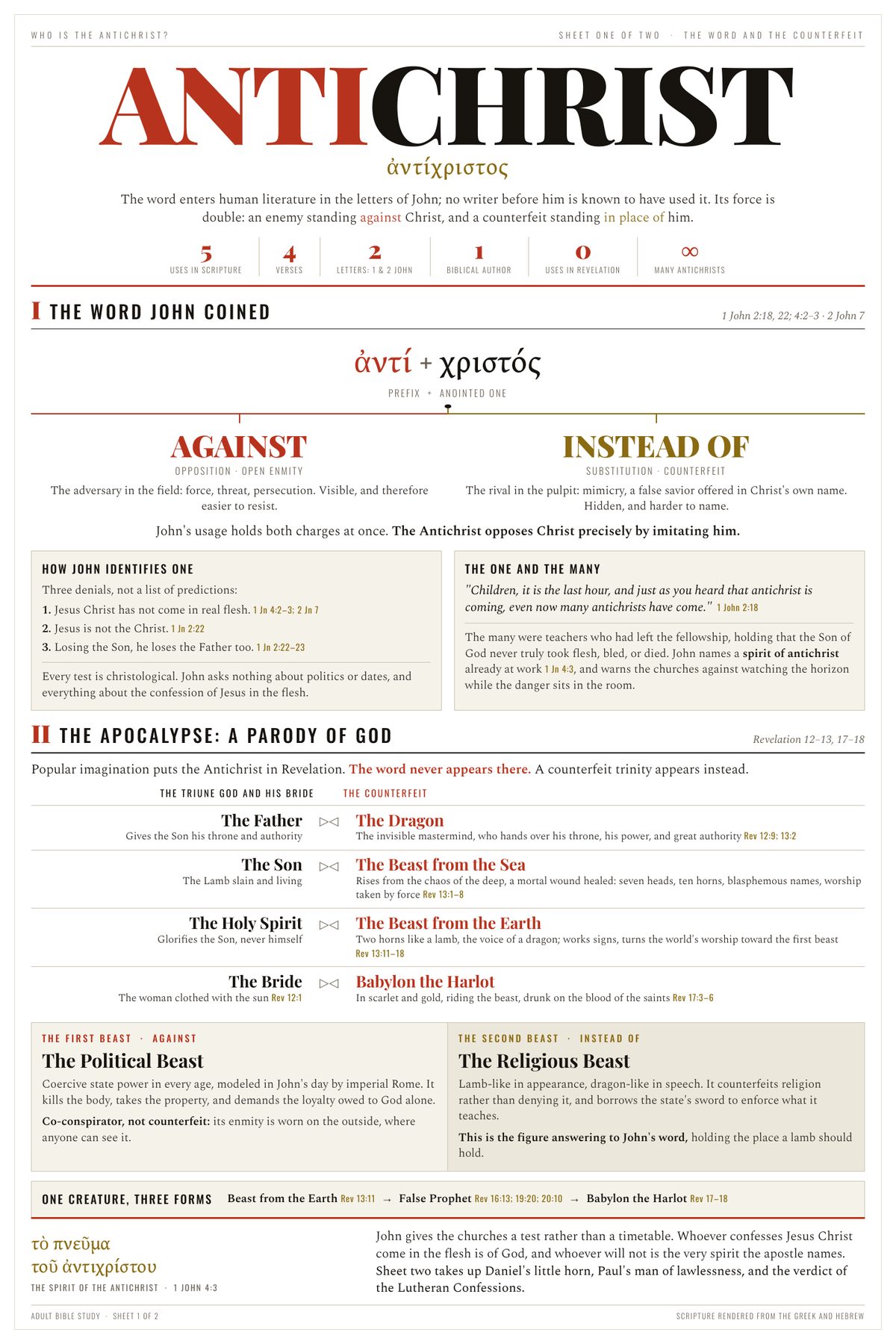
The word enters human literature in the letters of John; no writer before him is known to have used it. Its force is double: an enemy standing against Christ, and a counterfeit standing in place of him.
IThe word John coined 1 John 2:18, 22; 4:2–3 · 2 John 7
ἀντί + χριστός · prefix + Anointed One
Against
The adversary in the field: force, threat, persecution. Visible, and therefore easier to resist.
Instead of
The rival in the pulpit: mimicry, a false savior offered in Christ’s own name. Hidden, and harder to name.
John’s usage holds both charges at once. The Antichrist opposes Christ precisely by imitating him.
Three denials, not a list of predictions:
- Jesus Christ has not come in real flesh. 1 Jn 4:2–3; 2 Jn 7
- Jesus is not the Christ. 1 Jn 2:22
- Losing the Son, he loses the Father too. 1 Jn 2:22–23
Every test is christological. John asks nothing about politics or dates, and everything about the confession of Jesus in the flesh.
“Children, it is the last hour, and just as you heard that antichrist is coming, even now many antichrists have come.” 1 John 2:18
The many were teachers who had left the fellowship, holding that the Son of God never truly took flesh, bled, or died. John names a spirit of antichrist already at work 1 Jn 4:3, and warns the churches against watching the horizon while the danger sits in the room.
IIThe Apocalypse: a parody of God Revelation 12–13, 17–18
Popular imagination puts the Antichrist in Revelation. The word never appears there. A counterfeit trinity appears instead.
| The triune God and His bride | The counterfeit | |
|---|---|---|
| The FatherGives the Son His throne and authority | ▷◁ | The DragonThe invisible mastermind, who hands over his throne, his power, and great authority Rev 12:9; 13:2 |
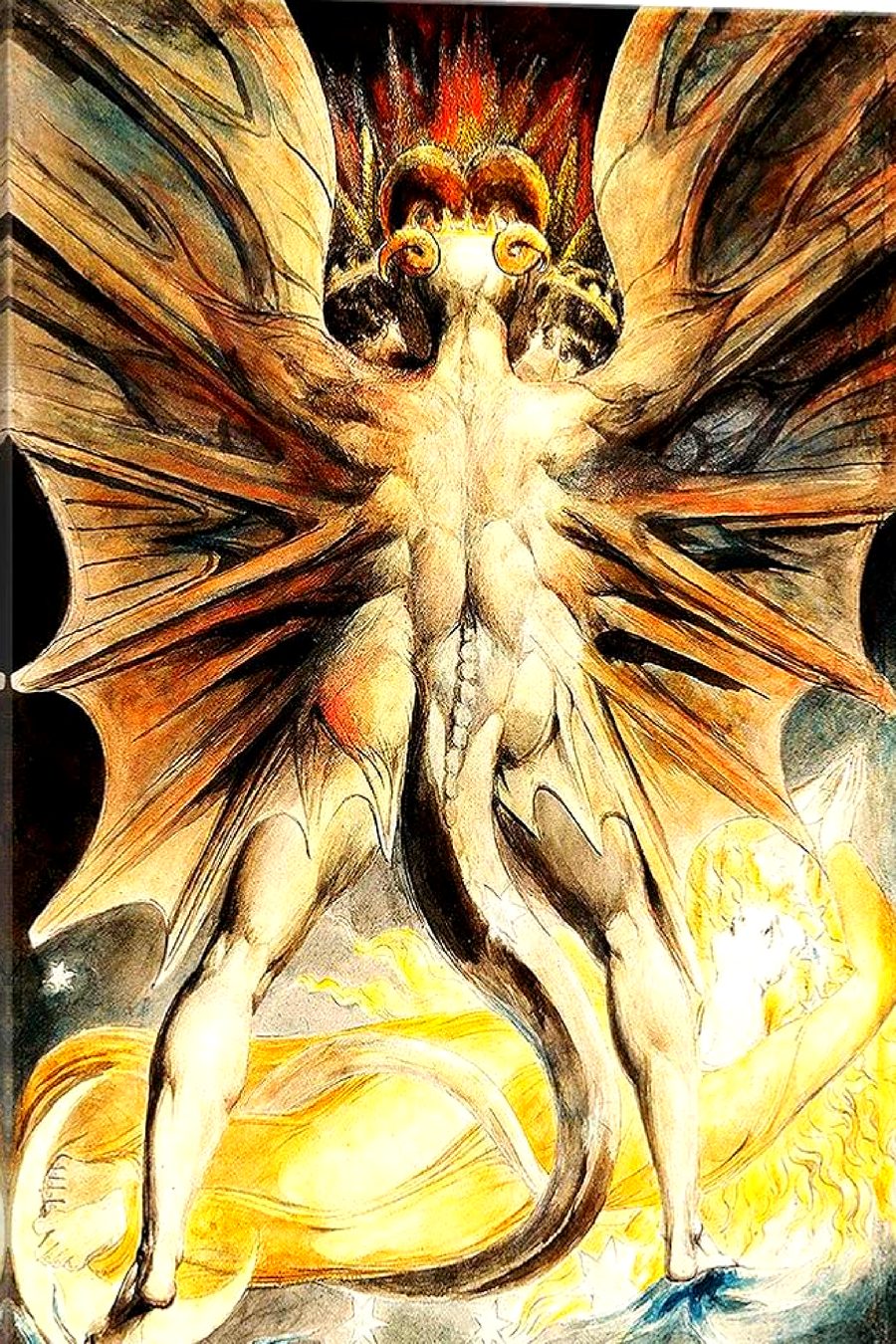
| The SonThe Lamb slain and living | ▷◁ | The Beast from the SeaRises from the chaos of the deep, a mortal wound healed: seven heads, ten horns, blasphemous names, worship taken by force Rev 13:1–8 |
| The Holy SpiritGlorifies the Son, never Himself | ▷◁ | The Beast from the EarthTwo horns like a lamb, the voice of a dragon; works signs, turns the world’s worship toward the first beast Rev 13:11–18 |
| The BrideThe woman clothed with the sun Rev 12:1 | ▷◁ | Babylon the HarlotIn scarlet and gold, riding the beast, drunk on the blood of the saints Rev 17:3–6 |
The Political Beast
Coercive state power in every age, modeled in John’s day by imperial Rome. It kills the body, takes the property, and demands the loyalty owed to God alone.
Co-conspirator, not counterfeit: its enmity is worn on the outside, where anyone can see it.
The Religious Beast
Lamb-like in appearance, dragon-like in speech. It counterfeits religion rather than denying it, and borrows the state’s sword to enforce what it teaches.
This is the figure answering to John’s word, holding the place a lamb should hold.
One creature, three forms Beast from the Earth Rev 13:11 → False Prophet Rev 16:13; 19:20; 20:10 → Babylon the Harlot Rev 17–18
John gives the churches a test rather than a timetable. Whoever confesses Jesus Christ come in the flesh is of God, and whoever will not is the very spirit the apostle names. Sheet two takes up Daniel’s little horn, Paul’s man of lawlessness, and the verdict of the Lutheran Confessions.
Sheet two of twoThe blueprint and the verdict
Seated in the Temple
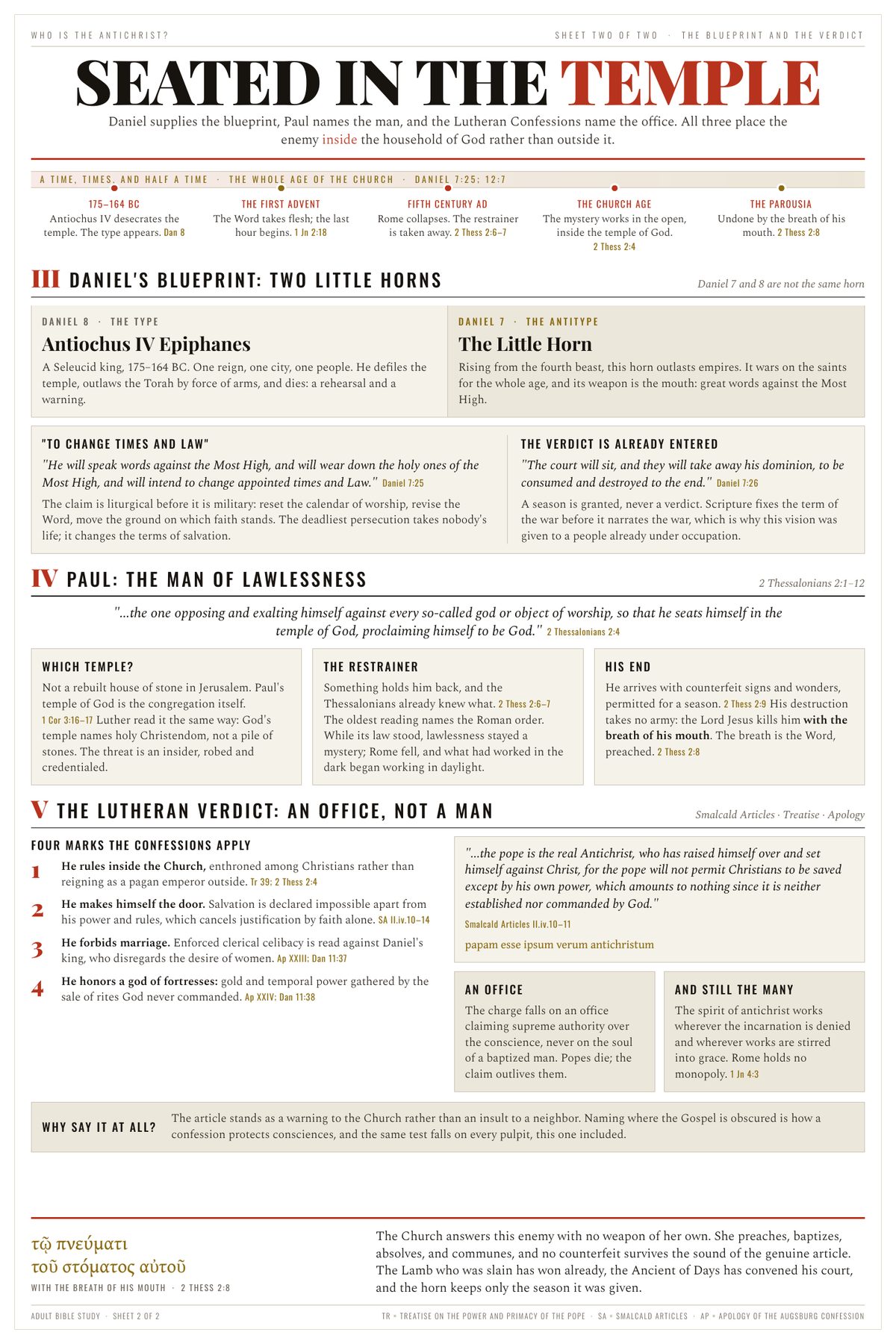
Daniel supplies the blueprint, Paul names the man, and the Lutheran Confessions name the office. All three place the enemy inside the household of God rather than outside it.
A time, times, and half a time The whole age of the Church · Daniel 7:25; 12:7
IIIDaniel’s blueprint: two little horns Daniel 7 and 8 are not the same horn
Antiochus IV Epiphanes
A Seleucid king, 175–164 BC. One reign, one city, one people. He defiles the temple, outlaws the Torah by force of arms, and dies: a rehearsal and a warning.
The Little Horn
Rising from the fourth beast, this horn outlasts empires. It wars on the saints for the whole age, and its weapon is the mouth: great words against the Most High.
“He will speak words against the Most High, and will wear down the holy ones of the Most High, and will intend to change appointed times and Law.” Daniel 7:25
The claim is liturgical before it is military: reset the calendar of worship, revise the Word, move the ground on which faith stands. The deadliest persecution takes nobody’s life; it changes the terms of salvation.
“The court will sit, and they will take away his dominion, to be consumed and destroyed to the end.” Daniel 7:26
A season is granted, never a verdict. Scripture fixes the term of the war before it narrates the war, which is why this vision was given to a people already under occupation.
IVPaul: the man of lawlessness 2 Thessalonians 2:1–12
“…the one opposing and exalting himself against every so-called god or object of worship, so that he seats himself in the temple of God, proclaiming himself to be God.”2 Thessalonians 2:4
Which temple?
Not a rebuilt house of stone in Jerusalem. Paul’s temple of God is the congregation itself. 1 Cor 3:16–17 Luther read it the same way: God’s temple names holy Christendom, not a pile of stones. The threat is an insider, robed and credentialed.
The restrainer
Something holds him back, and the Thessalonians already knew what. 2 Thess 2:6–7 The oldest reading names the Roman order. While its law stood, lawlessness stayed a mystery; Rome fell, and what had worked in the dark began working in daylight.
His end
He arrives with counterfeit signs and wonders, permitted for a season. 2 Thess 2:9 His destruction takes no army: the Lord Jesus kills him with the breath of his mouth. The breath is the Word, preached. 2 Thess 2:8
VThe Lutheran verdict: an office, not a man Smalcald Articles · Treatise · Apology
Four marks the Confessions apply
- 1He rules inside the Church, enthroned among Christians rather than reigning as a pagan emperor outside. Tr 39; 2 Thess 2:4
- 2He makes himself the door. Salvation is declared impossible apart from his power and rules, which cancels justification by faith alone. SA II.iv.10–14
- 3He forbids marriage. Enforced clerical celibacy is read against Daniel’s king, who disregards the desire of women. Ap XXIII; Dan 11:37
- 4He honors a god of fortresses: gold and temporal power gathered by the sale of rites God never commanded. Ap XXIV; Dan 11:38
“…the pope is the real Antichrist, who has raised himself over and set himself against Christ, for the pope will not permit Christians to be saved except by his own power, which amounts to nothing since it is neither established nor commanded by God.”Smalcald Articles II.iv.10–11
papam esse ipsum verum antichristum
The charge falls on an office claiming supreme authority over the conscience, never on the soul of a baptized man. Popes die; the claim outlives them.
The spirit of antichrist works wherever the incarnation is denied and wherever works are stirred into grace. Rome holds no monopoly. 1 Jn 4:3
The Church answers this enemy with no weapon of her own. She preaches, baptizes, absolves, and communes, and no counterfeit survives the sound of the genuine article. The Lamb who was slain has won already, the Ancient of Days has convened His court, and the horn keeps only the season it was given.
Tr = Treatise on the Power and Primacy of the Pope · SA = Smalcald Articles · Ap = Apology of the Augsburg Confession