Week one of five
Sola Scriptura
Scripture Alone
2 Timothy 3:14–17 · 2 Peter 1:19–21 · Psalm 119:105–112 · John 10:27–30 · Formula of Concord, Epitome, “Summary, Rule, and Norm” (§1–8)
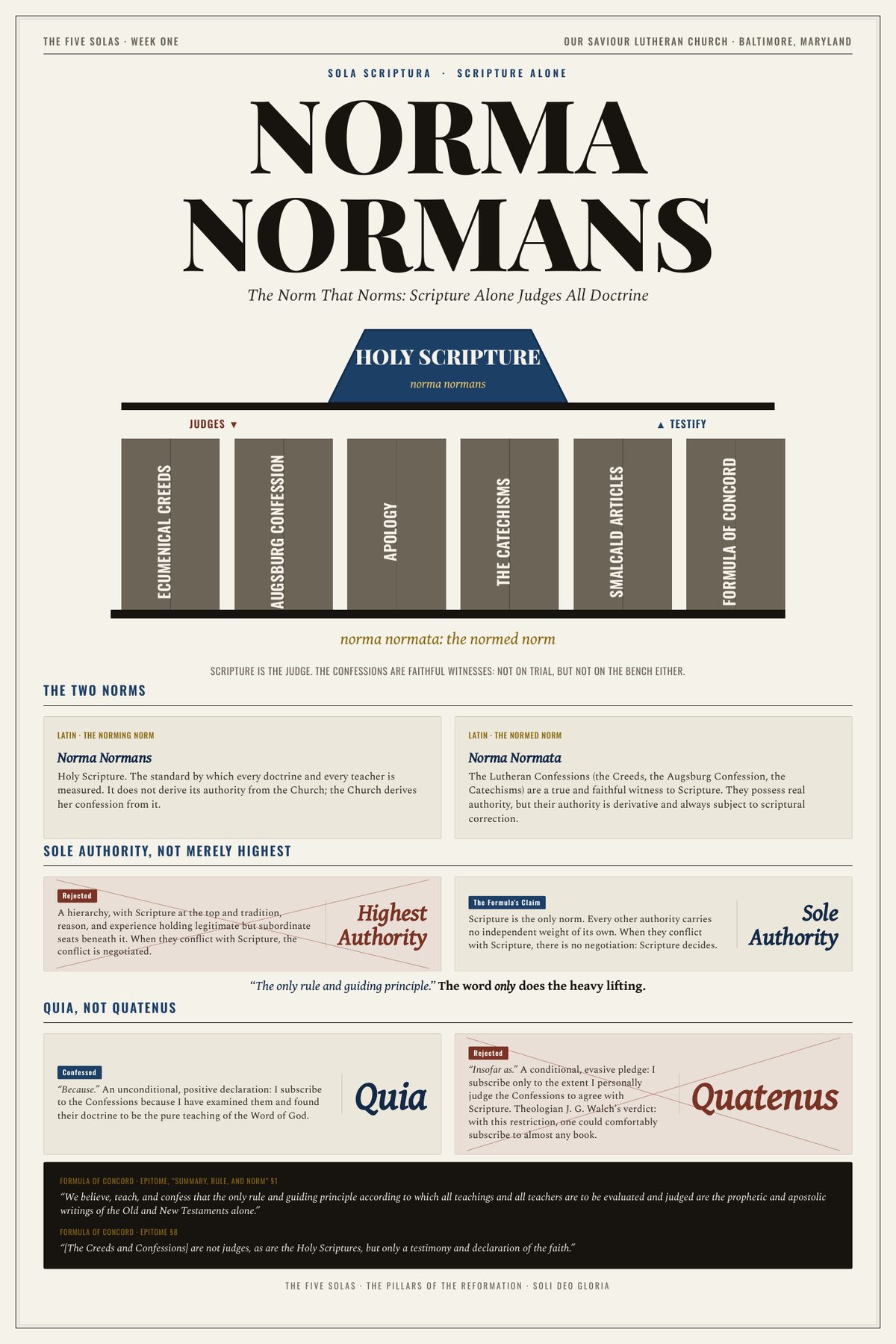
This week’s poster: Norma Normans
The whole session on one page, printed at 24 by 36 inches for the classroom. Open it on screen or download it to print.
How this session works
Every doctrine stands or falls on a prior question: by what authority? This first session of Reclaiming the Solas traces sola Scriptura through four biblical texts and one Confessional reading: the divine origin and sufficiency of Scripture (2 Timothy 3), the prophetic Word’s authority over experience (2 Peter 1), the devotional posture toward the Word (Psalm 119), the voice of the Good Shepherd (John 10), and the Formula of Concord’s definitive statement that Scripture alone is the rule and norm of all doctrine.
Opening Prayer
Almighty God, You have spoken through the prophets and apostles and breathed out Your holy Word for our instruction and salvation. Open our hearts by Your Spirit to receive that Word with faith, that we may know it as the sole authority for all we believe, teach, and confess. Through Jesus Christ, Your Son, our Lord, who lives and reigns with You and the Holy Spirit, one God, now and forever. Amen.
Opening and Framing
The Question of Authority
Every doctrine stands or falls on a prior question: by what authority? The Reformation did not begin with a debate about grace, faith, or merit. It began with a debate about authority. When Martin Luther stood at the Leipzig Debate in 1519, the question pressed upon him was whether a single friar had the right to appeal to Scripture against the combined weight of papal decrees, conciliar pronouncements, and centuries of tradition. His answer was the oldest answer in the Christian Church: the Scriptures of the Old and New Testaments, breathed out by the Holy Spirit, possess an authority that no pope, council, or tradition can override.
Discussion Question — The Central Question
Where do we go to hear God’s voice? What is the final authority for what we believe, teach, and confess? And how does that authority function in the life of the Church?
Question 1
The Reformation is often presented as a debate about indulgences or papal abuses, yet Luther himself said the heart of every dispute was the question of authority. In your experience, where do most disagreements among Christians ultimately come down? Is it usually a disagreement about what the Bible says, or a disagreement about whether the Bible has the final word?
Question 2
Luther did not reject tradition wholesale; he rejected the claim that tradition could override Scripture. What traditions do you value in your own congregation? How would you distinguish between a tradition that serves the Gospel and a tradition that has begun to rival it?
Framing Statement
This session will trace the doctrine of Sola Scriptura through four biblical texts and one Confessional reading: the divine origin and sufficiency of Scripture (2 Timothy 3), the prophetic Word’s authority over experience (2 Peter 1), the devotional posture toward the Word (Psalm 119), the voice of the Good Shepherd (John 10), and the Formula of Concord’s definitive statement that Scripture alone is the rule and norm of all doctrine.
Key Vocabulary
Sola Scriptura (Latin): “Scripture alone.” The doctrine that the prophetic and apostolic Scriptures of the Old and New Testaments are the sole source and norm of all Christian doctrine, the final judge before which all teaching must stand.
Theopneustos (θεóπνευστος, Greek): “God-breathed.” Paul’s term in 2 Timothy 3:16 for the origin of Scripture. The Scriptures proceed from God Himself, carried along by the breath (Spirit) of God.
Norma Normans (Latin): “The norm that norms.” Holy Scripture: the standard by which all other authorities are measured. It does not derive its authority from the Church; the Church derives her confession from it.
Norma Normata (Latin): “The normed norm.” The Lutheran Confessions: they possess genuine authority as a faithful exposition of Scripture, yet their authority is derivative and always subject to scriptural correction.
Pheromenoi (φερóμενοι, Greek): “Being carried along.” Peter’s term in 2 Peter 1:21 for how the Holy Spirit directed the human authors. The image is of a sailing vessel carried by the wind.
Autopistia (Greek): “Self-authenticating.” Scripture’s authority does not depend on the Church’s recognition. Scripture is authoritative because of what it is (the Word of God), not because of who certifies it.
Part One: The Divine Origin of Scripture, 2 Timothy 3:14–17
Paul anchors Timothy in the God-breathed Word. The Scriptures do not merely contain God’s message; they are His living breath, sufficient to equip the man of God for every good work.
✛ Read 2 Timothy 3:14–17 aloud.
2 Timothy 3:14–17 (ESV)
But as for you, continue in what you have learned and have firmly believed, knowing from whom you learned it and how from childhood you have been acquainted with the sacred writings, which are able to make you wise for salvation through faith in Christ Jesus. All Scripture is breathed out by God and profitable for teaching, for reproof, for correction, and for training in righteousness, that the man of God may be complete, equipped for every good work.
Key Greek Terms
Theopneustos (θεóπνευστος): “God-breathed.” This compound word does not describe the experience of the human authors (as though they were “inspired” the way a poet is inspired). It describes the origin of the text itself. In biblical theology, breath is synonymous with life and spirit (Genesis 2:7; Psalm 33:6). The words of Scripture are the very breath of the living God.
Artios (αρτιος): “Complete” or “fully fitted,” lacking nothing essential. If Scripture equips the man of God for every good work, then no additional revelation is required. This is an argument from sufficiency, not from silence.
Paideia (παιδεια): “Training” or “childhood discipline.” The word for “training in righteousness” carries the nuance of a father’s instruction. Through the Word, God trains His children in holy living.
Paul writes from prison, facing the end of his life. False teachers are active. Timothy is young and the temptation to compromise is real. Into this setting Paul delivers the most concentrated statement on the nature of Scripture in the New Testament. His argument rests on one word: theopneustos. Scripture is God-breathed. It originates not in human religious genius but in the creative, life-giving activity of the Holy Spirit.
Question 3
Paul says “all Scripture is breathed out by God” (theopneustos). This word describes the origin of the text, not the experience of the human authors. What is the difference between saying “the biblical writers were inspired” and saying “the Scriptures are God-breathed”? Why does the distinction matter for how we treat the authority of the text?
Question 4
Paul claims Scripture is profitable for four specific tasks: teaching, reproof, correction, and training in righteousness. These form a comprehensive pattern: teaching establishes what is true, reproof identifies what is false, correction restores what has gone wrong, and training (paideia) forms what is to be lived. Which of these four is most neglected in the contemporary Church? Which is most uncomfortable? Why?
Question 5
Verse 17 says the purpose of God-breathed Scripture is “that the man of God may be complete” (artios), equipped for every good work. If Scripture equips for every good work, what does that imply about the sufficiency of Scripture? Is there any dimension of the Church’s faith or life for which additional revelation is needed?
Question 6
Paul tells Timothy to “continue in what you have learned,” grounding his confidence in the sacred writings he has known since childhood. In a culture saturated with competing authorities — scientific consensus, political ideologies, personal experience, social media — what does it look like practically to treat Scripture as the final authority rather than one voice among many? Where are Christians most tempted to grant a rival authority equal standing with the Word of God?
Part Two: The Prophetic Word Confirmed, 2 Peter 1:19–21
Peter subordinates his own eyewitness experience of the Transfiguration to the written prophetic Word. If an apostle’s direct encounter with the voice of God from heaven is not the highest authority, nothing else can claim to be.
✛ Read 2 Peter 1:16–21 aloud.
2 Peter 1:19–21 (ESV)
And we have the prophetic word more fully confirmed, to which you will do well to pay attention as to a lamp shining in a dark place, until the day dawns and the morning star rises in your hearts, knowing this first of all, that no prophecy of Scripture comes from someone’s own interpretation. For no prophecy was ever produced by the will of man, but men spoke from God as they were carried along by the Holy Spirit.
Key Greek Terms
Bebaioteron (βεβαιóτερον): “More fully confirmed” or “exceedingly certain.” Though technically a comparative, in Koine Greek this frequently functions as an elative — an intensified absolute. The prophetic Word is absolutely certain.
Epilusis (επíλυσις): “Interpretation” or “explanation.” A New Testament hapax legomenon (appearing only here). Peter is asserting that the prophets did not invent or spin their own ideas; the message did not originate from the prophet’s own mind. This verse is about the origin of Scripture, not a prohibition on reading it.
Pheromenoi (φερóμενοι): “Being carried along.” The image is of a sailing vessel carried by the wind. Peter uses the verb pherō four times in vv. 17–21: twice for God’s voice being “conveyed” at the Transfiguration, and twice for how prophecy was “uttered” and the authors were “moved.” The same divine action that brought the Father’s audible voice to the mountain brings the Spirit’s written voice to the page.
Peter has just recounted the Transfiguration (vv. 16–18), where he personally heard the Father’s voice from heaven. Yet he calls the written prophetic Word “more fully confirmed” than even this experience. The eyewitness testimony of an apostle who stood on the holy mountain is not the highest authority; the written Word is.
Question 7
Peter had an extraordinary experience: he heard God the Father speak audibly from heaven at the Transfiguration. Yet he calls the written prophetic Word “more fully confirmed” (bebaioteron) than his own experience. What does this tell us about the relationship between personal spiritual experience and Scripture? How does this passage address the claim that a direct sense of God’s leading can override or supplement what Scripture teaches?
Question 8
Peter says the prophets were “carried along” (pheromenoi) by the Holy Spirit, like a sailing vessel moved by the wind. How does this image protect against two opposite errors: mechanical dictation (the human authors were passive instruments with no individual characteristics) and mere human insight (the authors were religious geniuses who wrote their own reflections)?
Question 9
Verse 20 says “no prophecy of Scripture comes from someone’s own interpretation” (epilusis). This is often misread as a prohibition on individual Bible reading. The context, however, is about the origin of Scripture, not its interpretation by readers. Why is it important to get this distinction right? What are the consequences of misreading this verse as a ban on personal engagement with the text?
Question 10
Peter describes the Word as “a lamp shining in a dark place” (cf. Psalm 119:105). The world is described as a murky, gloomy existence where human reason and worldly sources offer no real guidance. Where do you see this darkness most acutely in our own time? What “dark places” in your own life does the lamp of Scripture illumine?
Part Three: The Devotional Posture, Psalm 119:105–112
If Paul and Peter establish the authority of Scripture on doctrinal grounds, the psalmist reveals the proper posture toward it: not grudging submission, but joy, delight, and heritage. Martin Luther derived his three rules for studying theology — Oratio (prayer), Meditatio (meditation), and Tentatio (spiritual affliction) — directly from the pattern of Psalm 119.
✛ Read Psalm 119:105–112 aloud.
Psalm 119:105–112 (ESV)
Your word is a lamp to my feet and a light to my path. I have sworn an oath and confirmed it, to keep your righteous rules. I am severely afflicted; give me life, O LORD, according to your word! Accept my freewill offerings of praise, O LORD, and teach me your rules. I hold my life in my hand continually, but I do not forget your law. The wicked have laid a snare for me, but I do not stray from your precepts. Your testimonies are my heritage forever, for they are the joy of my heart. I incline my heart to perform your statutes forever, to the end.
Key Hebrew Terms
Torah (תוֹרָה): While often translated rigidly as “Law,” Torah more comprehensively means “teaching” or “instruction.” It encompasses both God’s commands and His saving promises. The psalmist’s synonyms — word, law, testimonies, precepts, statutes — all circle this concept.
Zēson me (ζ˜σóν με, LXX Greek): “Make me alive!” The psalmist’s cry in v. 107. The Scriptures do not merely convey historical information; they actively bestow and sustain life, reviving the soul when it faces death.
Nachalah (נַחֲלָה): “Heritage” or “inheritance.” In ancient Israel, the nachalah was the most precious possession a family could receive — the land given by God Himself. The psalmist treats God’s Word as his permanent, joy-giving inheritance (v. 111).
The psalmist does not treat the Word as an academic textbook or a legal code to be endured. He treats it as a lamp in darkness (v. 105), a source of life in affliction (v. 107), and the joy of his heart (v. 111). Luther emphasized from this psalm that “God will not give you his Spirit without the external Word.” The Holy Spirit binds Himself to the written and spoken Scriptures.
Question 11
The psalmist calls God’s testimonies “my heritage (nachalah) forever” and “the joy of my heart” (v. 111). In ancient Israel, the nachalah was the most precious thing a family possessed. In your own experience, is Scripture more often experienced as duty or as delight? What practices or habits have helped you (or might help you) to move from the former toward the latter?
Question 12
The psalmist is “severely afflicted” (v. 107), surrounded by deadly snares (v. 110), holding his life in his hands (v. 109). Luther called this experience Tentatio (Anfechtung — deep spiritual attack) and said it is “the touchstone which teaches you not only to know and understand, but also to experience how right, how true, how mighty, how comforting God’s Word is.” How does suffering or affliction drive a person deeper into Scripture? Have you experienced this?
Question 13
In verse 108, the psalmist prays: “Accept my freewill offerings of praise, O LORD, and teach me your rules.” Luther identified this as Oratio (prayer) — the recognition that the Bible is a divine book that cannot be mastered by sheer human intellect. The psalmist must ask God to be his teacher. How does this posture of prayer protect us from reading Scripture arrogantly, as though we were the masters of the text rather than its students?
Question 14
Verse 105 says the Word is “a lamp to my feet.” A lamp implies darkness. The psalmist acknowledges that human beings are born into spiritual darkness and lack innate spiritual wisdom — we must look outward to the external Word of God rather than inward to our own hearts and feelings. Where are Christians today most tempted to look inward for truth rather than outward to the objective Word?
Part Four: My Sheep Hear My Voice, John 10:27–30
Jesus declares that the defining mark of the true Church is hearing the Shepherd’s voice. The question for Sola Scriptura: where is that voice heard today?
✛ Read John 10:27–30 aloud.
John 10:27–30 (ESV)
My sheep hear my voice, and I know them, and they follow me. I give them eternal life, and they will never perish, and no one will snatch them out of my hand. My Father, who has given them to me, is greater than all, and no one is able to snatch them out of the Father’s hand. I and the Father are one.
Key Greek Terms
Akouousin (ακούουσιν): “They hear.” A neuter plural subject (probata, “sheep”) normally takes a singular verb in Greek, yet Jesus uses the plural, emphasizing that each sheep must hear the Shepherd’s voice individually. In John’s Gospel, to “hear” means to receive with faith and obedience.
Ou mē apolōntai (ού μή ἀπόλωνται): “They will never perish.” The double negative (ou mē) with an aorist subjunctive is the strongest possible negation in biblical Greek. It rules out even the possibility of perishing. This is an absolute, undeniable guarantee.
Hen (ἕν): “One” (neuter singular). Jesus says “I and the Father are one (hen)” — one in essence, not one person. If Jesus had used the masculine heis, He would have been teaching Modalism. The neuter declares two distinct persons sharing one divine substance.
The Reformers consistently identified the voice of the Good Shepherd with the external, written, preached Word of Holy Scripture. Jesus Himself makes this connection: “You search the Scriptures because you think that in them you have eternal life; and it is they that bear witness about me” (John 5:39). The sheep are not guided by the “voice of strangers” (John 10:5) — human traditions, earthly philosophies, or unbiblical institutional decrees.
Question 15
Jesus says “My sheep hear my voice” (akouousin). The Reformers insisted that Christ’s voice is heard in the written and preached Word. How does this claim challenge both the Roman Catholic identification of Church tradition as an equal authority alongside Scripture and the Protestant tendency to locate Christ’s voice in personal subjective experience? Where, concretely, do you hear the voice of the Good Shepherd in your weekly life?
Question 16
Jesus promises that His sheep “will never perish” (ou mē apolōntai) — the strongest possible negation in Greek, ruling out even the possibility. Sola Scriptura demands that our assurance of salvation rests on the objective promises of God’s Word, not on fluctuating feelings. How does this absolute grammatical guarantee strengthen your confidence in the written promises of Scripture?
Question 17
Verse 30 declares: “I and the Father are one (hen).” The neuter hen (“one thing/essence”) rather than the masculine heis (“one person”) is one of the most precise Trinitarian statements in the Bible. Why does it matter for Sola Scriptura that the voice of Jesus is the voice of God Himself? If the Shepherd who speaks in Scripture is very God of very God, what does that say about the weight of the biblical text?
Question 18
If additional authorities are placed alongside Scripture — papal decrees, personal revelations, cultural consensus, or even the collective decisions of a church body — then the sheep have multiple voices to sort out, and the clarity of the Shepherd’s call is compromised. Where do you see this confusion of voices at work today? How does Sola Scriptura protect the clarity of the Gospel?
Part Five: The Confessional Witness, Formula of Concord, Epitome, §1–8
The Formula of Concord begins where every doctrinal discussion must begin: by establishing the rule and norm by which everything else is to be judged. Without a shared authority, there is no basis for resolving any disagreement.
✛ Open your Book of Concord to the Formula of Concord, Epitome, “Summary, Rule, and Norm,” paragraphs 1 through 8. Read §1–8 aloud.
Formula of Concord, Epitome, Summary §1
We believe, teach, and confess that the only rule and guiding principle according to which all teachings and all teachers are to be evaluated and judged are the prophetic and apostolic writings of the Old and New Testaments alone.
Key Latin Terms
Norma normans: “The norming norm” or “the rule that rules.” Holy Scripture. The Bible is the sole judge, rule, and standard by which all dogmas must be discerned. It does not derive its authority from the Church; the Church derives her confession from it.
Norma normata: “The normed norm” or “the rule that is ruled.” The Confessional writings (Augsburg Confession, Catechisms, etc.). They hold authority only because they faithfully expound what Scripture teaches. They are not Scripture; they are a true witness to Scripture.
Quia (Latin): “Because.” The Lutheran standard for confessional subscription: we subscribe to the Confessions because they agree with Scripture. The subscriber has already recognized the Confessions to be the pure teaching of the Word of God.
Quatenus (Latin): “Insofar as.” The rejected alternative: subscribing to the Confessions only to the extent one personally judges them to agree with Scripture. As theologian J. G. Walch observed, with this restriction one could comfortably subscribe to almost any book.
The opening sentence of the Formula establishes the hermeneutical ground rules before any doctrine is addressed. The operative word is “alone.” The Confessions are then placed under Scripture as faithful witnesses to its teaching — a real yet derivative authority. This distinction protects the Church from two opposite errors: dismissing the Confessions as irrelevant human opinions (leaving each individual to interpret Scripture in isolation) and elevating the Confessions to the level of Scripture itself.
Question 19
The Formula calls Scripture the “only rule and guiding principle” (§1). What is the practical difference between saying Scripture is the “highest” authority and saying it is the “sole” authority?
Question 20
The distinction between norma normans (the norming norm, Scripture) and norma normata (the normed norm, the Confessions) is critical. If a Lutheran discovers an apparent tension between a passage of Scripture and a statement in the Book of Concord, what is the proper procedure? What would it mean if the Confessions were treated as a norma normans?
Question 21
The Formula accepts the Augsburg Confession “not because it was composed by our theologians, but because (quia) it has been derived from God’s Word.” What is the practical difference between a quia subscription (“because” the Confessions agree with Scripture) and a quatenus subscription (“insofar as” they agree)? Why does the orthodox Lutheran Church reject the quatenus pledge?
Question 22
If Scripture alone is the norm of doctrine, then no pastor, bishop, synodical president, or church body has the authority to require what Scripture does not require or to forbid what Scripture does not forbid in matters of conscience. The authority of the Church is ministerial (under the Word), not magisterial (over the Word). Luther argued at Leipzig that church councils can err and have erred. If councils and popes can err, how does the Church resolve doctrinal disputes? What safeguards prevent this from becoming merely “my interpretation versus yours”?
Synthesis and Closing
Summary: The Living Voice of God
| Text | Contribution to Sola Scriptura | Key Term |
|---|---|---|
| 2 Timothy 3:14–17 | Divine origin and sufficiency; equips for every good work | Theopneustos (God-breathed) |
| 2 Peter 1:19–21 | Experience subordinated to the written Word; Spirit carried the authors | Pheromenoi (carried along) |
| Psalm 119:105–112 | Devotional posture: lamp, heritage, joy; Oratio, Meditatio, Tentatio | Torah; Nachalah |
| John 10:27–30 | The Shepherd’s voice heard in the external Word; absolute promise | Akouousin; Hen |
| FC Ep §1–8 | Scripture as sole rule and norm; norma normans vs. norma normata | Quia vs. Quatenus |
Final Discussion
Read John 10:27 one more time.
Question 23
Sola Scriptura is often misunderstood as radical individualism (“me and my Bible alone”). The Reformers valued the Confessions, the creeds, and the pastoral office. How do we hold together the sole authority of Scripture with the genuine (if derivative) authority of the Church’s confession? What is the difference between a church that submits to Scripture and a church in which every individual claims the right to interpret Scripture apart from the community of faith?
Question 24
We have traced Sola Scriptura through its divine origin (2 Timothy 3), its authority over experience (2 Peter 1), its devotional claim on the heart (Psalm 119), the voice of the Shepherd (John 10), and the Confessional articulation (Formula of Concord). If you had to explain Sola Scriptura in one sentence to someone who had never heard of it, what would you say?
Question 25
As we close this first session and prepare for Sola Gratia next week, consider: if the Scriptures are truly God-breathed, truly sufficient, truly the lamp in our darkness and the joy of our hearts, what is one concrete way you could take Sola Scriptura more seriously in your own devotional life, your family’s life, or your congregation’s life this week?
Appendix — Liturgical, Lectionary, and Hymnic Connections
Where these texts appear in the life of the Church.
2 Timothy 3:14–17
This is the appointed Epistle reading for Proper 24 in Series C of the Three-Year Lectionary. The Formula of Concord explicitly cites 2 Timothy 3:15–17 to confess that the prophetic and apostolic Scriptures are the sole rule and norm of doctrine.
2 Peter 1:19–21
This is the appointed Epistle reading for the Feast of the Transfiguration in Series A. Peter’s eyewitness account of Christ’s glory on the mountain pivots to the “more sure” prophetic Word inspired by the Holy Spirit.
Psalm 119:105
This is used as the appointed antiphon for the Introit on the Sixth Sunday of Easter (Series A) and Proper 11 (Series C). During Evening Prayer, the “Thanksgiving for Light” couples the petition for God’s light with Psalm 119:105.
John 10:27–30
This text is connected to the pastoral mandate in the Formula of Concord: faithful pastors preach the Scriptures so that the sheep may “flee from strange voices (John 10:5) and separate the precious from the worthless.”
Hymn selections
LSB 578 — Thy Strong Word
Martin Franzmann’s hymn celebrates the creative, life-giving power of God’s Word. The opening stanza echoes Psalm 119:105 and Paul’s teaching that the God-breathed Scriptures bring life out of darkness.
LSB 585 — Lord Jesus Christ, with Us Abide
This Reformation-era hymn prays for the preservation of God’s Word against false teaching, directly reflecting the Formula of Concord’s concern for the sole authority of the prophetic and apostolic Scriptures.
LSB 523 — O Word of God Incarnate
William Walsham How pictures the incarnate Christ as the path-illuminating lamp of Psalm 119:105: a “lantern to our footsteps” shining “through the darkness of our earthly way.”
LSB 973 — Thy Word Is a Lamp
The refrain directly quotes Psalm 119:105 and expresses the Christian’s trust that God’s Word guides the path of faith.
LSB 656 — A Mighty Fortress Is Our God
Luther’s great Reformation hymn, appointed for Reformation Sunday. The final stanza confesses: “The Word they still shall let remain” — the indestructibility and sufficiency of Scripture against every foe.
Closing Prayer
Lord God, heavenly Father, we thank You that You have not left us to grope in the darkness of our own reason but have given us the pure, clear fountain of Your prophetic and apostolic Word. Grant us faithfulness to hear the voice of our Good Shepherd in these Scriptures, courage to submit all teaching to their judgment, and joy to treasure them as our heritage forever. Through Jesus Christ, our Lord. Amen.
Soli Deo Gloria