Reclaiming the Solas
The Grammar of the Gospel, Confessed at Augsburg
The solas were not a checklist invented by the Reformers. They are the grammar of the Gospel itself, and each one answers a specific question about how sinners are reconciled to a holy God: by what authority, from what source, through what means, on what ground, and to whose glory.
Five Sundays through Scripture and the Lutheran Confessions, ending on Reformation Sunday.
Scripture alone, grace alone, faith alone, Christ alone, and to God alone the glory.
The five sessions
 View poster
Session one · Sunday, October 4
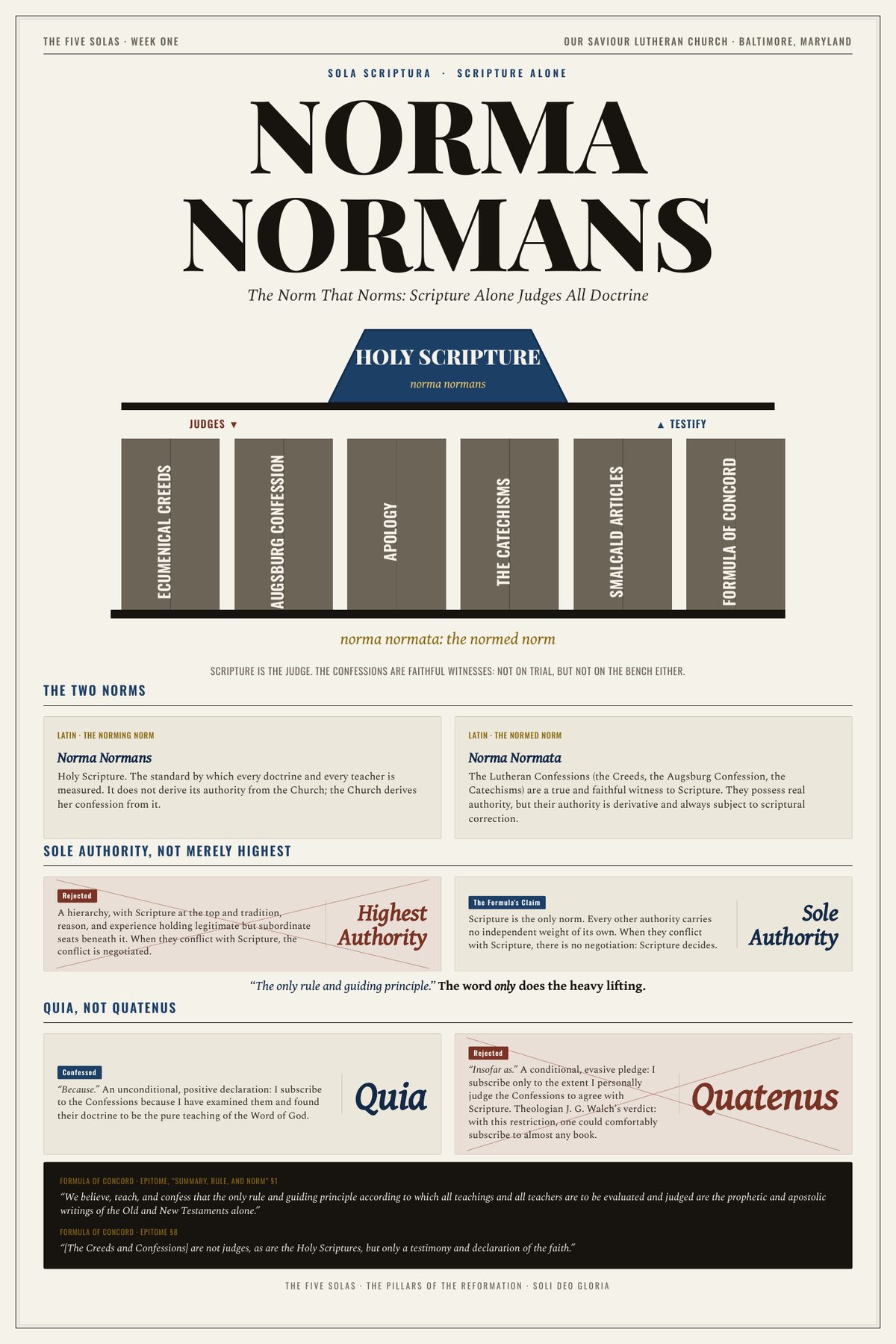
Sola Scriptura
Scripture Alone · Norma Normans
2 Timothy 3:14–17 · 2 Peter 1:19–21 · Psalm 119:105–112 · John 10:27–30 · Formula of Concord, Epitome, Rule and Norm
Where do we go to hear God’s voice, and what is the final authority for what we believe, teach, and confess? The class reads 2 Timothy 3, 2 Peter 1, Psalm 119, and John 10, then the opening of the Formula of Concord. Sola Scriptura does not mean “me and my Bible alone.” It means Scripture is the sole source and norm before which all teaching must stand.
The norm that norms: Scripture alone judges all doctrine.
 View poster
Session two · Sunday, October 11
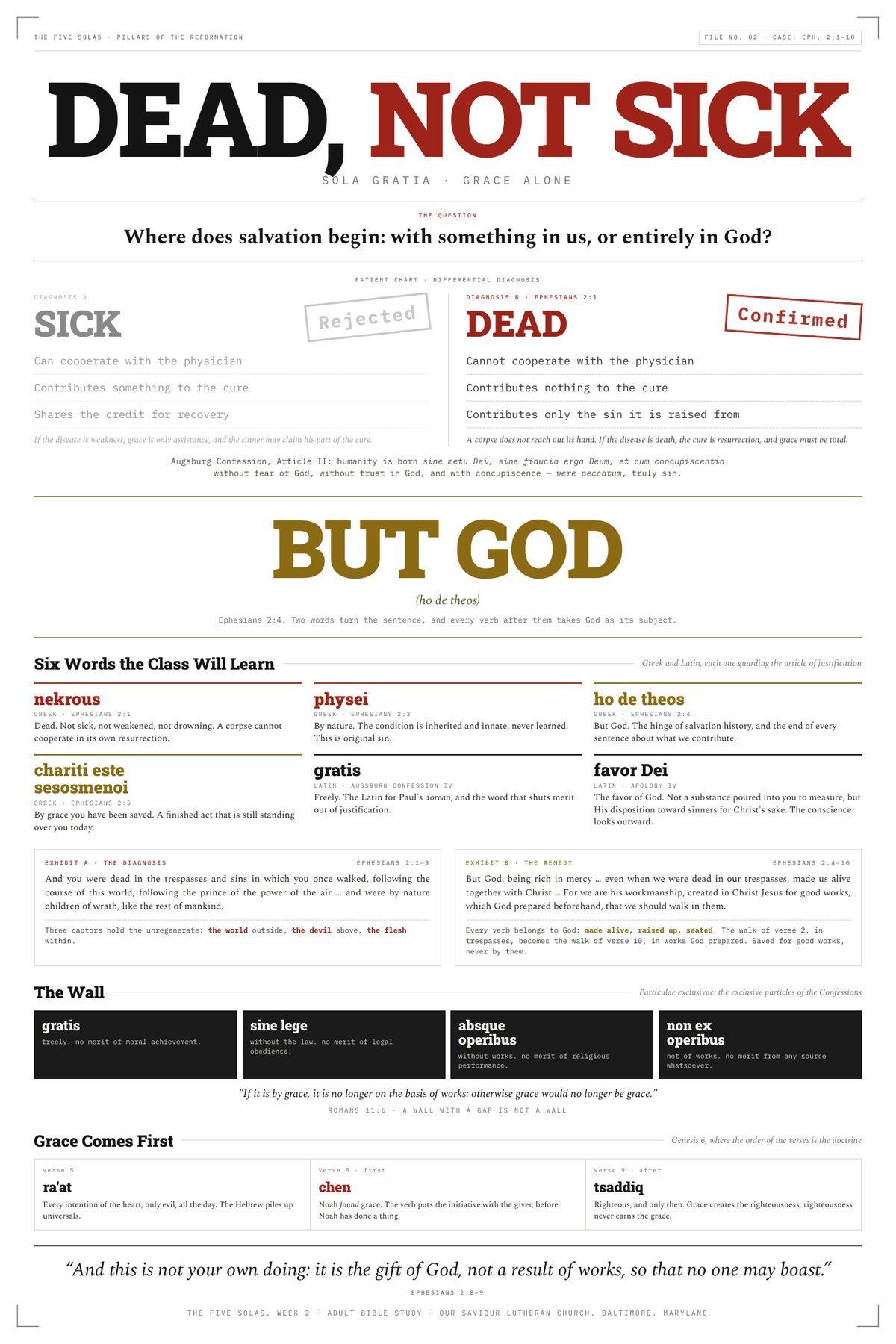
Sola Gratia
Grace Alone · Dead, Not Sick
Ephesians 2:1–10 · Romans 3:21–28 · Romans 11:5–6 · Genesis 6:5–8 · Augsburg Confession II and IV
What moves God to save sinners, and does salvation begin with something in us or entirely in Him? Ephesians 2, Romans 3 and 11, and Genesis 6 are read against Augsburg Confession II and IV, the Solid Declaration on free will, and the Apology. The class confronts the bondage of the will directly rather than softening it.
A sick man can cooperate with the physician. A dead man contributes nothing to the cure. “But God, being rich in mercy…”
 View poster
Session three · Sunday, October 18
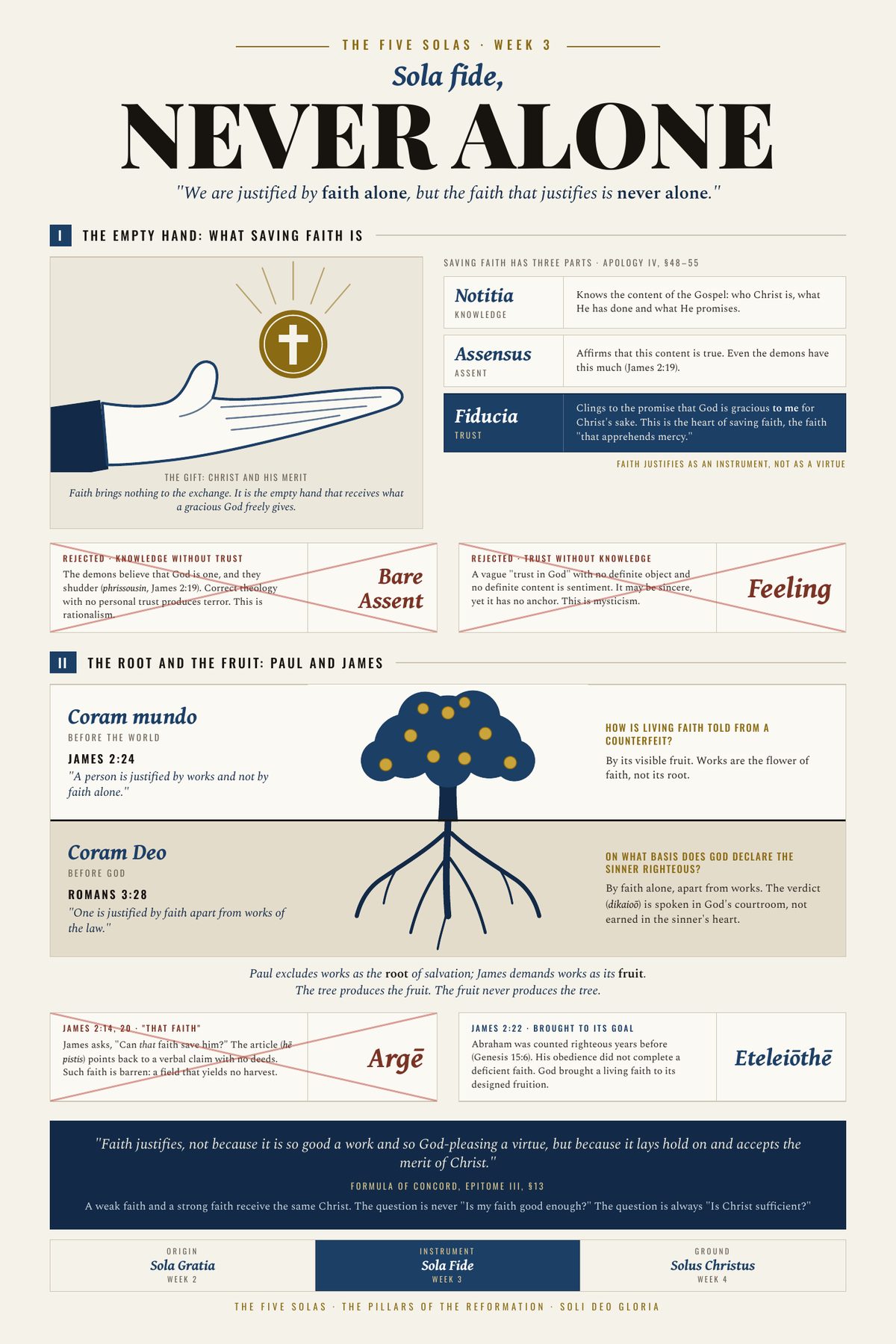
Sola Fide
Faith Alone · Never Alone
Romans 3:28 · Romans 4:1–8 · Galatians 2:15–21 · James 2:14–26 · John 3:14–18 · Augsburg Confession IV and VI
How do sinners receive what God gives, and what is the instrument through which the benefits of Christ’s work become ours? Romans 3 and 4, Galatians 2, and John 3 are set beside James 2, and the apparent conflict is worked through with Augsburg Confession IV and VI and the Apology. Justification and new obedience are distinguished without being separated.
We are justified by faith alone, but the faith that justifies is never alone.
 View poster
Session four · Sunday, October 25
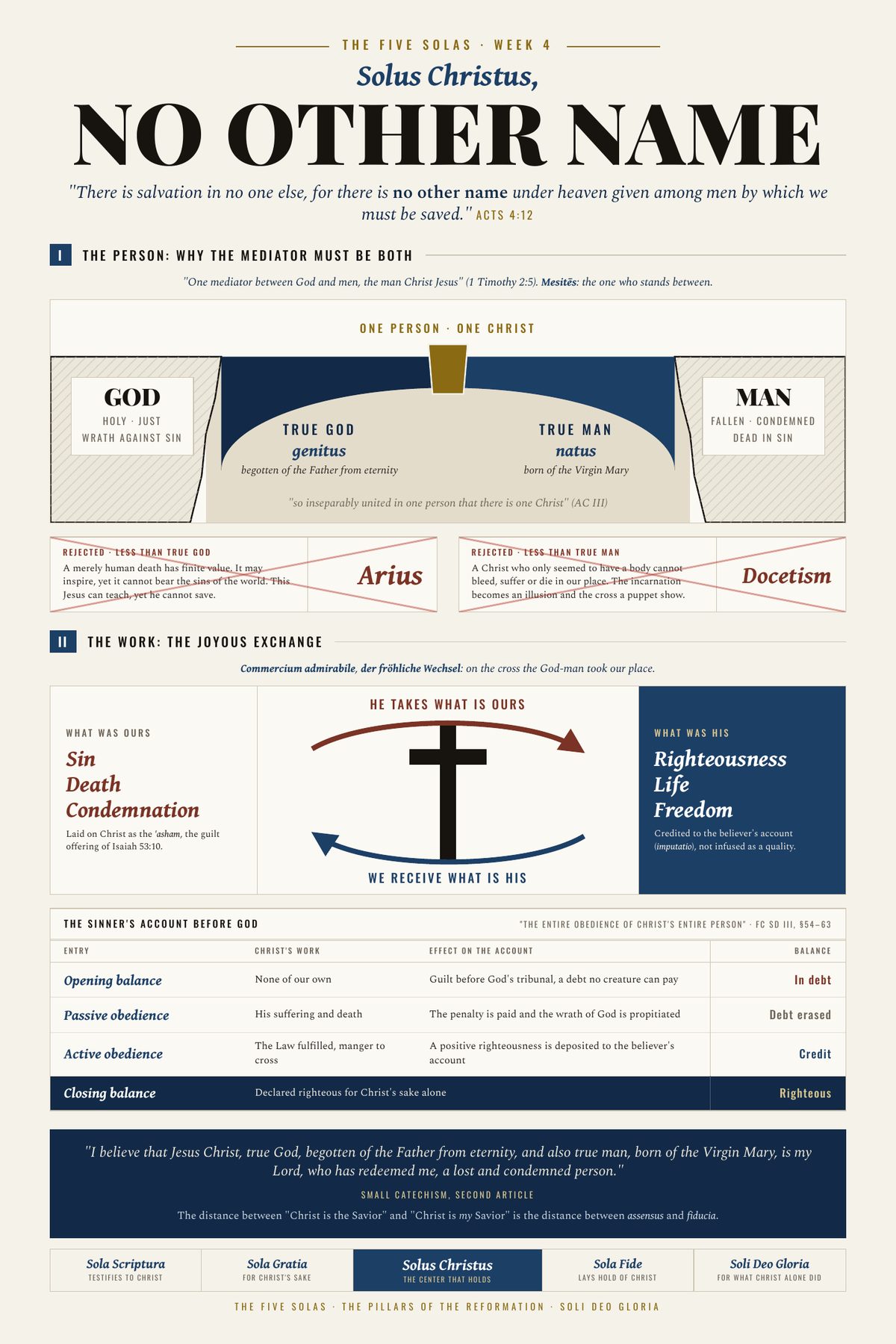
Solus Christus
Christ Alone · No Other Name
Acts 4:8–12 · 1 Timothy 2:5–6 · Colossians 1:15–20 · Hebrews 7:23–27 · John 14:6 · Augsburg Confession III
On what basis does God declare sinners righteous, and whose merit avails before Him? Acts 4, 1 Timothy 2, Colossians 1, Hebrews 7, and John 14 are read with Augsburg Confession III and the Solid Declaration on the person of Christ. The exclusivity of the one Mediator is the burden of the session.
“There is salvation in no one else, for there is no other name under heaven given among men by which we must be saved.” (Acts 4:12)
 View poster
Session five · Sunday, November 1 · Reformation Sunday
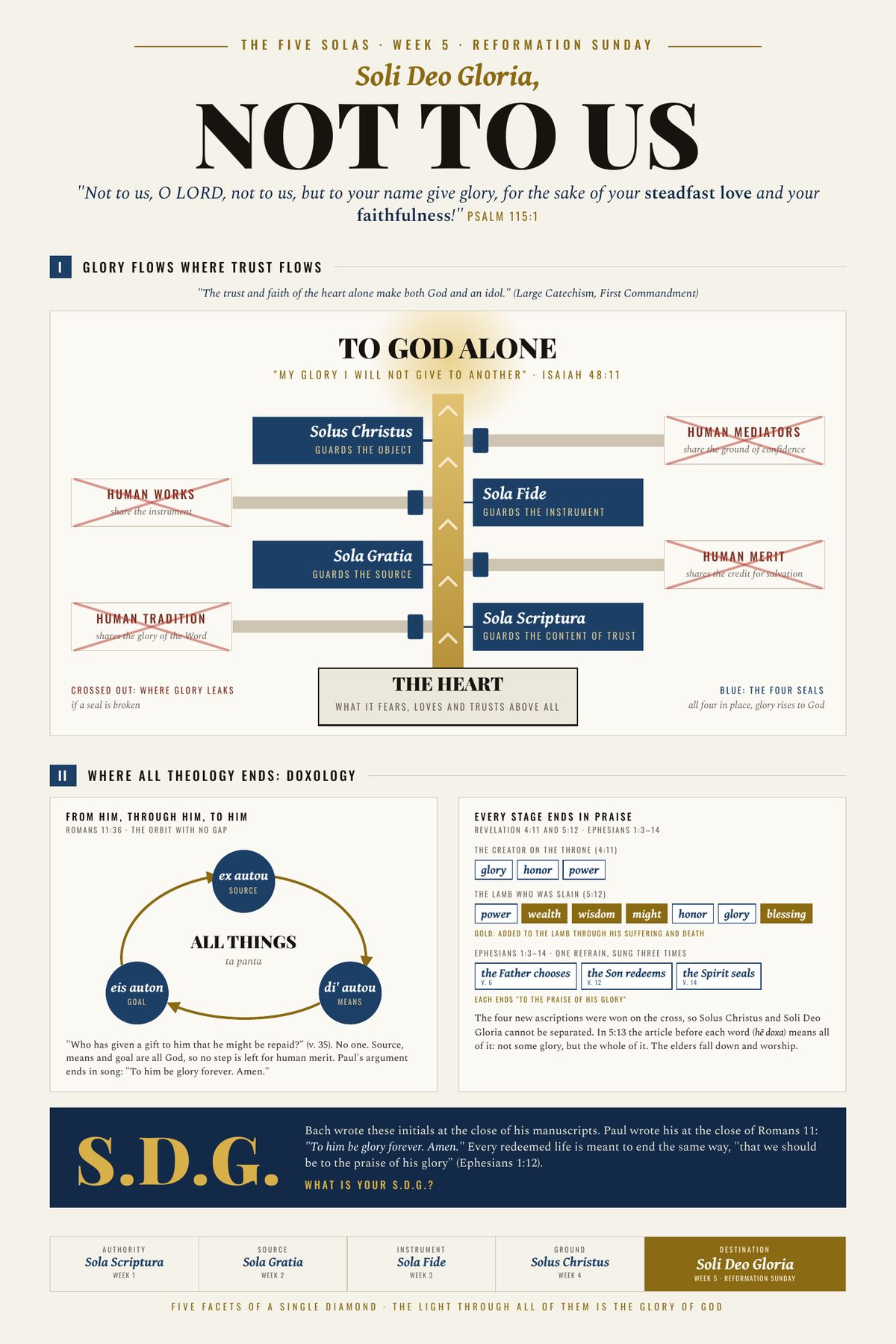
Soli Deo Gloria
To God Alone Be the Glory · Not to Us
Romans 11:33–36 · Isaiah 48:9–11 · Ephesians 1:3–14 · Revelation 5:9–14 · Psalm 115:1 · Large Catechism, First Commandment
For whose glory does God save, to whom does the praise belong, and what does that mean for the life of the Church? Romans 11, Isaiah 48, Ephesians 1, Revelation 5, and Psalm 115 are read with the Large Catechism on the First Commandment. The series closes with the doxological principle that directs all the others.
“Not to us, O LORD, not to us, but to your name give glory.” (Psalm 115:1)
Why this order
The sequence is deliberate. Scripture alone establishes the authority on which everything else rests. Grace alone and faith alone describe how justification works: God’s undeserved favor is its source, and faith is the empty hand that receives it. Christ alone stands at the center as the ground and object of that faith. The series ends with the doxological principle that unites the other four.
Each session reads the Bible first and then the Confessions: the Augsburg Confession and its Apology, Luther’s Catechisms, and the Formula of Concord. The Reformers claimed to teach nothing new, and the class tests that claim against the text.
What to bring
A Bible and a copy of the Book of Concord. Every session comes with a printable student guide, free to download here or handed to you at the door. Each week also has a 24×36 poster that summarizes the session.
Questions about attending? Write to Scott Jones at [email protected].
Join online
Sundays, 9:45 to 10:45 am Eastern, in person or on Google Meet. No Google account is needed; dismiss the sign-in prompt and join as a guest.