Week two of five
Sola Gratia
Grace Alone
Ephesians 2:1–10 · Romans 3:21–28 · Romans 11:5–6 · Genesis 6:5–8 · Augsburg Confession, Articles II and IV · Apology of the Augsburg Confession, Article IV (§40–45, §56–62)
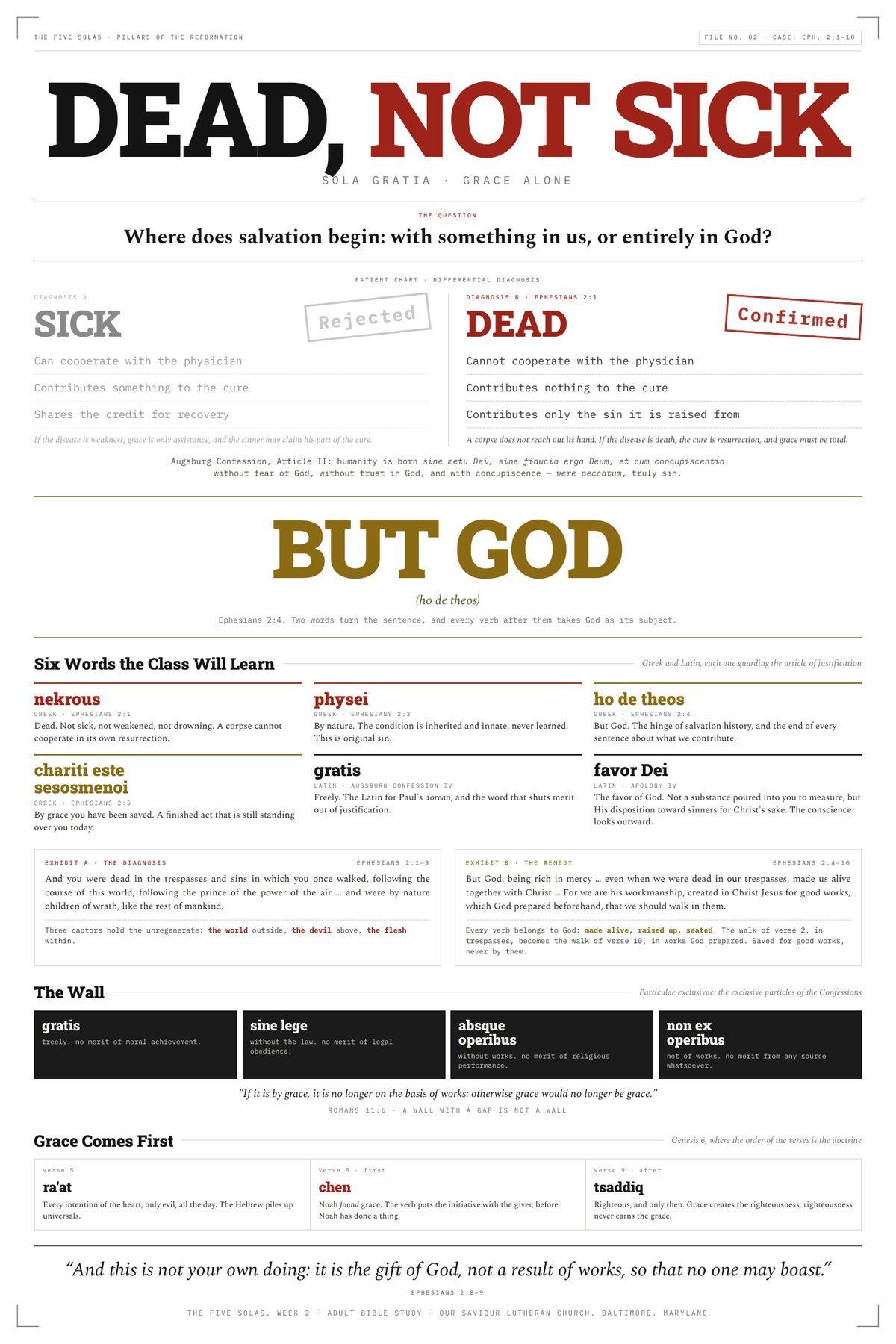
This week’s poster: Dead, Not Sick
The whole session on one page, printed at 24 by 36 inches for the classroom. Open it on screen or download it to print.
How this session works
Last week established where we go to hear God’s voice: Scripture alone. This second session of Reclaiming the Solas turns to the first thing that voice declares about the human condition, tracing sola Gratia through the anatomy of spiritual death and its divine remedy (Ephesians 2:1–10), the forensic mechanics of justification by grace as a gift (Romans 3:21–28), the mutual exclusivity of grace and works (Romans 11:5–6), the Old Testament portrait of total depravity and unmerited favor (Genesis 6:5–8), and the Augsburg Confession’s paired articles on Original Sin and Justification.
Opening Prayer
Merciful God, You have declared that we were dead in our trespasses and sins, unable to help ourselves, unable even to desire our own rescue. Yet in Your rich mercy and great love, You made us alive together with Christ, freely and without any merit of our own. Open our eyes by Your Holy Spirit to see the depth of our need and the height of Your grace, that we may confess with grateful hearts that salvation is Yours alone. Through Jesus Christ, Your Son, our Lord, who lives and reigns with You and the Holy Spirit, one God, now and forever. Amen.
Opening and Framing
The Question of Origin
Last week we established where we go to hear God’s voice: to the prophetic and apostolic Scriptures alone. This week we turn to the first thing that voice declares about the human condition. The diagnosis is not gentle. Scripture does not say that fallen human beings are weakened, wounded, or in need of assistance. It says they are dead (Ephesians 2:1). A corpse does not cooperate with the physician. A corpse does not reach out its hand. If there is to be life, it must come entirely from outside.
The Reformers understood that every error in soteriology traces back to an insufficient diagnosis. If the disease is merely weakness, then grace is merely assistance, and the patient can claim partial credit for the cure. If the disease is death, then the cure is resurrection, and the dead have nothing to contribute except the sin from which they are raised. The sequence of this session is deliberate: we begin with the diagnosis before we arrive at the remedy, so that grace will be recognized as grace and not as divine help for human effort.
Discussion Question — The Central Question
What moves God to save sinners? Does salvation begin with something in us or entirely in Him? And what difference does the answer make for the terrified conscience?
Question 1
The Reformation is often presented as a dispute about indulgences or papal abuses, yet the heart of the controversy was the question of how a sinner is made right with God. In your experience, where do most disagreements among Christians about salvation ultimately come down: a disagreement about how bad the human condition really is, or a disagreement about the nature of God’s remedy? How are those two questions related?
Question 2
Many Christians would affirm that salvation is “by grace” while still speaking of grace as help that God gives so that we can do our part. The Confessions insist that grace is not divine assistance to a weakened will; it is divine resurrection of a dead one. In everyday Christian conversation, where do you hear grace described more as assistance than as rescue? What practical difference does the distinction make?
Framing Statement
This session will trace the doctrine of Sola Gratia through four biblical texts and two Confessional readings: the anatomy of spiritual death and the divine remedy (Ephesians 2:1–10), the forensic mechanics of justification by grace as a gift (Romans 3:21–28), the mutual exclusivity of grace and works (Romans 11:5–6), the Old Testament portrait of total depravity and unmerited favor (Genesis 6:5–8), and the Augsburg Confession’s paired articles on Original Sin (Article II) and Justification (Article IV).
Key Vocabulary
Sola Gratia (Latin): “Grace alone.” The doctrine that salvation originates entirely in the unmerited favor of God, without any human cooperation, merit, or worthiness contributing to the ground of justification.
Nekrous (νεκρούς, Greek): “Dead.” Paul’s term in Ephesians 2:1 for the spiritual condition of fallen humanity. Not sick, not weakened, but dead. The theological bedrock of monergism: a corpse cannot cooperate in its own resurrection.
Favor Dei (Latin): “The favor of God.” Melanchthon’s definition of grace in the Apology: God’s favorable disposition toward sinners, pronounced for Christ’s sake. Distinguished from gratia infusa (an infused quality in the soul). The distinction is pastorally decisive.
Gratia Infusa (Latin): “Infused grace.” The medieval scholastic understanding of grace as a supernatural quality poured into the soul, progressively making the sinner more acceptable to God. The Reformers rejected this definition as obscuring the Gospel.
Monergism (Greek: monos + ergon): “One working.” The doctrine that God alone is the active agent in conversion and regeneration, without any cooperation from the human will. Distinguished from synergism (“working together”).
Hilasterion (ιλαστήριον, Greek): “Propitiation” or “mercy seat.” In the Greek Old Testament (LXX), the technical term for the golden lid on the Ark of the Covenant where the high priest sprinkled blood on the Day of Atonement (Leviticus 16). Paul applies this term to Christ Himself in Romans 3:25.
Concupiscence (Latin: concupiscentia): The inward inclination toward evil that persists even after Baptism. The Augsburg Confession identifies this as part of original sin; Rome at Trent denied that post-baptismal concupiscence is truly sin.
Dorean (δωρεάν, Greek): “Freely” or “as a gift.” The adverb Paul uses in Romans 3:24 to modify justification, emphasizing its sheer gift character. Corresponds to the Latin gratis in Augsburg Confession Article IV.
Part One: The Anatomy of Spiritual Death, Ephesians 2:1–3
Paul delivers the most concentrated diagnosis of the fallen human condition in the New Testament. Before the remedy can be understood, the disease must be felt in its full severity.
A. The Condition: Dead, Not Sick
✛ Read Ephesians 2:1–3 aloud.
Ephesians 2:1–3 (ESV)
And you were dead in the trespasses and sins in which you once walked, following the course of this world, following the prince of the power of the air, the spirit that is now at work in the sons of disobedience — among whom we all once lived in the passions of our flesh, carrying out the desires of the body and the mind, and were by nature children of wrath, like the rest of mankind.
Key Greek Terms
Nekrous (νεκρούς): “Dead.” Paul does not say humanity is spiritually sick, drowning, or merely wounded. He declares that apart from Christ, people are dead. A corpse cannot resuscitate itself, choose to seek God, or cooperate in its own resurrection. This is the theological bedrock of monergism.
Paraptomasin (παραπτώμασιν) and Hamartiais (ἀμαρτίαις): “Trespasses” and “sins.” The dative plural shows the sphere in which this death exists. These are the elements that suffocated spiritual life.
Physei (φύσει): “By nature.” In verse 3, Paul says we were “by nature children of wrath.” This is one of the strongest proofs of Original Sin in Scripture: we were not born neutral and then corrupted by imitation; we were born into this condition naturally through descent from Adam (cf. Romans 5:12).
Tekna Orges (τέκνα ὄργῆς): “Children of wrath.” A Semitic idiom: to be a “child” of something designates a person by his or her dominating characteristic or ultimate destiny. To be a “child of wrath” is to be entirely destined for and deserving of God’s righteous, eschatological anger against sin.
Paul uses pronouns with deliberate precision. In verse 1, “you” points to the Gentile Christians in Ephesus. In verse 3, he shifts to “we all,” including himself and all Jewish believers. The spiritual death is universal: no heritage, no law-keeping, no covenant privilege exempts anyone from the diagnosis.
Question 3
Paul says the Ephesians were nekrous (“dead”) in trespasses, not sick, not weakened, not drowning. The Greek carries no ambiguity: a corpse cannot cooperate with the physician. What is the practical difference between spiritual sickness and spiritual death? If the human condition after the Fall were sickness rather than death, how would that change the nature of the remedy God provides, and why would Sola Gratia no longer be strictly necessary?
Question 4
Paul describes an “unholy trinity” enslaving the unregenerate: the world (the prevailing anti-God culture of the present age), the devil (described as a cosmic ruler actively “at work” in the sons of disobedience), and the flesh (sarx, the corrupt fallen nature producing base passions and cravings, epithumiai). If the unregenerate person is enslaved from the outside by Satan and from the inside by his or her own corrupt nature, what room is left for a “free decision” to accept God’s grace? How does the Formula of Concord, Solid Declaration, Article II address this question?
Question 5
Paul says we were “by nature” (physei) children of wrath. The word physei means this is not learned behavior or environmental corruption; it is inherited, natural, and innate. How does this verse function as one of the strongest proofs of Original Sin in the New Testament? How does the Augsburg Confession, Article II, echo this diagnosis when it declares that all human beings are born “without true fear of God and without true trust in God”?
Question 6
In verse 3, Paul shifts from “you” (the Gentile Ephesians) to “we all” (ἡμε… — hemeis pantes), including himself and all Jewish Christians. He shatters the illusion that covenant privilege or Law-keeping exempted Israel from spiritual death. Why is the universality of this diagnosis essential for Sola Gratia? What would happen theologically if one category of people were exempted from total spiritual inability?
Part Two: The Divine Remedy, Ephesians 2:4–10
Into the graveyard of Ephesians 2:1–3, Paul drops the greatest two-word transition in salvation history. The dead do not raise themselves. God raises the dead.
B. The Pivot: “But God”
✛ Read Ephesians 2:4–10 aloud.
Ephesians 2:4–10 (ESV)
But God, being rich in mercy, because of the great love with which he loved us, even when we were dead in our trespasses, made us alive together with Christ — by grace you have been saved — and raised us up with him and seated us with him in the heavenly places in Christ Jesus, so that in the coming ages he might show the immeasurable riches of his grace in kindness toward us in Christ Jesus. For by grace you have been saved through faith. And this is not your own doing; it is the gift of God, not a result of works, so that no one may boast. For we are his workmanship, created in Christ Jesus for good works, which God prepared beforehand, that we should walk in them.
Key Greek Terms
Ho de theos (ἇ δḤ θεός): “But God.” The two-word hinge on which the entire passage turns. The dead sinners of verses 1–3 are the passive recipients of verses 4–6. God “made us alive,” God “raised us up,” God “seated us.” Every verb is active voice with God as subject.
Chariti este sesōsmenoi (χάριτί ἐστε σεσωσμένοι): “By grace you have been saved.” Paul interrupts his own sentence in verse 5 with this doxological interjection, then repeats it in verse 8. The periphrastic perfect (este sesōsmenoi) indicates a past completed action with abiding present results: you have been saved and you remain saved.
Touto (τοῦτο): “This.” In verse 8, “this is not your own doing.” The pronoun is neuter, while “faith” (pistis) is feminine. Therefore touto refers not merely to faith but to the entire preceding reality: the whole process of salvation by grace through faith is a divine gift.
Poiēma (ποίημα): “Workmanship” or “work of art.” From this word we derive “poem.” Notice the Greek word order: the pronoun “His” (autou) is placed at the very front for intense emphasis: “For His workmanship we are.” We are God’s crafted masterpiece, not self-made creations.
Ktisthentes (κτισθέντες): “Created.” Paul uses the verb ktizō, deliberately echoing the Genesis creation account. Just as humanity could not assist God in the original creation, we cannot assist God in our spiritual re-creation.
Paul constructs Ephesians 2:1–10 as a chiasm (a symmetric, concentric literary structure) in which the central point falls at verse 5: “by grace you have been saved.” This doxological interjection, repeated in verse 8, is the thematic heartbeat of the text. Everything before it establishes the need; everything after it unfolds the gift.
Question 7
“But God” (ho de theos). These two words mark the transition from death to life. Paul explains God’s motivation with three terms: He is “rich in mercy” (plousios ōn en eleei, where eleos in the Septuagint translates the Hebrew hesed, God’s loyal covenantal loving-kindness), He acted “because of His great love,” and He shows “kindness” (chrēstotēs). Notice that every motivating factor lies in God, not in us. What was it in us that moved God to act? How does this answer the question, “Does salvation begin with something in us or entirely in Him?”
Question 8
In verse 5, Paul interrupts his own sentence with the exclamation, “by grace you have been saved!” (chariti este sesōsmenoi). The verb form is a periphrastic perfect, indicating a completed past action with abiding present results. Paul shouts this confession at the structural center of the chiasm, then repeats it in verse 8. Why does Paul treat this as a doxological eruption rather than a calm doctrinal statement? What does this tell us about the proper posture toward Sola Gratia: is it merely a doctrine to be affirmed, or a reality to be celebrated?
Question 9
Verse 8 says, “And this is not your own doing; it is the gift of God, not a result of works.” The Greek pronoun “this” (touto) is neuter, while “faith” (pistis) is feminine. Grammatically, touto cannot refer only to faith; it refers to the entire preceding clause. What does this grammatical observation mean for the claim that “faith is our contribution” to salvation? Furthermore, Paul omits the word nomos (“Law”); he says “not a result of works” rather than “not a result of works of the Law.” Why does this universal exclusion of all human effort matter for the doctrine of Sola Gratia?
Question 10
Verse 10 calls believers God’s “workmanship” (poiēma, from which we derive “poem”), “created” (ktisthentes, echoing Genesis) “in Christ Jesus for good works, which God prepared beforehand, that we should walk in them.” The word “walk” (peripatēsōmen) forms a literary inclusio with verse 2, where we formerly “walked” in trespasses. We are not saved by our good works, yet we are saved for them. How does this verse answer the objection that Sola Gratia produces moral indifference? How does the order of Paul’s argument (dead in sin, made alive by grace, created for good works) protect against both works-righteousness and antinomianism?
Part Three: The Forensic Mechanics of Grace, Romans 3:21–28
If Ephesians 2 provides the fullest narrative arc of Sola Gratia, Romans 3 provides the tightest doctrinal formulation. Luther called this passage “the chief point, and the very central place of the Epistle, and of the whole Bible.”
C. The Righteousness of God Apart from the Law
✛ Read Romans 3:21–28 aloud.
Romans 3:21–28 (ESV)
But now the righteousness of God has been manifested apart from the law, although the Law and the Prophets bear witness to it — the righteousness of God through faith in Jesus Christ for all who believe. For there is no distinction: for all have sinned and fall short of the glory of God, and are justified by his grace as a gift, through the redemption that is in Christ Jesus, whom God put forward as a propitiation by his blood, to be received by faith. This was to show God’s righteousness, because in his divine forbearance he had passed over former sins. It was to show his righteousness at the present time, so that he might be just and the justifier of the one who has faith in Jesus. Then what becomes of our boasting? It is excluded. By what kind of law? By a law of works? No, but by the law of faith. For we hold that one is justified by faith apart from works of the law.
Key Greek Terms
Nyni de (νυνί δέ): “But now.” An eschatological hinge marking the turning point of salvation history, paralleling “But God” in Ephesians 2:4.
Dikaioumenoi (δικαιούμενοι): “Being declared righteous / justified.” A present passive participle: justification is a forensic courtroom verdict rendered by God in the present, declaring the believer righteous. The Hebrew verb hitsdiq and the Greek dikaioō mean “to declare righteous,” not “to make righteous.”
Dorean (δωρεάν): “Freely” / “as a gift.” This adverb modifies the justification, emphasizing its sheer gift character. Corresponds to the Latin gratis in Augsburg Confession Article IV.
Hilastērion (ιλαστήριον): “Propitiation” / “mercy seat.” In the LXX, this is the technical term for the golden lid on the Ark of the Covenant where the high priest sprinkled blood on the Day of Atonement (Leviticus 16). Christ Himself is the ultimate mercy seat.
Apolytrosēs (ἀπολύτρωσις): “Redemption.” Liberation through the payment of a price, drawn from the practice of ransoming slaves or prisoners of war. While grace is free to us, it was infinitely costly to God.
Verse 24 packs four massive theological terms into a single clause: “justified” (the verdict), “by His grace” (the cause), “as a gift” (the cost to us), and “through the redemption” (the cost to God). The Augsburg Confession’s Latin distills this into a threefold formula: gratis (freely), propter Christum (on account of Christ), per fidem (through faith).
Question 11
Paul says “all have sinned” (hēmarton, aorist tense: a final, collective verdict on humanity’s past rebellion) and “fall short” (hysterountai, present tense: the ongoing state of deprivation) of “the glory of God.” The loss of glory points back to Romans 1:23, where humanity exchanged God’s glory for idols. If every human being without exception is under this verdict, what does Paul’s phrase “there is no distinction” mean for any system that grants some people a spiritual advantage over others?
Question 12
Verse 24 says believers are “justified by his grace as a gift” (dorean, “freely”). The corresponding Latin in Augsburg Confession Article IV is gratis. The Confession reads: “We cannot obtain forgiveness of sin and righteousness before God by our own merits, works, or satisfactions, but we receive forgiveness of sin and become righteous before God out of grace, for Christ’s sake, through faith.” Notice the threefold formula: gratis (freely), propter Christum (for Christ’s sake), per fidem (through faith). How does each element exclude a different form of human merit?
Question 13
Paul says God put Christ forward as a “propitiation” (hilastērion) by His blood. In the LXX, hilastērion is the mercy seat on the Ark of the Covenant, where the high priest sprinkled blood once a year on the Day of Atonement (Leviticus 16). A critical theological question arises: how can a perfectly just God freely declare guilty sinners righteous without sweeping sin under the rug? Paul’s answer is that the cross is the “demonstration” (endeixis) of God’s righteousness: God is simultaneously “just and the justifier” (dikaion kai dikaiounta). How does the cross preserve both God’s justice and His mercy without compromising either?
Question 14
Verse 27: “Where then is the boasting? It was shut out” (exekleisthē, an aorist divine passive, meaning God Himself shut the door on it). Paul says boasting is excluded not by a “law of works” but by the “law of faith” (nomou pisteōs). Why is the exclusion of boasting not merely a matter of Christian humility but a theological necessity? The Apology, Article IV (§154–160) argues that the doctrine of justification by faith “gives glory to God” precisely by taking glory away from human merit. How does Sola Gratia already point toward the final sola of Week 5, Soli Deo Gloria?
Part Four: The Mutual Exclusivity of Grace and Works, Romans 11:5–6
Two verses, yet they function as a razor that cuts through every attempt to blend grace with human merit. Paul establishes an eternal, unbreakable rule regarding how God saves.
D. Grace or Works, Never Both
✛ Read Romans 11:5–6 aloud.
Romans 11:5–6 (ESV)
So too at the present time there is a remnant, chosen by grace. But if it is by grace, it is no longer on the basis of works; otherwise grace would no longer be grace.
Key Greek Terms
Leimma (λεῖμμα): “Remnant.” This noun occurs only here in the entire New Testament. It refers to a “small remainder” of people who believe the Gospel, preserved by God’s faithfulness.
Kat’ eklogen charitos (κατ’ ἐκλογὴν χάριτος): “According to the choice of grace” or “a gracious election.” The genitive charitos likely reflects a Hebrew construct state, functioning as an adjective: the election itself is gracious in character. The remnant exists solely as a result of God’s free and unconditional choice.
Ouketi ex ergōn (οὐκέτι ἀξ ἔργων): “No longer from works.” A theological absolute, shutting the door on any contribution of human merit to election or justification. Paul treats grace and works as two mutually exclusive avenues of salvation.
The logic is simple and devastating. Grace and works are mutually exclusive categories. If you introduce even a fraction of human cooperation as a contributing cause, grace ceases to be grace. There is no ninety-percent-grace-and-ten-percent-human-effort option. The Formula of Concord echoes this when it excludes all works from the article of justification.
Question 15
Paul says the remnant is “chosen by grace” (kat’ eklogen charitos). The genitive charitos defines the character of the election: it is a “gracious election,” entirely unconditional. The remnant does not exist because its members were smarter, holier, or more responsive than those who rejected Christ. How does this definition of election comfort the believer who doubts his or her own worthiness? How does it guard against spiritual pride?
Question 16
Verse 6 reads: “If it is by grace, it is no longer on the basis of works; otherwise grace would no longer be grace.” Paul treats grace and works as mutually exclusive, not as two ingredients that can be blended. If a person says, “God saved me, and I contributed my willingness, my decision, my cooperation,” has that person preserved grace, or has he or she introduced a basis for boasting that the unwilling, the undecided, and the uncooperative cannot claim? How does this verse function as a diagnostic test for whether any teaching has preserved the sola in Sola Gratia?
Question 17
The word “remnant” (leimma) occurs only here in the New Testament. Paul uses the perfect tense verb gegonen (“has come to be and still exists”) to describe this remnant, indicating a past divine act with ongoing, continuing results. The Church today is this remnant. How does the knowledge that the Church’s existence is itself a product of grace, not of human initiative, shape the way we understand our congregational life, our evangelism, and our confidence in God’s ongoing faithfulness?
Part Five: Grace Before the Law, Genesis 6:5–8
The earliest chapters of Scripture reveal the pattern of Sola Gratia long before Paul articulated it in doctrinal categories. Grace comes first. Grace finds the sinner. Grace does not wait for a worthy recipient; it creates one.
E. Total Depravity and Unmerited Favor in Genesis
✛ Read Genesis 6:5–8 aloud.
Genesis 6:5–8 (ESV)
The LORD saw that the wickedness of man was great in the earth, and that every intention of the thoughts of his heart was only evil continually. And the LORD regretted that he had made man on the earth, and it grieved him to his heart. So the LORD said, “I will blot out man whom I have created from the face of the land, man and animals and creeping things and birds of the heavens, for I am sorry that I have made them.” But Noah found grace in the eyes of the LORD.
Key Hebrew Terms
Ra’at (רעת): “Evil / wickedness.” The Hebrew piles up universals: every intention, only evil, continually. There is no residual island of goodness left untouched by the corruption.
Chen (חֵן): “Grace / favor.” The Hebrew word carries the sense of favor that is undeserved, favor the recipient has no claim upon. Noah “found” grace; the verb places the initiative with the giver, not the finder.
Nacham (נָחַם): “To be deeply grieved.” The Hithpael verb used of God in verse 6. The continuous wickedness of the human heart is met by the profound sorrow of God’s heart.
Tsaddiq (צַֹדִּיק) and Tamim (תָמִים): “Righteous” and “blameless.” The descriptions of Noah in Genesis 6:9, which follow the statement of grace in 6:8. Read through the lens of Sola Gratia, Noah’s righteousness is the result of God’s favor, not the cause of it.
The theological order is critical: grace in verse 8 precedes the description of righteousness in verse 9. Noah was righteous because he had found grace, not gracious because he was righteous. God first bestows His favor freely, and that grace justifies and sanctifies Noah.
Question 18
Genesis 6:5 describes the human heart with devastating comprehensiveness: “every intention of the thoughts of his heart was only evil continually.” The Hebrew piles up universals (kol, “every”; raq, “only”; kol-hayyom, “all the day”). Genesis 8:21, after the Flood, repeats essentially the same diagnosis: “the intention of man’s heart is evil from his youth.” The Flood did not fix the human heart. What does this tell us about the nature of the human problem and the kind of remedy it requires? Why does the persistence of this diagnosis after the Flood strengthen the case for Sola Gratia?
Question 19
Verse 8: “Noah found grace (chen) in the eyes of the LORD.” The Hebrew chen carries the sense of undeserved, unclaimed favor. The text does not say Noah earned favor or that his relative righteousness attracted God’s attention. It says he “found” grace. The verb places the initiative with the giver. Notice the order: grace in verse 8, then the description of Noah as “righteous” (tsaddiq) and “blameless” (tamim) in verse 9. How does this sequence demonstrate that Noah’s righteousness was the result of grace, not the cause of it?
Question 20
First Peter 3:18–22 draws a direct typological connection between Noah’s rescue through the waters of the Flood and Christian Baptism. God saved eight souls through water, and “Baptism, which corresponds to this, now saves you.” The number eight in biblical theology signifies new creation (the original creation was completed in seven days). How does this typological connection between Noah’s deliverance and Holy Baptism reinforce the pattern of Sola Gratia: God acting to save through external means, apart from human merit?
Part Six: The Confessional Witness, Augsburg Confession, Articles II and IV
The Augsburg Confession pairs the diagnosis (Article II, Original Sin) with the cure (Article IV, Justification). The arrangement is deliberate: you cannot understand the magnitude of grace until you have grasped the totality of the ruin.
F. The Diagnosis: Augsburg Confession, Article II (Original Sin)
✛ Open your Book of Concord to the Augsburg Confession, Article II. Read the article in full aloud.
Augsburg Confession, Article II
Furthermore, it is taught among us that since the fall of Adam, all human beings who are born in the natural way are conceived and born in sin. This means that from birth they are full of evil lust and inclination and cannot by nature possess true fear of God and true faith in God. Moreover, this same innate disease and original sin is truly sin and condemns to God’s eternal wrath all who are not in turn born anew through baptism and the Holy Spirit.
Key Latin Terms
Sine metu Dei, sine fiducia erga Deum, et cum concupiscentia: “Without the fear of God, without trust in God, and with concupiscence.” The Confession defines original sin with a negative-positive formula: the sine (without) describes active spiritual inability; the cum (with) describes the corrupt desire that fills the void.
Vere peccatum: “Truly sin.” The Confession insists that original sin is not a mere weakness or disadvantage but genuine sin that condemns and brings eternal death. This was directly controverted: Rome at Trent denied that post-baptismal concupiscence is truly sin.
Article II establishes three claims foundational for Sola Gratia: original sin is universal (“all human beings”), it is radical (they “cannot” possess true fear and trust), and it is “truly sin” that condemns. The word “cannot” is decisive. The will is not merely weakened; it is bound.
Question 21
The Confession defines original sin with the formula sine metu Dei, sine fiducia erga Deum, et cum concupiscentia (“without the fear of God, without trust in God, and with concupiscence”). The sine describes what is absent; the cum describes what fills the void. Why is it important that the Confession describes original sin as both a lack (of fear and trust) and a presence (of evil desire)? How does this paired definition connect to Paul’s diagnosis in Ephesians 2:1–3 and to the Hebrew description in Genesis 6:5?
Question 22
The Formula of Concord, Solid Declaration, Article II teaches that in spiritual matters (conversion, faith, the reception of the Gospel), the unregenerate will is not merely weak but actively hostile to God, while it retains some capacity in civil and earthly matters. Why is this distinction important? What would go wrong theologically if we denied the will’s capacity in civil matters (as though human beings can do no earthly good at all)? What would go wrong if we denied the will’s incapacity in spiritual matters (as though conversion were partly a human achievement)?
G. The Cure: Augsburg Confession, Article IV (Justification)
✛ Open your Book of Concord to the Augsburg Confession, Article IV. Read the article in full aloud.
Augsburg Confession, Article IV
Furthermore, it is taught that we cannot obtain forgiveness of sin and righteousness before God through our own merit, work, or satisfactions, but that we receive forgiveness of sin and become righteous before God out of grace for Christ’s sake through faith when we believe that Christ has suffered for us and that for his sake our sin is forgiven and righteousness and eternal life are given to us.
Key Latin Terms
Gratis: “Freely / by grace.” Directly translates the Greek dorean of Romans 3:24. God’s favorable verdict comes without any cost to the recipient.
Propter Christum: “On account of Christ.” Grace is free to us, yet it was infinitely costly to God. We receive grace only because Christ “made satisfaction for our sins by His death.”
Per fidem: “Through faith.” While grace is the efficient cause, faith is the receiving instrument. Faith is the empty hand that grasps the promise.
Favor Dei vs. Gratia Infusa: The Apology (Article IV, §40–45) insists that grace is God’s favorable disposition toward sinners (favor Dei), not an infused quality in the soul (gratia infusa). The terrified conscience finds comfort not in measuring whether enough grace has been infused but in hearing that God is favorably disposed toward sinners for Christ’s sake.
Melanchthon later called Article IV the articulus stantis et cadentis ecclesiae: the article on which the Church stands or falls. Its brevity is part of its power. The first clause eliminates every human contribution; the second identifies the sole source (grace), the sole ground (Christ’s sake), and the sole instrument (faith).
Question 23
The Apology of the Augsburg Confession (Article IV, §40–45, §56–62) distinguishes between grace as favor Dei (God’s favorable disposition toward sinners) and grace as gratia infusa (an infused quality in the soul). The medieval system defined grace primarily as a supernatural quality progressively transforming the sinner. Melanchthon argued that this turns the terrified conscience inward, forcing it to ask, “Has enough grace been infused? Am I sufficiently transformed?” The Confessional definition turns the conscience outward, toward the promise. Consider a parishioner struggling with doubt and assurance: what difference does it make whether that person is told, “God has infused grace into your soul, and you must cooperate with it,” versus, “God is favorably disposed toward you, a sinner, for Christ’s sake, and this favor does not depend on the quality of your response”?
Question 24
The medieval church developed a system of merits: meritum de congruo (merit of congruity, by which a person performed preparatory works to earn the initial infusion of grace) and meritum de condigno (merit of condignity, by which subsequent good works earned eternal life). The Confession and the Apology obliterate this system with the particulae exclusivae (the exclusive particles): gratis, sine lege, absque operibus, non ex operibus. How do these particles function as a wall that prevents human merit from entering the article of justification at any point? Why must the wall be total rather than partial?
Question 25
A common objection to Sola Gratia: “If everything depends on God’s grace and nothing on my will, why bother doing anything? Why pray, why come to church, why pursue holiness?” How would you answer this from the texts and Confessional readings we have studied today? Consider: the Apology (IV, §67) says, “One cannot deal with God or grasp Him except through the Word. Therefore justification takes place through the Word.” How does the teaching that grace is delivered through the external Word and the Sacraments answer the charge that Sola Gratia produces passivity? How does Ephesians 2:10 (“created in Christ Jesus for good works, which God prepared beforehand”) show that grace produces not inaction but a new kind of action?
Synthesis and Closing
Summary: Grace All the Way Down
| Text | Contribution to Sola Gratia | Key Term |
|---|---|---|
| Ephesians 2:1–3 | The diagnosis: spiritual death, enslavement to world, devil, and flesh; universal “children of wrath” | Nekrous (dead); Physei (by nature) |
| Ephesians 2:4–10 | The remedy: “But God”; made alive by grace; salvation is gift, not works; created for good works | Chariti este sesōsmenoi; Poiēma; Touto |
| Romans 3:21–28 | Forensic justification as a gift; propitiation by Christ’s blood; boasting excluded | Dorean (freely); Hilastērion (mercy seat) |
| Romans 11:5–6 | Grace and works mutually exclusive; the remnant chosen by a gracious election | Leimma (remnant); Kat’ eklogen charitos |
| Genesis 6:5–8 | Total depravity; grace precedes and creates righteousness; typology of Baptism | Ra’at (evil); Chen (grace/favor) |
| AC II & IV | Original sin: universal, radical, truly sin; justification: gratis, propter Christum, per fidem | Favor Dei; Gratis; Particulae exclusivae |
Final Discussion
Read Ephesians 2:8–9 one final time.
Question 26
We have traced Sola Gratia from the anatomy of spiritual death (Ephesians 2:1–3) through the divine remedy (“But God,” Ephesians 2:4–10), the forensic mechanics of justification (Romans 3:21–28), the mutual exclusivity of grace and works (Romans 11:5–6), the Old Testament pattern (Genesis 6:5–8), and the Confessional codification (Augsburg Confession, Articles II and IV). If you had to explain Sola Gratia in one sentence to someone who had never heard of it, what would you say?
Question 27
The pastoral heart of Sola Gratia is this: the terrified conscience does not need to look inward to measure whether enough grace has been received, whether the decision was sincere enough, whether the cooperation was sufficient. It needs to look outward, to the promise of a God who is favorably disposed toward sinners for Christ’s sake. Where in your own life, or in the life of your congregation, is this outward-looking posture most needed? What is the difference between a religion that exhausts and a Gospel that rescues?
Question 28
As we close this second session and prepare for Sola Fide (Faith Alone) next week, consider the connection: if grace is the source (Sola Gratia), faith is the instrument that receives it (Sola Fide). The Apology says faith is the “empty hand” that grasps the promise. What is one concrete way you could receive the grace of God more attentively this week, whether in the hearing of the Word, in the reception of the Sacrament, or in the daily remembrance of your Baptism?
Appendix — Liturgical, Lectionary, and Hymnic Connections
Where these texts appear in the life of the Church.
Ephesians 2:1–10
This is the appointed Epistle reading for the Fourth Sunday in Lent (Series B) of the Three-Year Lectionary. The declaration that we are “saved by grace through faith” and not by works (Ephesians 2:8–9) is a central Gospel theme. Paul’s statement that God “raised us up with him” (Ephesians 2:6) teaches that believers in Christ have already been seated in the heavenly places with Him.
Romans 3:21–28
This is appointed as the Epistle reading for Proper 4 in Series A. Paul’s climactic conclusion in verse 28, that a person is justified by faith apart from works of the Law, serves as a bedrock memory verse and a foundation of Reformation theology.
Romans 11:5–6
This is used theologically to teach that the believing remnant exists as a direct result of God’s gracious election. Verse 6 is cited to establish firmly that grace and works are mutually exclusive principles, completely excluding human works from the article of justification.
Genesis 6:5–8
This sets the stage for the Flood narrative (Genesis 7–9), which is a prominent Old Testament reading appointed for the Easter Vigil across all three lectionary series. The historic “Flood Prayer” (a Collect following the Easter Vigil reading) explicitly connects God’s judgment upon a “wicked and perverse generation” and His salvation of Noah’s family to the saving waters of Holy Baptism, praying that the congregation may be kept safe in “the ark of Christ’s body, the Church.”
Hymn selections
LSB 566 — By Grace I’m Saved, Grace Free and Boundless
This pedagogical hymn, grounded directly in Ephesians 2:8–9, repeats the word “grace” sixteen times, deliberately contrasting God’s unmerited favor with human works. It is among the clearest hymnic expositions of Sola Gratia in the Lutheran Service Book.
LSB 555 — Salvation unto Us Has Come
Paul Speratus’s great Reformation chorale, which explicitly cites Romans 3:20 and 3:22 as the scriptural proofs for its stanzas distinguishing Law and Gospel. Stanza 3 cites Ephesians 2:3 to describe our fallen, sinful nature.
LSB 643 — Sent Forth by God’s Blessing
Reflects Ephesians 2:10 (“good works, which God prepared beforehand, that we should walk in them”) by preparing the congregation for life in the daily vocations God has prepared.
LSB 656 — A Mighty Fortress Is Our God
Luther’s great Reformation hymn, appointed for Reformation Sunday. The stanzas confess the total inability of human effort (“With might of ours can naught be done”) and the sufficiency of Christ’s victory won entirely by grace.
LSB 571 — God Loved the World So That He Gave
A hymnic exposition of John 3:16 that confesses the unmerited character of God’s love and the sheer gift of salvation through Christ. The hymn reinforces the Sola Gratia teaching that the initiative of salvation lies entirely in God’s love.
Closing Prayer
Lord God, heavenly Father, we confess that we were dead in our trespasses, enslaved to the world, the devil, and our own corrupt flesh, children of wrath by nature, with nothing in us that could reach out to You. Yet You, being rich in mercy, because of Your great love, made us alive together with Christ. By grace You have saved us, and this is not our own doing; it is Your gift. Keep us in this confession, that we may never look inward for the ground of our salvation but always outward to Christ and His cross. Deliver us from the idolatry of our own merits, and grant us the joy of knowing that we are Your workmanship, created in Christ Jesus for the good works You have prepared. Through Jesus Christ, Your Son, our Lord, who lives and reigns with You and the Holy Spirit, one God, now and forever. Amen.
Soli Deo Gloria