Week three of five
Sola Fide
Faith Alone
Romans 3:28 · Romans 4:1–8 · Galatians 2:15–21 · James 2:14–26 · John 3:14–18 · Augsburg Confession, Articles IV and VI; Apology IV (§48–55, 68–74, 86–93) · Formula of Concord, Epitome, Article III (§1–11)
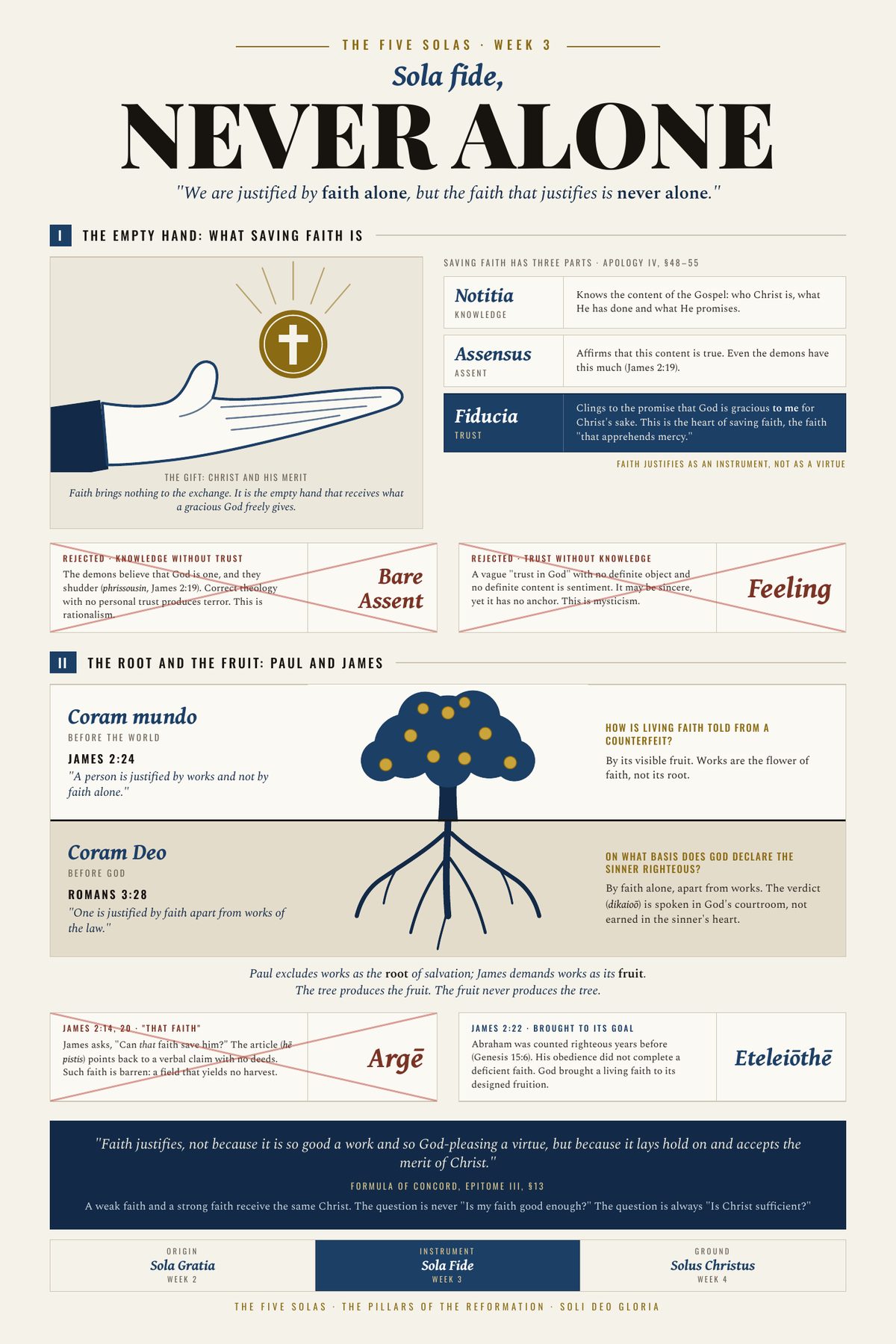
This week’s poster: Never Alone
The whole session on one page, printed at 24 by 36 inches for the classroom. Open it on screen or download it to print.
How this session works
Last week established that salvation originates entirely in the grace of God: the dead are raised, the ungodly are declared righteous, and the whole rescue, from first to last, is God’s unmerited gift. This third session presses the next question: if grace is the source, what is the instrument? It traces Sola Fide through the apostolic verdict on justification by faith (Romans 3:28), Abraham as the model of credited righteousness (Romans 4:1–8), the death of the old self and life in Christ (Galatians 2:15–21), the resolution of Paul and James on faith and works (James 2:14–26), the lifted serpent as the image of saving faith (John 3:14–18), and the Confessional witness in the Augsburg Confession, Articles IV and VI, the Apology’s treatment of faith, and the Formula of Concord’s Article III on the righteousness of faith.
Opening Prayer
Almighty God, who justifies the ungodly and calls into existence the things that do not exist, we confess that we bring nothing to You but empty hands. Grant us by Your Holy Spirit a living faith that clings to Christ alone, receives His righteousness as its own, and bears the fruit of love and good works in our daily callings. Through Jesus Christ, Your Son, our Lord, who lives and reigns with You and the Holy Spirit, one God, now and forever. Amen.
Opening and Framing
The Empty Hand That Receives
Last week we established that salvation originates entirely in the grace of God. The dead are raised; the ungodly are declared righteous; and the whole rescue, from first to last, is God’s unmerited gift. This week we press the next question: how do sinners receive what God gives? If grace is the source, what is the instrument? The Confessional answer is faith alone. Faith does not contribute to the transaction; it simply trusts the promise. It is the empty hand that receives what a gracious God freely offers.
Yet this answer has been misunderstood so persistently, from so many directions, that precision is essential. Faith is not a meritorious work that earns salvation. Faith is not a contentless feeling detached from knowledge. Faith is not mere intellectual agreement with historical facts. The Confessions define saving faith as personal trust (fiducia) that apprehends the promise of God’s mercy for Christ’s sake. This session must also address the most famous objection in the entire canon of Scripture: the apparent contradiction between Paul (“justified by faith apart from works of the law,” Romans 3:28) and James (“a person is justified by works and not by faith alone,” James 2:24).
Discussion Question — The Central Question
How do sinners receive what God gives? What is the instrument through which the benefits of Christ’s work become ours?
Question 1
If someone asked you, “What must I do to be saved?” how would you answer? Notice the assumptions embedded in the word “do.” The Philippian jailer asked Paul this exact question (Acts 16:30–31). Paul’s answer was not a list of actions but a single verb: “Believe.” What is the difference between answering with a set of requirements and answering with a promise to be trusted?
Question 2
The Apology of the Augsburg Confession distinguishes three components of faith: knowledge (notitia), assent (assensus), and trust (fiducia). Can you have one or two of these without the third? Consider: a person who knows the facts of the Gospel but does not trust Christ personally has notitia and perhaps assensus but lacks fiducia. James 2:19 says even the demons “believe” in that sense. On the other side, a person who claims to trust Jesus but rejects the content of the Gospel has feeling without knowledge. How does this threefold definition protect against errors on both sides?
Framing Statement
This session will trace the doctrine of Sola Fide through five biblical texts and three Confessional readings: the apostolic verdict on justification by faith (Romans 3:28), the patriarch Abraham as the model of credited righteousness (Romans 4:1–8), the death of the old self and life in Christ (Galatians 2:15–21), the resolution of Paul and James on faith and works (James 2:14–26), the lifted serpent as the image of saving faith (John 3:14–18), and the Confessional witness in the Augsburg Confession Articles IV and VI, the Apology’s treatment of faith, and the Formula of Concord’s Article III on the righteousness of faith.
Key Vocabulary
Sola Fide (Latin): “Faith alone.” The doctrine that sinners receive the benefits of Christ’s work through faith alone, not through works, merits, or love. Faith is the instrument of justification, not its ground or cause.
Fiducia (Latin): “Trust” or “confidence.” The heart of saving faith. Not mere intellectual knowledge (notitia) or historical assent (assensus), but personal, clinging trust in Christ’s promise. The Apology calls this the faith “that apprehends mercy.”
Notitia (Latin): “Knowledge.” The cognitive content of faith. Saving faith knows the facts of the Gospel: who Christ is, what He has done, and what He promises. Faith without content is not faith; it is sentiment.
Assensus (Latin): “Assent.” The affirmation that the content of the Gospel is true. Assensus accepts the claims of Scripture as reliable. Yet even the demons possess assensus (James 2:19); assent without trust does not save.
Logizomai (λογίζομαι, Greek): “To reckon, credit, or account.” A technical term from ancient banking. When Paul says Abraham’s faith was “counted” to him as righteousness (Romans 4:3), he uses this verb. God credits a righteousness that does not inherently belong to the sinner.
Dikaioō (δικαιόω, Greek): “To justify” or “to declare righteous.” A forensic, legal term. God does not make the sinner inwardly righteous; He pronounces a verdict of acquittal in His courtroom. The distinction between “declare righteous” and “make righteous” is the divide between the Reformation and Rome.
Coram Deo / Coram Mundo (Latin): “Before God” / “Before the world.” The critical distinction for resolving Paul and James. Paul speaks of justification coram Deo (how a sinner is declared righteous in God’s courtroom). James speaks of the demonstration of faith coram mundo (how genuine faith is made visible to others). The two apostles answer different questions.
Part One: The Apostolic Verdict, Romans 3:28
Paul delivers the conclusion of his three-chapter prosecution of humanity. Every mouth has been stopped. Now the verdict falls: a person is justified by faith, apart from works of the Law.
A. The Verdict Rendered (3:28)
✛ Read Romans 3:21–28 aloud.
Romans 3:28 (ESV)
For we hold that one is justified by faith apart from works of the law.
Key Greek Terms
Logizometha (λογιζόμεθα): “We conclude” or “we reckon.” Paul uses logizomai nineteen times in Romans. It is a technical term from finance and law: to calculate, to credit to one’s account. Here, with a human subject (“we”), Paul and the apostles render a definitive theological and legal conclusion on how a person is accounted righteous before God.
Pistei (πίστει): “By faith.” The simple dative noun. Romans 3:28 is the only time in the entire New Testament where the simple dative of “faith” occurs directly with any form of the verb “to justify.” In every other instance Paul uses prepositions (“through faith,” “from faith”). The bare dative emphasizes faith as the sheer instrument or means of justification.
Chōris ergōn nomou (χωρὶς ἔργων νόμου): “Apart from works of the Law.” The preposition chōris means “without connection to, severed from.” It unites two previous statements: no one is justified “from works” (3:20) and God’s righteousness comes “apart from the Law” (3:21). The juxtaposition is absolute.
This single verse is the battle cry of the Reformation. Paul has spent two and a half chapters proving that every human being, Jew and Gentile, stands guilty before God. Every mouth is stopped (3:19). Then comes the verdict: justification is by faith, severed entirely from works.
Question 3
Paul uses the verb logizometha (“we conclude/reckon”), a term from the world of accounting and law. He is not offering a personal opinion; he is rendering an apostolic verdict. The same verb, when God is its subject in Romans 4, means to “credit” righteousness to someone’s account. How does Paul’s choice of this accounting term shape the way we should understand justification? Is justification a process of moral improvement or a legal declaration?
Question 4
Romans 3:28 is the only verse in the New Testament where the simple dative pistei (“by faith”) appears directly with the verb “to justify” (dikaioō). Everywhere else Paul uses prepositions: “through faith” (dia pisteōs) or “from faith” (ek pisteōs). The bare dative emphasizes faith as the sheer means or instrument. Why does this grammatical distinction matter? How does it reinforce the teaching that faith is the empty hand that receives rather than a meritorious act that earns?
Question 5
Luther famously translated Romans 3:28 with the word allein (“alone”): “a person is justified by faith alone, apart from works of the law.” His critics attacked him for adding a word not in the Greek. The Apology defends this by pointing to the exclusive particles in the text (“apart from,” “as a gift,” “not of works”). When you have a stark either/or contrast—“by faith” set directly against “apart from works”—does the grammar demand the word “alone,” even if it is not literally present? Is Luther’s addition a distortion of Paul or an accurate rendering of Paul’s logic?
Part Two: The Ledger of Grace, Romans 4:1–8
Paul calls Abraham to the witness stand, the patriarch whom every Jew revered as the model of obedience, and demonstrates that even he was justified not by working but by believing.
✛ Read Romans 4:1–8 aloud.
Romans 4:1–8 (ESV)
What then shall we say was gained by Abraham, our forefather according to the flesh? For if Abraham was justified by works, he has something to boast about, but not before God. For what does the Scripture say? “Abraham believed God, and it was counted to him as righteousness.” Now to the one who works, his wages are not counted as a gift but as his due. And to the one who does not work but believes in him who justifies the ungodly, his faith is counted as righteousness—just as David also speaks of the blessing of the one to whom God counts righteousness apart from works: “Blessed are those whose lawless deeds are forgiven, and whose sins are covered; blessed is the man against whom the Lord will not count his sin.”
Key Greek and Hebrew Terms
Elogisthē (ἐλογίσθη): “It was credited.” A divine passive: God is the implied actor doing the crediting. Paul uses forms of logizomai eleven times in Romans 4 alone. God accounts to Abraham a righteousness that does not inherently belong to him. It is not a reward for a righteous act; it is a pure gift.
’Aman (אָמַן, Hebrew Hiphil): The Hebrew verb behind “believed” in Genesis 15:6. In the Hiphil stem it means to place one’s full, unconditional trust and reliance upon someone. Abraham’s faith was not a blind leap; it was absolute confidence in God’s specific Word of promise.
Asebē (ἀσεβῆ): “The ungodly.” In verse 5, God justifies the ungodly. The word means irreverent, impious, one who refuses to worship. Human logic says God should justify the good. The radical news of Sola Fide is that God credits perfect righteousness to the spiritually bankrupt sinner who brings nothing but the empty hands of faith.
Gezerah shawah: A first-century Jewish exegetical technique. If two biblical texts share the same key word, they may interpret one another. Paul links Abraham (Genesis 15:6) and David (Psalm 32:1–2) through the shared verb logizomai/hashab (“to count/reckon”), merging their theological weight.
Paul’s argument is devastatingly simple. Abraham, the patriarch whom Jewish tradition revered as perfectly obedient, was in fact justified by believing, not by working. The accounting metaphor governs the entire passage: God credits righteousness to the one who does not work but believes.
Question 6
In verses 4–5, Paul draws a sharp economic contrast. The worker receives wages as something owed (kata opheilēma, “according to debt”); the believer receives righteousness as a gift of grace (kata charin, “according to grace”). If salvation involved our works, God would owe us—which would destroy the very concept of grace. How does this workplace metaphor clarify the difference between faith and works? Why is it important that the relationship between God and the justified sinner is not one of employer and employee?
Question 7
Verse 5 contains one of the most shocking statements in Scripture: God “justifies the ungodly” (ton asebē). The word asebēs means “irreverent, impious.” First-century Jewish tradition taught that Abraham was “perfect in all his deeds with the Lord” (Jubilees 23:10). Paul overturns this: Abraham was not justified because he was godly; he was an ungodly man whom God declared righteous. How does this verse shatter every system that conditions God’s verdict on the sinner’s prior moral improvement?
Question 8
Paul links Abraham (Genesis 15:6) to David (Psalm 32:1–2) through the exegetical technique known as gezerah shawah: both texts share the verb logizomai / hashab (“to count, to reckon”). David pronounces a blessing on the person to whom God “counts righteousness apart from works” (v. 6) and against whom the Lord “will not count his sin” (v. 8). Justification thus has two sides: the crediting of Christ’s righteousness and the non-counting of the sinner’s guilt. Why are both sides necessary? What would be missing if God forgave sin but credited no positive righteousness?
Part Three: Crucified with Christ, Galatians 2:15–21
Paul’s most personal and most urgent statement on justification by faith. What began as a confrontation with Peter at Antioch becomes a theological confession that reaches to the very identity of the believer.
✛ Read Galatians 2:15–21 aloud.
Galatians 2:15–21 (ESV)
We ourselves are Jews by birth and not Gentile sinners; yet we know that a person is not justified by works of the law but through faith in Jesus Christ, so we also have believed in Christ Jesus, in order to be justified by faith in Christ and not by works of the law, because by works of the law no one will be justified. But if, in our endeavor to be justified in Christ, we too were found to be sinners, is Christ then a servant of sin? Certainly not! For if I rebuild what I tore down, I prove myself to be a transgressor. For through the law I died to the law, so that I might live to God. I have been crucified with Christ. It is no longer I who live, but Christ who lives in me. And the life I now live in the flesh I live by faith in the Son of God, who loved me and gave himself for me. I do not nullify the grace of God, for if righteousness were through the law, then Christ died for no purpose.
Key Greek Terms
Ean mē (ἐὰν μή): “Except” or “but rather.” In verse 16, Paul states that a person is not justified by works of the law ean mē through faith in Christ. In this context the phrase carries a strong adversative (contrasting) force: faith and works of the Law are mutually exclusive avenues.
Pistis Christou (πίστις Χριστοῦ): “Faith in Christ” (objective genitive) or “faithfulness of Christ” (subjective genitive). Debated among scholars, yet Paul immediately follows with “even we ourselves believed in Christ Jesus” (using the cognate verb pisteuō), strongly suggesting he emphasizes the believer’s trusting reception of Christ.
Pasa sarx (πᾶσα σάρξ): “All flesh.” Paul quotes Psalm 143:2 but deliberately alters it. The original Psalm says “every living being”; Paul changes this to pasa sarx, a Hebrew idiom for human weakness and sinfulness, and inserts “by works of the law.” The alteration obliterates any possibility of justification through obedience.
Atheteō (ἀθετέω): “To nullify, set aside, render ineffective.” In verse 21, Paul says: “I do not nullify the grace of God.” If human beings could attain righteousness through Law-keeping, God’s grace would be made void and the cross would be rendered pointless.
Dōrean (δωρεάν): “For nothing, to no purpose.” The word translated “for no purpose” in verse 21. It means “without a cause, gratis.” If righteousness could be obtained through the Law, then Christ’s death accomplished nothing whatsoever.
Paul repeats his thesis three times in verse 16 alone, with a rhetorical intensity that reflects the mortal stakes involved. The Galatian churches were being seduced by teachers who demanded circumcision and Torah-observance as conditions of justification. Paul recognizes that this is not a minor adjustment to the Gospel; it is its annihilation.
Question 9
In verse 16, Paul makes the same point three times: justified not by works of the law but through faith in Christ. Why does he repeat it with such force? The Galatian false teachers were not denying Christ; they were adding requirements to faith in Christ. Is the addition of even one human requirement to the Gospel a minor modification or a fundamental destruction of it? How does verse 21 (“if righteousness were through the law, then Christ died for no purpose”) settle the question?
Question 10
Paul quotes Psalm 143:2 in verse 16 but makes a deliberate alteration: where the Psalm says “no living being,” Paul substitutes “all flesh” (pasa sarx) and inserts the phrase “by works of the law.” Why does Paul tighten and intensify the Old Testament text? What does sarx (“flesh”) convey that “living being” does not? How does this alteration serve Paul’s argument that the Law cannot save?
Question 11
Verse 20 is the personal confession at the heart of Sola Fide: “I have been crucified with Christ. It is no longer I who live, but Christ who lives in me.” This is not a contradiction but a profound duality. The old “I” governed by the Law and the flesh is dead; Christ is now the source of life. Paul then says the life he now lives in the flesh, he lives “in faith” (en pistei) in the Son of God. How does the concept of being “crucified with Christ” relate to justification by faith? Is Paul describing an experience the believer achieves, or a reality the believer receives in baptism (cf. Romans 6:3–4)?
Question 12
Verse 21 contains the devastating conclusion: “I do not nullify (atheteō) the grace of God, for if righteousness were through the law, then Christ died for nothing (dōrean).” The verb atheteō means to render ineffective or to reject. Every system that conditions righteousness on human obedience renders the cross purposeless. How does this verse serve as a test for evaluating any proposed addition to the Gospel? If someone says, “You must believe in Christ and do X in order to be saved,” what has happened to grace?
Part Four: The Breath of Living Faith, James 2:14–26
James does not destroy Sola Fide; he defends it against a counterfeit. His target is not genuine trust in Christ but a barren, verbal claim that produces no fruit. The question is not whether faith saves, but what kind of faith saves.
✛ Read James 2:14–26 aloud.
James 2:14–26 (ESV)
What good is it, my brothers, if someone says he has faith but does not have works? Can that faith save him? If a brother or sister is poorly clothed and lacking in daily food, and one of you says to them, “Go in peace, be warmed and filled,” without giving them the things needed for the body, what good is that? So also faith by itself, if it does not have works, is dead. But someone will say, “You have faith and I have works.” Show me your faith apart from your works, and I will show you my faith by my works. You believe that God is one; you do well. Even the demons believe—and shudder! Do you want to be shown, you foolish person, that faith apart from works is useless? Was not Abraham our father justified by works when he offered up his son Isaac on the altar? You see that faith was active along with his works, and faith was completed by his works; and the Scripture was fulfilled that says, “Abraham believed God, and it was counted to him as righteousness”—and he was called a friend of God. You see that a person is justified by works and not by faith alone. And in the same way was not also Rahab the prostitute justified by works when she received the messengers and sent them out by another way? For as the body apart from the spirit is dead, so also faith apart from works is dead.
Key Greek Terms
Hē pistis (ἡ πίστις): “That faith.” In verse 14, the Greek includes the anaphoric definite article hē, pointing backward to the faith just mentioned. James does not ask, “Can faith save?” He asks, “Can that faith save?”—that is, the empty, verbal claim he has just described. He is questioning not the power of genuine faith but the legitimacy of a counterfeit.
Phrissousin (φρίσσουσιν): “They shudder.” A hapax legomenon (used only here in the New Testament). The demons possess accurate theology—they believe that God is one—and it causes them to bristle with terror. If faith were nothing more than correct intellectual assent, Satan himself would qualify as a believer.
Argē (ἀργή): “Barren” or “unproductive.” An agricultural term (v. 20). Faith without works is not merely deficient; it is fruitless, yielding no harvest. This word brilliantly sets up the example of Abraham, who was physically barren until God made him fruitful.
Eteleiothē (ἐτελειώθη): “Was brought to its intended goal” or “was perfected” (v. 22). Abraham’s faith was not previously insufficient to save—Genesis 15:6 already declared him righteous. The passive verb indicates that God brought Abraham’s faith to its designed fruition through his obedient actions. Works are the flower of faith, not its root.
James 2:24 is the only place in the entire Bible that uses the exact phrase “faith alone” (ek pisteōs monon). It appears to contradict Paul directly. The resolution lies not in pitting one apostle against the other but in recognizing that they answer different questions and use the verb “justify” (dikaioō) in different senses.
Question 13
In verse 14, James asks: “Can that faith save him?” The Greek includes the anaphoric definite article hē, which points backward to the faith he has just described: a mere verbal claim with no deeds. James is not questioning whether genuine, Christ-clinging faith saves. He is exposing a counterfeit. How does this grammatical observation change the way you hear the passage? What is the difference between saying “faith cannot save” and saying “that kind of faith cannot save”?
Question 14
James says even the demons “believe and shudder” (phrissousin, v. 19). The demons possess accurate theology: they know God is one. Yet their “faith” produces not trust but terror. The Apology’s threefold definition of faith (notitia, assensus, fiducia) is directly relevant here. The demons have knowledge and assent but utterly lack trust. How does James’s argument reinforce the Confessional insistence that saving faith is not merely intellectual agreement but personal, clinging trust in Christ’s promise?
Question 15
James 2:24 says, “A person is justified by works and not by faith alone.” Paul says, “A person is justified by faith apart from works of the law” (Romans 3:28). The Confessions resolve this not by pitting one apostle against the other but by distinguishing two different questions. Paul answers: on what basis does God declare a sinner righteous? (Answer: by faith, coram Deo.) James answers: how is genuine faith distinguished from counterfeit faith? (Answer: by its fruits, coram mundo.) In your own words, explain this distinction. What goes wrong if you read James as answering Paul’s question or Paul as answering James’s question?
Question 16
James says Abraham’s faith “was completed” (eteleiothē) by his works (v. 22). The passive voice is significant: God brought Abraham’s faith to its designed goal through his obedient actions. Notice: James does not say Abraham’s faith was created by works or earned its justifying power through works. Genesis 15:6 had already declared Abraham righteous decades before the offering of Isaac in Genesis 22. The works completed what was already a living, justified faith. How does the sequence of Genesis 15 and Genesis 22 protect against reading James as teaching works-righteousness?
Question 17
James’s closing analogy in verse 26 is devastating: “As the body apart from the spirit (pneuma) is dead, so also faith apart from works is dead.” Just as the absence of breath proves a body is a corpse, the absence of good works proves that a “faith” is a spiritual corpse. The Reformers summarized it this way: “We are justified by faith alone, but the faith that justifies is never alone.” Does this analogy teach that works contribute to justification, or that works are the vital sign of a faith that is already alive? What is the difference?
Part Five: The Lifted Serpent, John 3:14–18
Jesus provides the most vivid image of saving faith in all of Scripture. As the dying Israelites could only look to the bronze serpent and live, sinners dying from the venom of sin can only look to the crucified Christ. Faith is the looking; Christ is the object.
✛ Read John 3:14–18 aloud.
John 3:14–18 (ESV)
And as Moses lifted up the serpent in the wilderness, so must the Son of Man be lifted up, that whoever believes in him may have eternal life. For God so loved the world, that he gave his only Son, that whoever believes in him should not perish but have eternal life. For God did not send his Son into the world to condemn the world, but in order that the world might be saved through him. Whoever believes in him is not condemned, but whoever does not believe is condemned already, because he has not believed in the name of the only Son of God.
Key Greek Terms
Dei (δεῖ): “It is necessary, it must.” Divine necessity. The Son of Man “must” be lifted up. This is not a contingent possibility; it is the unalterable plan of God for the salvation of the world.
Hypsōthēnai (ἥψωθῆναι): “To be lifted up.” In John’s Gospel, this verb carries a double meaning: Jesus is physically “lifted up” on the cross in crucifixion and simultaneously “lifted up” in exaltation and glory. The cross is the glory of the Son.
Ho pisteuōn (ὁ πιστεύων): “The one who believes.” A substantival present participle describing an ongoing characteristic. The disciple is defined as one whose entire existence is characterized by believing—trusting in Jesus. Faith is not a one-time decision but an ongoing posture of reception.
Monogenē (μονογενῆ): “Only, unique, one-of-a-kind.” Expresses Christ’s absolute uniqueness and divine origin from the Father. The Father gave not merely a prophet or an angel but His one and only Son.
Ēdē kekritai (ἡδη κέκριται): “Is condemned already.” The perfect tense indicates a state that has occurred and continues. Unbelief is not merely a future risk; it is a present, settled condition. The one who refuses to believe in the Son stands under judgment right now.
The image from Numbers 21 is worth pausing over, for it is the image Jesus Himself chose to explain saving faith. The Israelites were dying of snake venom. They could not heal themselves. God commanded Moses to set a bronze serpent on a pole; anyone who looked at it lived. The cure required no effort, no worthiness, no prior improvement—only looking.
Question 18
Jesus says the Son of Man “must” (dei) be lifted up (v. 14). This word signals divine necessity—God’s unalterable plan. The verb “lifted up” (hypsōthēnai) carries a double meaning in John: physical lifting on the cross and exaltation in glory. The cross is the glory. How does this double meaning shape our understanding of saving faith? What does faith look to: a defeated victim or an exalted Savior? The answer, according to John, is both at once.
Question 19
The bronze serpent typology (Numbers 21:4–9) is the image Jesus Himself chose to explain the nature of faith. The Israelites were dying; they could do nothing to cure themselves; they could only look to the serpent on the pole and live. The Formula of Concord says faith justifies “not because it is so good a work and so God-pleasing a virtue, but because it lays hold on and accepts the merit of Christ” (FC Ep III, §13). How does the serpent image protect against treating faith itself as a meritorious act? What is the difference between “faith saves because of its quality” and “faith saves because of its object”?
Question 20
Verse 18 sets up an absolute dichotomy: “whoever believes in him is not condemned (ou krinetai), but whoever does not believe is condemned already (ēdē kekritai).” The perfect tense kekritai indicates a settled, continuing state. The verdict of acquittal or condemnation is rendered now, not at some future tribunal. How does this present-tense assurance relate to Sola Fide? If justification is a completed verdict for the believer, what does this do to the terrified conscience that asks, “Am I saved?”
Part Six: The Confessional Witness, AC IV, AC VI, Apology IV, and FC Ep III
The Confessions articulate the doctrine of Sola Fide with precision, defining the nature of faith, guarding it against antinomian abuse, and insisting that faith justifies as an instrument, never as a virtue.
A. The Instrument: Augsburg Confession, Article IV (Justification)
✛ Open your Book of Concord to the Augsburg Confession, Article IV. Read the article aloud.
Augsburg Confession, Article IV
It is taught among us that human beings cannot be justified before God by their own powers, merits, or works. They are justified as a gift on account of Christ through faith, when they believe that they are received into grace and that their sins are forgiven on account of Christ, who by his death made satisfaction for our sins. God reckons this faith as righteousness in his sight (Romans 3 and 4).
B. The Fruit: Augsburg Confession, Article VI (New Obedience)
✛ Open your Book of Concord to the Augsburg Confession, Article VI. Read the article aloud.
Augsburg Confession, Article VI
It is also taught among us that such faith is bound to bring forth good fruits and that it is necessary to do the good works commanded by God. We must do so because it is God’s will and not because we rely on such works to merit justification before God.
Key Confessional Terms
Fiducia (Apology IV, §48–55): The Apology defines saving faith not as mere historical knowledge (notitia) or intellectual assent (assensus) but as personal trust (fiducia) in the promise that God is gracious to me for Christ’s sake. This threefold understanding protects against reducing faith to head-knowledge on one side and to a contentless feeling on the other.
Instrument, not virtue (FC Ep III, §1–11): The Formula of Concord insists that faith justifies “not because it is so good a work and so God-pleasing a virtue, but because it lays hold on and accepts the merit of Christ.” If faith justified as a virtue, then the quality of our believing would matter. It does not. The quality of the object matters: Christ and His merit.
Question 21
Article IV says believers are justified “when they believe that they are received into grace and that their sins are forgiven on account of Christ.” The content of faith is specified: it is not a generic religious feeling but a specific trust that God is gracious to me for Christ’s sake. Luther’s explanation of the Second Article is intensely personal: “my Lord” who has redeemed “me.” How does Sola Fide move from an abstract doctrine to a personal confession? What is the difference between saying “Christ is the Savior” and “Christ is my Savior”?
Question 22
Article VI declares that faith “is bound to bring forth good fruits” and that good works “must” be done “because it is God’s will.” Yet the article adds the critical qualifier: “not because we rely on such works to merit justification.” The tree produces fruit; the fruit does not produce the tree. How does this article prevent the antinomian misreading of Sola Fide (that is, the claim that since faith alone justifies, good works do not matter)? Where do you see this misreading at work today?
Question 23
The Formula of Concord says faith justifies “not because it is so good a work and so God-pleasing a virtue, but because it lays hold on and accepts the merit of Christ” (FC Ep III, §13). Why does it matter that faith is classified as an instrument rather than a virtue? If faith justified because of its quality (its intensity, its sincerity, its depth), where would the troubled conscience look for assurance: to the strength of its own believing or to the merit of Christ? How does the instrument/virtue distinction protect the Gospel?
Synthesis and Closing
Summary: Instrument, Not Virtue
| Text | Contribution to Sola Fide | Key Term |
|---|---|---|
| Romans 3:28 | The apostolic verdict: justified by faith apart from works of the law; exclusive particles demand the word “alone” | Pistei (dative of means); Chōris (apart from) |
| Romans 4:1–8 | Abraham justified by believing, not working; God credits righteousness to the ungodly; David’s double accounting | Logizomai (to credit); Asebē (the ungodly) |
| Galatians 2:15–21 | Threefold repetition of justification by faith; death to the Law; crucified with Christ; adding works nullifies grace | Pasa sarx (all flesh); Atheteō (nullify); Dōrean (for nothing) |
| James 2:14–26 | Living faith vs. dead faith; “that faith” cannot save; works demonstrate (coram mundo) what faith receives (coram Deo) | Hē pistis (that faith); Argē (barren); Eteleiothē (completed) |
| John 3:14–18 | The bronze serpent: look and live; faith as reception, not achievement; present verdict of acquittal for the believer | Hypsōthēnai (lifted up); Ho pisteuōn (the one who believes) |
| AC IV, VI; Ap IV; FC Ep III | Faith as instrument, not virtue; fiducia (trust) as the heart of faith; good works as fruit, not root; merit belongs to Christ alone | Fiducia; Notitia; Assensus; Instrument vs. virtue |
Final Discussion
Read Ephesians 2:8–9 one more time.
Question 24
We have now established the authority (Sola Scriptura), the source (Sola Gratia), and the instrument (Sola Fide). Next week we turn to Solus Christus—the material center around which all the other solas orbit. If grace is the source and faith is the instrument, then Christ is the object of faith and the ground of justification. If you had to explain Sola Fide in one sentence to someone who had never heard of it, what would you say?
Question 25
Someone says: “I believe in God, but I don’t think it matters which church you go to or what you believe about the details.” How does the Confessional understanding of faith as having content (notitia), assent (assensus), and trust (fiducia) respond to this claim? Can faith exist without specific doctrinal content? What happens to fiducia when notitia is removed?
Question 26
Luther wrote in his Preface to Romans (1522): “Faith is a living, daring confidence in God’s grace, so sure and certain that the believer would stake his life on it a thousand times. This knowledge of and confidence in God’s grace makes a person glad, bold, and happy in dealing with God and all creatures.” As we close this session and prepare for Solus Christus next week, how does the doctrine of Sola Fide shape the way you approach God in prayer, receive the Lord’s Supper, and face the afflictions of daily life? What is one concrete way you could take the “alone” in “faith alone” more seriously this week?
Appendix — Liturgical, Lectionary, and Hymnic Connections
Where these texts appear in the life of the Church.
Romans 3:28
This verse (within the broader pericope of Romans 3:19–28) is the appointed Epistle reading for Reformation Day. Paul’s exclusionary verdict that a person is “justified by faith apart from works of the law” is the doctrinal heart of every Reformation observance. The Reformation Day pairing with John 8:31–36 (“the truth will set you free”) grounds Christian freedom in the Gospel’s declaration of acquittal.
Romans 4:1–8
This text (along with verses 13–17) is the appointed Epistle reading for Proper 5 in Series A. Paul’s demonstration that Abraham was justified by faith, not by works, provides the apostolic precedent for the doctrine. Romans 4:7–8 quotes Psalm 32:1–2, which is also utilized as the appointed Psalm for Lent 1A and Proper 6C.
Galatians 2:15–21
This is the appointed Epistle reading for Proper 6 in Series C. Paul’s personal confession (“I have been crucified with Christ”) and his threefold insistence on justification by faith make this a concentrated liturgical proclamation of Sola Fide. The baptismal imagery of co-crucifixion connects naturally to the rite of Holy Baptism.
James 2:14–26
This text (specifically James 2:1–10, 14–18) is appointed as the Epistle reading for Proper 18 in Series B. The lectionary’s pairing of James with the Gospel reading ensures that the call to living faith is always heard within the context of Christ’s saving work.
John 3:14–18
This text (within John 3:16–21) serves as the appointed Holy Gospel for Pentecost Monday. John 3:14b–15 is also paired with Isaiah 49:22a to form the appointed Gradual for the Fifth Sunday in Lent (Series B), linking the bronze serpent typology directly to the Lenten journey toward the cross.
Hymn selections
LSB 555 — Salvation unto Us Has Come
Paul Speratus’s 1524 chorale is the supreme hymnic treatment of Sola Fide. When Speratus published it, he provided scriptural proofs for each stanza, extensively citing Romans 3. Stanza 9 specifically cites James 2:26b alongside Romans 3:22, harmonizing Paul and James in poetic form: true faith organically produces good works.
LSB 571 — God Loved the World So That He Gave
This hymn unfolds John 3:16 stanza by stanza. Speratus cited John 3:16b as a foundational proof-text for stanza 7 of LSB 555, emphasizing the promise that whoever believes “shall never perish.” LSB 571 develops this promise into a full hymnic meditation on saving faith.
LSB 761 — Rock of Ages, Cleft for Me
Toplady’s hymn confesses: “Nothing in my hand I bring; simply to Thy cross I cling.” The image of the empty hand perfectly captures the Confessional teaching that faith is an instrument, not a virtue—it brings nothing and receives everything.
LSB 563 — Jesus, Thy Blood and Righteousness
Zinzendorf’s hymn confesses the imputed righteousness of Christ as the believer’s sole garment before God: “Bold shall I stand in that great day, cleansed and redeemed, no debt to pay.” The hymn captures the forensic character of justification that underlies Sola Fide.
LSB 656 — A Mighty Fortress Is Our God
Luther’s Reformation hymn, appointed for Reformation Sunday. The third stanza’s confession that “one little word can fell” the devil identifies the Word of the Gospel—the promise received by faith—as the weapon that wins the battle no human effort could win.
Closing Prayer
Lord Jesus Christ, Son of the living God, You were lifted up on the cross that whoever looks to You in faith may not perish but have eternal life. We confess that our faith is often weak, our trust faltering, and our hands far from empty. Strengthen what You Yourself have given. Fix our eyes not on the quality of our believing but on the perfection of Your merit, that resting in You alone we may have the confidence that passes through death into life everlasting. To You, with the Father and the Holy Spirit, be all glory, now and forever. Amen.
Soli Deo Gloria