Week four of five
Solus Christus
Christ Alone
Acts 4:8–12 · 1 Timothy 2:5–6 · Colossians 1:15–20 · Hebrews 7:23–27 · John 14:6 · Augsburg Confession, Article III · Small Catechism, Second Article
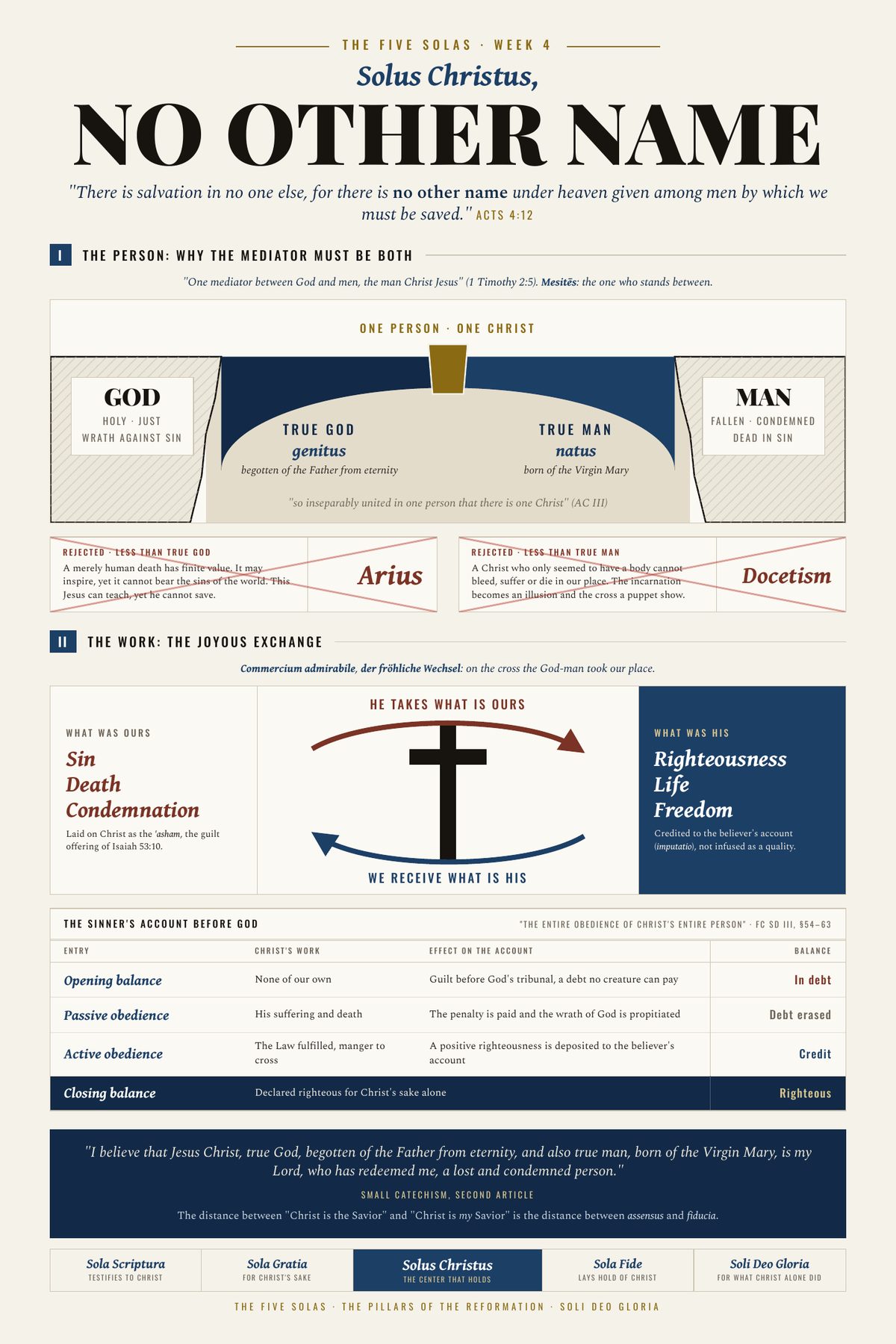
This week’s poster: No Other Name
The whole session on one page, printed at 24 by 36 inches for the classroom. Open it on screen or download it to print.
How this session works
For three weeks we have traced where God speaks (Sola Scriptura), what moves Him to save (Sola Gratia), and the instrument that receives the gift (Sola Fide). This fourth session names the Person every other sola presupposes, tracing Solus Christus through the exclusive claim of the apostolic preaching (Acts 4:8–12), the sole mediatorship and permanent priesthood of the God-man (1 Timothy 2:5–6; Hebrews 7:23–27), the cosmic supremacy of Christ over all creation (Colossians 1:15–20), His threefold self-identification as the Way, the Truth, and the Life (John 14:6), and the Confessions’ articulation of the two natures united in one Person (Augsburg Confession, Article III; Small Catechism, Second Article).
Opening Prayer
Almighty God, You sent Your only-begotten Son into our flesh to be our Mediator, our High Priest, and our Redeemer. Open our eyes to see that in Him alone the fullness of Your grace dwells, that His blood alone atones for our sin, and that His name alone avails for our salvation. Grant that we may confess with boldness and receive with joy that there is no other name under heaven given among men by which we must be saved. Through Jesus Christ, Your Son, our Lord, who lives and reigns with You and the Holy Spirit, one God, now and forever. Amen.
Opening and Framing
The Center That Holds
For three weeks we have been circling a center without yet naming it. Scripture is the authority (Sola Scriptura), yet what gives Scripture its saving power is the One to whom it testifies: “It is they that bear witness about me” (John 5:39). Grace is the source of salvation (Sola Gratia), yet grace is never an abstract commodity; it is always grace “for Christ’s sake.” Faith is the instrument (Sola Fide), yet faith justifies only because it lays hold of Christ’s merit. Remove Christ from any of the other solas, and what remains is an empty frame with no portrait.
This week we stand before the portrait. Solus Christus is the material center of the Reformation confession. It answers the question that every other sola presupposes: on what basis does God declare sinners righteous? The answer is not a program or a principle. The answer is a Person.
The Central Question
On what basis does God declare sinners righteous? Whose merit, whose work, whose righteousness avails before God’s tribunal? And why must that Person be both true God and true man?
Question 1
The Reformation is often summarized with five Latin phrases, yet Luther himself said that the article of justification stands or falls with the Person of Christ. If someone asked you, “Why does it matter who Jesus is, as long as He is a good moral teacher?” how would you respond? What is at stake in the identity of Christ that is not at stake in His ethical teachings alone?
Question 2
We have studied Scripture as the authority, grace as the source, and faith as the instrument. In each case, Christ was already present in the background. Where did you notice Christ most clearly in the previous three sessions? What happens to Sola Scriptura if the Scriptures do not testify to Christ? What happens to Sola Gratia if grace is not given “for Christ’s sake”?
Framing Statement
This session will trace the doctrine of Solus Christus through five biblical texts and two Confessional readings: the exclusive claim that there is no other name (Acts 4), the sole mediatorship and ransom price (1 Timothy 2), the cosmic supremacy and reconciling blood of Christ (Colossians 1), the permanent and sufficient priesthood (Hebrews 7), the threefold self-identification as Way, Truth, and Life (John 14), and the Confessional articulation of the two natures (Augsburg Confession III) and the intensely personal confession of redemption (Small Catechism, Second Article).
Key Vocabulary
Solus Christus (Latin): “Christ alone.” The doctrine that Jesus Christ is the sole ground of justification, the sole Mediator between God and man, and the sole object of saving faith. His merit, not ours, is the basis on which God declares sinners righteous.
Communicatio Idiomatum (Latin): “Communication of attributes.” The properties of each nature (divine and human) are rightly predicated of the whole Person of Christ. The Son of God truly suffered; the son of Mary is truly omnipotent.
Active Obedience (obœdientia activa): Christ’s perfect fulfillment of the Law throughout His earthly life. This constitutes the positive righteousness imputed to believers.
Passive Obedience (obœdientia passiva): Christ’s suffering and death, by which He bore the penalty for sin. This satisfies the just wrath of God.
Mesitēs (μεσίτης, Greek): “Mediator.” One who stands between two estranged parties to forge reconciliation. Christ alone qualifies as the one Mediator, being both true God and true man (1 Timothy 2:5).
Ephapax (ἐφάπαξ, Greek): “Once for all.” The word used in Hebrews 7:27 to describe the finality and unrepeatable sufficiency of Christ’s self-sacrifice.
Imputatio (Latin): “Imputation.” The crediting of Christ’s righteousness to the believer’s account. Justification is not infusion but declaration: the sinner is righteous on the basis of Christ’s righteousness, received through faith.
Part One: No Other Name, Acts 4:8–12
Peter stands before the Sanhedrin, the court that condemned Jesus, and announces the most exclusive claim in the New Testament. The stone the builders rejected has become the cornerstone, and there is salvation in no one else.
A. The Courtroom Declaration
✛ Read Acts 4:8–12 aloud.
Acts 4:8–12 (ESV)
Then Peter, filled with the Holy Spirit, said to them, “Rulers of the people and elders, if we are being examined today concerning a good deed done to a crippled man, by what means this man has been healed, let it be known to all of you and to all the people of Israel that by the name of Jesus Christ of Nazareth, whom you crucified, whom God raised from the dead—by him this man is standing before you well. This Jesus is the stone that was rejected by you, the builders, which has become the cornerstone. And there is salvation in no one else, for there is no other name under heaven given among men by which we must be saved.”
Key Greek Terms
Onoma (ὄνομα): “Name.” In biblical theology, a name signifies the authority, presence, and saving power of the person named. Peter seizes the Sanhedrin’s own question (“by what name?”) and makes the name of Jesus the exclusive cause of salvation.
Sōtēria (σωτηρία): “Salvation.” The noun encompasses physical deliverance (the healed man) and eternal spiritual rescue. Peter bridges visible healing and invisible redemption: the lame man’s restoration is a living parable of the Gospel.
Dei (δεῖ): “It is necessary.” Carries the force of divine necessity. We are not merely invited to be saved through this name; we must be, for there is no alternative.
Peter speaks these words before the very court that condemned Jesus to death. The phrase “whom you crucified” is not incidental; it is the heart of the proclamation. The stone that the builders rejected has become the cornerstone (Psalm 118:22). The irony is devastating: the court that sits in judgment on Peter is itself judged by the name it rejected.
Question 3
Peter declares that the healing occurred “by the name (onoma) of Jesus Christ of Nazareth.” In biblical theology, a “name” signifies the authority, presence, and power of the person named. The Sanhedrin asked, “By what power or by what name did you do this?” (v. 7). How does Peter’s answer turn the court’s interrogation into a proclamation of the Gospel? What does it mean that salvation is located in a name rather than in a system, a method, or a moral program?
Question 4
Verse 12 uses the Greek word dei (“it is necessary”), indicating divine necessity: “there is no other name under heaven given among men by which we must be saved.” The exclusivity is not arbitrary; it follows from the nature of the remedy. Only one Person has lived the perfectly righteous life, borne the penalty for sin, and conquered death. If there is only one cure, exclusivity is not narrow-mindedness; it is the nature of the disease. In a culture that prizes religious pluralism and regards exclusive truth claims as arrogant, how do we confess this truth with both courage and compassion?
Question 5
Peter quotes Psalm 118:22: “The stone that was rejected by you, the builders, which has become the cornerstone.” The religious leaders who fancied themselves the master builders of Israel discarded the very stone on which everything rests. How does the image of the rejected cornerstone function as a summary of Solus Christus? What happens to any structure that removes its cornerstone? What does this say about any theological system that removes Christ from the center?
Part Two: The One Mediator and the Eternal Priest, 1 Timothy 2:5–6; Hebrews 7:23–27
If Acts 4 establishes the exclusivity of Christ’s name, these passages establish the exclusivity of His mediatorship and priesthood. The question is not merely “through whom are we saved?” but “through whom do we approach God?”
A. The Sole Mediator (1 Timothy 2:5–6)
✛ Read 1 Timothy 2:5–6 aloud.
1 Timothy 2:5–6 (ESV)
For there is one God, and there is one mediator between God and men, the man Christ Jesus, who gave himself as a ransom for all, which is the testimony given at the proper time.
Key Greek Terms
Mesitēs (μεσίτης): “Mediator” or “arbitrator.” One who stands in the middle of two estranged parties to forge peace. Christ is the only go-between to reconcile the holy God and sinful humanity.
Antilytron (ἀντίλυτρον): “Ransom.” An intensified form of lytron, translating the Old Testament Hebrew kofer (כֹפֶר), the exact substitutionary price paid to release captives. Jesus mediated not by giving advice but by surrendering His own life as the substitute payment.
Anthrōpos (ἄνθρωπος): “Man.” Paul says “the man Christ Jesus,” emphasizing the true humanity of the Mediator. A mediator must represent both sides; as God, His work has infinite value; as man, He acts as our true substitute.
Paul’s statement is arithmetically precise: one God, one mediator. If there is one, there are not two or three or a hierarchy arranged by rank. The medieval devotional system had developed a structure of intercessory saints, with the Blessed Virgin at the highest position beneath Christ. The Reformers did not deny that the saints are honored examples of faith; they denied that any saint functions as a mediator between God and man.
Question 6
Paul calls Jesus the “one mediator” (mesitēs), an arbitrator standing between two estranged parties. The Mediator must perfectly represent both sides. Why does Paul then immediately specify “the man Christ Jesus” (anthrōpos)? What would be lost if the Mediator were only God? What would be lost if He were only man? How does the two-nature Christology of the Augsburg Confession (Article III) make mediation possible?
Question 7
The ransom price is described with the intensified Greek word antilytron, which translates the Hebrew kofer (כֹפֶר): the exact substitutionary price paid on the principle of “life for life” (Exodus 21:23). Jesus did not mediate by offering counsel or moral example; He mediated by surrendering His own life. What does the specificity of the ransom language tell us about the nature of salvation? Why is moral influence or good teaching insufficient as a ransom?
B. The Permanent Priesthood (Hebrews 7:23–27)
✛ Read Hebrews 7:23–27 aloud.
Hebrews 7:23–27 (ESV)
The former priests were many in number, because they were prevented by death from continuing in office, but he holds his priesthood permanently, because he continues forever. Consequently, he is able to save to the uttermost those who draw near to God through him, since he always lives to make intercession for them. For it was indeed fitting that we should have such a high priest, holy, innocent, unstained, separated from sinners, and exalted above the heavens. He has no need, like those high priests, to offer sacrifices daily, first for his own sins and then for those of the people, since he did this once for all when he offered up himself.
Key Greek Terms
Aparabaton (ἀπαράβατον): “Permanent” or “without disruption.” Christ’s priesthood cannot be interrupted by unavailability, sickness, aging, or death. He has no deputies, no assistants, and no successors.
Eis to panteles (εἰς τὸ παντελές): “To the uttermost” or “completely.” Carries a dual meaning: He saves completely in spatial extent (no sin unatoned for) and completely in temporal length (finally and forever).
Ephapax (ἐφάπαξ): “Once for all.” A single, unique, final occurrence with permanent, eternal significance. The daily sacrifices testified to their own inadequacy by their very repetition; Christ’s one sacrifice needs no supplement.
Heauton anenēgkas (ᵽαυτὸν ἀνενέγκας): “By offering up himself.” The verb anapherō (“to carry up, to offer”) describes a sacrifice sent up to God. This is the only place in the Greek Bible where this sacrificial verb refers to the offering of a person. The great High Priest is simultaneously the unblemished sacrificial Lamb.
The argument of Hebrews is devastating in its simplicity. The old priests died and were replaced. Their sacrifices were repeated daily, the very repetition testifying to their inadequacy. Christ’s priesthood is permanent: He “continues forever” and “always lives to make intercession.”
Question 8
Hebrews draws a contrast using the Greek particles men and de (“on the one hand” / “on the other hand”): “on the one hand” there were many priests who kept dying; “on the other hand” there is He who holds His priesthood permanently (aparabaton). What does it mean for the assurance of the believer that Christ’s priesthood can never be interrupted, that He has no deputies, assistants, or successors?
Question 9
Verse 25 says Christ is “able to save to the uttermost” (eis to panteles), a phrase that means both “completely” and “for all time.” There is no sin too deep for His blood to cover and no expiration date on His priesthood. He saves those who “draw near” (proserchomenous), a term that in the Septuagint was used for priests approaching God in the sanctuary. How does Solus Christus grant every believer the right to approach the heavenly throne that only priests could once approach? What does this mean for how you pray?
Question 10
The author declares that Jesus offered Himself ephapax (“once for all”), using the compound Greek verb heauton anenēgkas (“by offering up himself”), the only place in the entire Greek Bible where the sacrificial verb anapherō refers to the offering of a person. The Priest becomes the Sacrifice. Any system that attempts repeatedly to sacrifice Christ, or suggests that our works must supplement His cross, denies the word ephapax. How does this shape the Lutheran understanding of what happens in the Lord’s Supper: is it a re-sacrifice, or the distribution of a finished sacrifice?
Question 11
Hebrews says Christ “always lives to make intercession” (entugchanein) for those who draw near through Him. If Christ’s intercession is permanent and complete, what need remains for any other intercessor? The Reformers did not deny that Christians can pray for one another; they denied that departed saints function as mediators whose intercession supplements Christ’s. The Augsburg Confession, Article XXI, declares: “Scripture sets before us the one Christ as the Mediator.” What is the practical difference between asking a living brother or sister to pray for you and directing prayers to departed saints as intercessors before God?
Part Three: The Cosmic Christ, Colossians 1:15–20
Paul unleashes the most majestic Christological hymn in the New Testament against a proto-Gnostic heresy at Colossae. Christ is not merely the Savior of sinners; He is the Creator and Sustainer of all reality, and the fullness of God dwells in Him bodily.
A. Lord of Creation (1:15–17)
✛ Read Colossians 1:15–20 aloud.
Colossians 1:15–20 (ESV)
He is the image of the invisible God, the firstborn of all creation. For by him all things were created, in heaven and on earth, visible and invisible, whether thrones or dominions or rulers or authorities—all things were created through him and for him. And he is before all things, and in him all things hold together. And he is the head of the body, the church. He is the beginning, the firstborn from the dead, that in everything he might be preeminent. For in him all the fullness of God was pleased to dwell, and through him to reconcile to himself all things, whether on earth or in heaven, making peace by the blood of his cross.
Key Greek Terms
Prōtotokos (πρωτότοκος): “Firstborn.” Not a statement of biological origin but a title of supreme rank, sovereignty, and priority. Just as Yahweh calls the Davidic king “firstborn” to denote supremacy over the kings of the earth (Psalm 89:27), Christ holds the absolute right of inheritance over all creation.
Plērōma (πλήρωμα): “Fullness.” Proto-Gnostic teachers held that the divine essence was scattered among a hierarchy of spirit-beings. Paul declares that all the fullness of God was pleased to dwell in Jesus bodily. One hundred percent of the divine essence resides exclusively in the incarnate Christ.
Synestēken (συνέστηκεν): “Hold together” or “subsist.” Christ is the cosmic glue. If He were to remove His sustaining hand, the entire universe would disintegrate.
Paul applies three prepositions to Christ in verse 16 to lock out every rival: en autō (“in Him”, the sphere of creation), di’ autou (“through Him”, the agent of creation), and eis auton (“for Him”, the goal of creation). Everything exists in Christ, was made through Christ, and finds its purpose in Christ.
Question 12
Paul calls Christ the “firstborn of all creation” (prōtotokos). The Arians (and modern Jehovah’s Witnesses) have seized this phrase to argue that Christ is the first creature God made. Yet grammatically and culturally, prōtotokos is a title of supreme rank, not biological origin (cf. Psalm 89:27, where the Davidic king is called “firstborn” to denote supremacy). Why is it essential for Solus Christus that Christ is the Lord of creation and not part of creation? What happens to the sufficiency of His sacrifice if He is merely a creature?
Question 13
Paul uses three prepositions in verse 16 to describe Christ’s relationship to creation: en autō (“in Him,” the sphere), di’ autou (“through Him,” the agent), and eis auton (“for Him,” the goal). The Colossian heretics were worshiping invisible angelic beings (“thrones, dominions, rulers, authorities”). How does Paul’s argument that Jesus manufactured those very angels destroy any basis for venerating them alongside Christ?
B. Head of the New Creation (1:18–20)
Question 14
Verse 19 declares that “all the fullness” (plērōma) of God was pleased to dwell in Christ. The proto-Gnostics taught that divine fullness was scattered among a hierarchy of spirit-beings and that worshipers had to climb a spiritual ladder to reach God. Paul destroys this by locating one hundred percent of the divine essence in the incarnate Jesus. Where do Christians today seek spiritual “fullness” in something or someone other than Christ? How does the plērōma declaration speak to every form of “Christ plus” theology?
Question 15
Verse 20 brings the cosmic scope down to the cross: reconciliation is accomplished “by the blood of his cross.” The majestic Christology of the hymn meets the grit of the crucifixion. The Christ who sustains the atomic structure of wood and nails (synestēken, v. 17) is the Christ who bleeds on the wood and nails. How does this intersection of cosmic supremacy and cruciform humiliation deepen our understanding of what the cross accomplished? Why must the blood shed on Calvary be the blood of the God-man for it to reconcile “all things, whether on earth or in heaven”?
Part Four: The Way, the Truth, and the Life, John 14:6
On the night before His crucifixion, Thomas asks, “How can we know the way?” Jesus’ answer is not a direction; it is a Person. He does not show the way; He is the Way. He does not teach the truth; He is the Truth. He does not give life; He is the Life.
A. The Divine Self-Identification
✛ Read John 14:6 aloud.
John 14:6 (ESV)
Jesus said to him, “I am the way, and the truth, and the life. No one comes to the Father except through me.”
Key Greek Terms
Egō eimi (ἐγώ εἰμί): “I AM.” The emphatic self-identification that directly evokes the divine name revealed at the burning bush (Exodus 3:14). Jesus is not presenting Himself as a guide; He is identifying Himself as the one, true God incarnate.
Hē hodos (ἡ ὁδός): “The Way.” The definite article is exclusive: not a way but the Way. In the Old Testament, the “way” of God was practically synonymous with His Torah. Jesus is the incarnate instruction of God; the path to the Father is the way of the cross.
Hē alētheia (ἡ ἀλήθεια): “The Truth.” In John’s Gospel, truth is not merely a philosophical concept; truth is a Person. God alone defines ultimate reality, and this reality is manifested in the Son.
Hē zōē (ἡ ζωή): “The Life.” Jesus does not merely dispense life as a gift separate from Himself; He is the human form of the Life of God. His death and resurrection guarantee that those united to Him share in eternal life.
Jesus uses the definite article (“hē”) before each noun. He does not claim to be a way, a truth, or a life. He is the absolute, exclusive embodiment of all three. The concluding negative, “No one comes to the Father except through me,” reinforces the positive with an unqualified exclusion.
Question 16
Jesus’ statement begins with egō eimi (“I AM”), one of the seven “I AM” declarations in John’s Gospel. This phrase directly evokes the divine name Yahweh revealed to Moses at the burning bush (Exodus 3:14). How does the divine authority of the Speaker determine the weight of the exclusive claim? If a mere prophet said “No one comes to the Father except through me,” it would be presumption. When the eternal egō eimi says it, what is it?
Question 17
Jesus uses the definite article (hē) before each noun: the Way, the Truth, the Life. He does not claim to be one way among many, one truth among several, one source of life alongside others. He identifies Himself as the Way, the Truth, and the Life. What difference does this identification make? If Christ is not merely a teacher who shows the way but the Way itself, what does this mean for the claim that all religions lead to the same God?
Question 18
John 14:6 connects Solus Christus to the previous three solas with elegant precision. The Way to the Father is through Christ, not through human effort (therefore Sola Gratia). The Way is received by coming to Christ, which is what faith does (therefore Sola Fide). The Truth about the Way is revealed in Scripture, which testifies to Christ (therefore Sola Scriptura). How does Christ function as the hub from which every spoke of the Reformation confession extends?
Part Five: The Confessional Witness, Augsburg Confession, Article III; Small Catechism, Second Article
The Augsburg Confession’s Third Article confesses who Christ is (the Person), and Luther’s explanation of the Second Article confesses what Christ has done (the work) in the most personal terms the Reformation produced.
A. Two Natures, One Christ (Augsburg Confession, Article III)
✛ Open your Book of Concord to the Augsburg Confession, Article III. Read the article aloud.
Augsburg Confession, Article III
Furthermore, it is taught that God the Son became a human being, born of the pure Virgin Mary, and that the two natures, divine and human, are so inseparably united in one person that there is one Christ. He is true God and true human being who truly was born, suffered, was crucified, died, and was buried, in order both to be a sacrifice not only for original sin but also for all other sins, and to propitiate God’s wrath.
Key Theological Terms
Logos asarkos / Logos ensarkos: The Word not yet made flesh / the incarnate Word. Before the incarnation, the second Person of the Trinity existed eternally as the Logos asarkos. In the fullness of time, He became the Logos ensarkos, stepping into human history.
Genitus / Natus: “Begotten” / “Born.” As the Athanasian Creed distinguishes: Jesus is “God, begotten from the substance of the Father before all ages; and He is man, born from the substance of His mother in this age.”
Commercium admirabile: “The joyous exchange.” Luther’s term for the atonement: on the cross, the God-man swapped places with sinners. He absorbed our punishment; we receive His righteousness.
’Asham (אָשָׁם, Hebrew): “Guilt offering.” The sacrificial term from Isaiah 53:10 that the Confessions link to Christ’s atoning work. An ’asham was a victim offered to make satisfaction for sin.
The key phrase is “so inseparably united in one person that there is one Christ.” The two natures are not blended (the error of Eutyches) or merely associated in a loose partnership (the error of Nestorius). They are united without confusion, without change, without division, without separation. If the two natures are separated, the cross loses its power.
Question 19
The Confession distinguishes between Jesus as genitus (begotten of the Father from eternity) and natus (born of the Virgin Mary in time). The Formula of Concord affirms: “Christ is and remains to all eternity God and man in one undivided person. Next to the Holy Trinity, this is the highest mystery, upon which our only consolation, life, and salvation depends.” Why does the Formula place this mystery so high? What would collapse in the doctrine of salvation if either nature were denied?
Question 20
The communication of attributes (communicatio idiomatum) teaches that what is true of either nature is rightly said of the whole Person. The Son of God truly suffered; the son of Mary truly upholds the universe. Why does this matter for the Lord’s Supper? Consider: the body given “for you” is the body of the Person who is also God. The blood shed “for the forgiveness of sins” is the blood of the eternal Son. How does the union of the two natures determine the value of what is given in the Sacrament?
Question 21
Luther described the atonement as the commercium admirabile (“joyous exchange”): on the cross, Christ took our sin, death, and condemnation and gave us His righteousness, life, and freedom. The Apology links this to the Hebrew ’asham (“guilt offering”) of Isaiah 53:10, declaring that God does not want our own righteousness but the merits of another to reconcile Him to us. How does the image of the “joyous exchange” reframe the cross: is it primarily something done to Jesus or something done for us? How does this distinction comfort the conscience?
B. “My Lord, Who Has Redeemed Me” (Small Catechism, Second Article)
✛ Open your Small Catechism to the Second Article of the Creed and Luther’s explanation. Read it aloud.
Small Catechism, Second Article Explanation
I believe that Jesus Christ, true God, begotten of the Father from eternity, and also true man, born of the Virgin Mary, is my Lord, who has redeemed me, a lost and condemned person, purchased and won me from all sins, from death, and from the power of the devil, not with gold or silver but with his holy, precious blood and with his innocent suffering and death, in order that I may be his own, live under him in his kingdom, and serve him in everlasting righteousness, innocence, and blessedness, just as he has risen from death and lives and rules eternally. This is most certainly true.
Every phrase is personal: “my Lord,” “has redeemed me,” “a lost and condemned person.” Luther compresses the entire history of redemption into a single breathless sentence and directs it at the individual believer. The word “Lord” means “Redeemer”: He is the exclusive One who has brought us back from the devil to God, from death to life, from sin to righteousness.
Question 22
Luther’s explanation is intensely personal: “my Lord” who has redeemed “me, a lost and condemned person.” The doctrine of Solus Christus can remain an abstract theological principle until it becomes a first-person confession. What is the distance between saying “Christ is the Savior” and “Christ is my Savior”? In the language of Week 3, this is the distance between assensus (intellectual agreement) and fiducia (personal trust). How would you help someone in your congregation cross that distance?
Question 23
The explanation names three enemies from which Christ redeems: “all sins, from death, and from the power of the devil.” The ransom price is specified: “not with gold or silver but with his holy, precious blood.” In light of the Greek antilytron (1 Timothy 2:6) and the Hebrew kofer (Exodus 21:23), why does Luther insist that the ransom was paid with blood and not with any other currency? What does the costliness of the price reveal about the depth of our bondage?
Synthesis and Closing
Summary: The Person and the Work
| Text | Contribution to Solus Christus | Key Term |
|---|---|---|
| Acts 4:8–12 | The exclusive claim: no other name under heaven for salvation | Onoma; Dei |
| 1 Timothy 2:5–6 | The sole mediatorship; ransom paid by the God-man | Mesitēs; Antilytron |
| Colossians 1:15–20 | Cosmic supremacy: Creator, Sustainer, Reconciler; fullness of God in Christ | Prōtotokos; Plērōma |
| Hebrews 7:23–27 | Permanent priesthood; saves to the uttermost; once-for-all sacrifice | Aparabaton; Ephapax |
| John 14:6 | The Way, the Truth, the Life; absolute exclusion of all other paths | Egō eimi; Hē hodos |
| AC III; SC Second Art. | Two natures, one Person; personal confession: “my Lord, who has redeemed me” | Communicatio Idiomatum; Commercium admirabile |
Final Discussion
Read the Small Catechism’s Second Article explanation one more time.
Question 24
The Formula of Concord insists on both the active and the passive obedience of Christ as the ground of justification: “the entire obedience of Christ’s entire person” (FC SD III, §54–63). The passive obedience is His suffering and death, bearing the penalty for sin. The active obedience is His perfect fulfillment of the Law, earning the positive righteousness credited to believers. In your own words, what would be lost if we affirmed only the passive obedience without the active? The sinner’s debt would be cancelled, yet what positive righteousness would stand to his or her credit? What would be lost if we affirmed only the active without the passive? The Law would be fulfilled, yet who would have paid the penalty?
Question 25
We have traced Solus Christus from the exclusive claim (Acts 4), through the sole mediatorship (1 Timothy 2), the cosmic supremacy (Colossians 1), the permanent priesthood (Hebrews 7), the threefold self-identification (John 14), the Confessional articulation of the two natures (AC III), and the personal confession of redemption (Small Catechism). As we prepare for Reformation Sunday next week and Soli Deo Gloria, consider: if Christ alone is the ground of justification, the sole Mediator, and the exclusive Way to the Father, then to whom does the glory belong? How does Solus Christus lead inevitably to Soli Deo Gloria?
Appendix — Liturgical, Lectionary, and Hymnic Connections
Where these texts appear in the life of the Church.
Acts 4:8–12
This is the appointed First Reading for Easter 4 in Series B of the Three-Year Lectionary. It is also the appointed First Reading for the Festival of the Confession of St. Peter, where Peter’s bold declaration that there is salvation in no one else provides the text for celebrating the apostolic confession of Christ.
1 Timothy 2:5–6
This falls within the Epistle reading for Proper 20 in Series C. On that Sunday, 1 Timothy 2:5–6a serves as the appointed Alleluia Verse: “Alleluia. For there is one God, and there is one mediator between God and men, the man Christ Jesus, who gave himself as a ransom for all. Alleluia.”
Colossians 1:15–20
This is the appointed Epistle reading for Proper 29 in Series C (the Last Sunday of the Church Year). The Church also draws on Colossians 1:20 in the Good Friday liturgy, where the theology of the cross is grounded in the reconciliation accomplished through “the blood of his cross.”
Hebrews 7:23–27
This (extending to v. 28) is the appointed Epistle reading for Proper 25 in Series B. The teaching that Christ offered Himself “once for all” profoundly shapes Lutheran sacramental theology and the Communion liturgy.
John 14:6
This falls within the appointed Holy Gospel for Easter 5 in Series A and for the Festival of St. Philip and St. James, Apostles. On that festival, John 14:6 also serves as the Alleluia Verse: “Alleluia. I am the way, and the truth, and the life. No one comes to the Father except through me. Alleluia.”
Hymn selections
LSB 538 — Praise Be to Christ in Whom We See
Timothy Dudley-Smith’s hymn is a direct versification of Colossians 1:15–20. Scholars widely regard the Christ Hymn as one of the earliest Christian hymns, predating Paul’s letter; LSB 538 is therefore a modern versification of one of the oldest songs of the Church.
LSB 617 — O Lord, We Praise Thee
This Communion hymn confesses that the Lord’s Supper is not a propitiatory sacrifice offered to God but a feast where God distributes the pardon, grace, and peace already won by the once-for-all sacrifice of Hebrews 7:27.
LSB 941 — We Praise You and Acknowledge You, O God
This metrical paraphrase of the Te Deum laudamus closely parallels the Second Article of the Creed, giving the singer a complete synopsis of the life of Christ and mirroring Luther’s explanation of “my Lord, who has redeemed me.”
LSB 656 — A Mighty Fortress Is Our God
Luther’s great Reformation hymn. The second stanza identifies Christ as the Champion who fights and wins the battle for us: “Lord Sabaoth, His name, from age to age the same.” The entire hymn is a confession that victory belongs to Christ alone.
LSB 557 — Sing Praise to the God of Israel
A paraphrase of the Benedictus (Luke 1:68–79), celebrating God’s visitation and redemption of His people through the promised Messiah, the sole horn of salvation raised up for us.
Closing Prayer
Lord Jesus Christ, Son of the living God, You are the Way when we are lost, the Truth when we are deceived, and the Life when we are dead in sin. We thank You that You did not send another in Your place but came Yourself, true God and true man, to bear our guilt and purchase our freedom with Your own blood. Strengthen us to confess before the world that there is salvation in no one else, and keep us always in the comfort of Your finished work, until we see You face to face in everlasting glory. Amen.
Soli Deo Gloria