Week five of five
Soli Deo Gloria
To God Alone Be the Glory
Romans 11:33–36 · Isaiah 48:9–11 · Ephesians 1:3–14 · Revelation 5:9–14 · Psalm 115:1 · Large Catechism, First Commandment (§1–22)
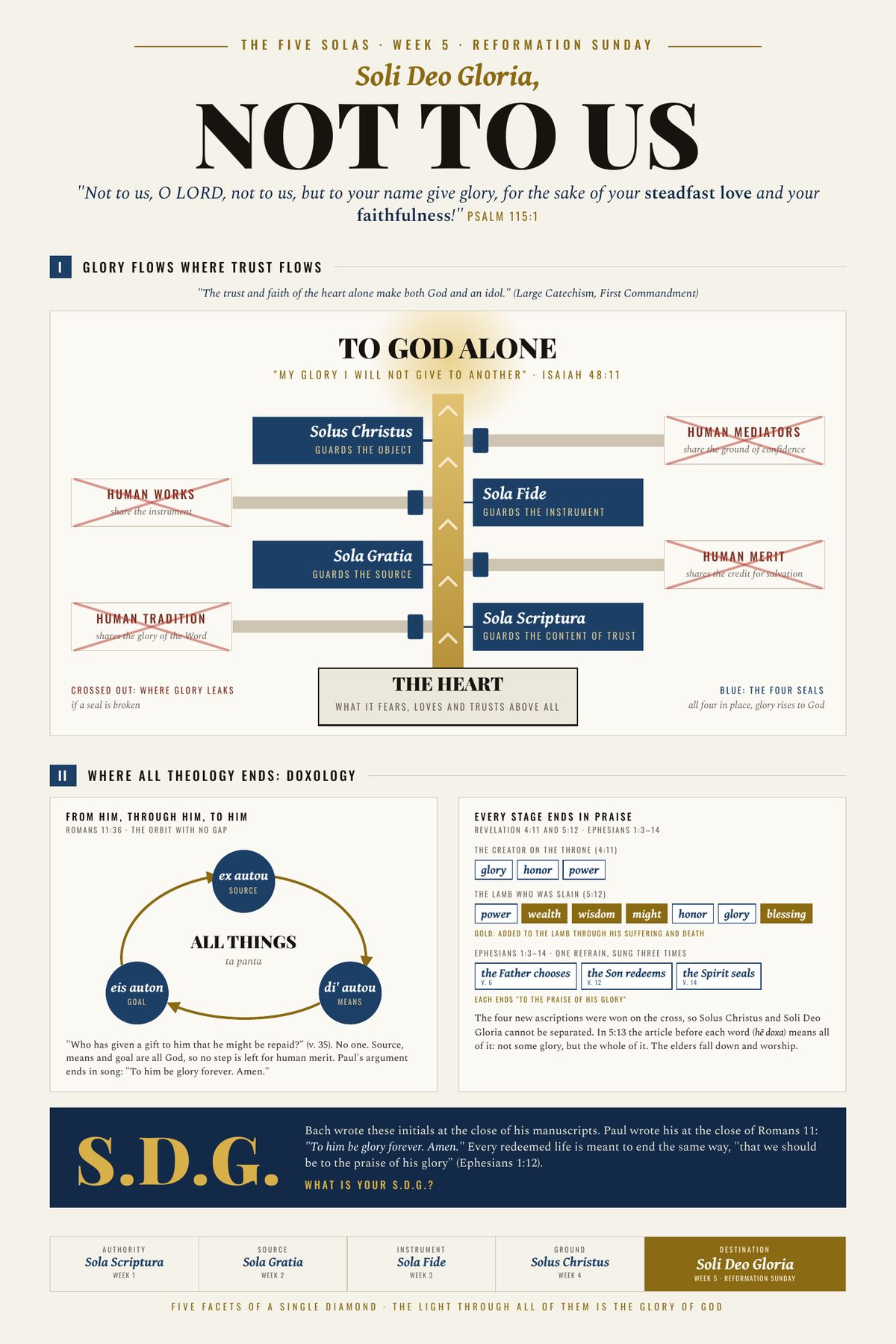
This week’s poster: Not to Us
The whole session on one page, printed at 24 by 36 inches for the classroom. Open it on screen or download it to print.
How this session works
For four weeks we have traced the grammar of the Gospel through its constituent parts: Scripture alone as the authority, grace alone as the source, faith alone as the instrument, Christ alone as the ground. This fifth and final session, on Reformation Sunday, asks the question all four have been pointing toward: for whose glory does it exist? It traces Soli Deo Gloria through the great doxology that erupts at the climax of Paul’s argument (Romans 11:33–36), God’s fierce jealousy for His own name (Isaiah 48:9–11), the Trinitarian plan of salvation directed to the praise of His glory (Ephesians 1:3–14), the eschatological worship of the Lamb (Revelation 5:9–14), the anthem of human self-effacement (Psalm 115:1), and Luther’s exposition of the First Commandment (Large Catechism, §1–22).
Opening Prayer
Almighty God, from whom and through whom and to whom are all things, You have revealed in Your Word that Your glory is the end and purpose of all You have made and all You have redeemed. Open our hearts by Your Spirit on this Reformation Sunday to see that every blessing we have received—Your Word, Your grace, the faith You have given, the Christ who died for us—exists for the praise of Your glory alone. Strip away every idol that competes for our heart’s allegiance, and fix our trust on You, the only true God, now and forever. Through Jesus Christ, Your Son, our Lord, who lives and reigns with You and the Holy Spirit, one God, now and forever. Amen.
Opening and Framing
Where All Theology Ends
For four weeks we have traced the grammar of the Gospel through its constituent parts. Scripture alone is the authority. Grace alone is the source. Faith alone is the instrument. Christ alone is the ground. Each sola answered a specific question, and each one proved indispensable. Yet each one, properly understood, pointed beyond itself to the question that this final session addresses: for whose glory does all of this exist?
The answer is not a new idea appended to the previous four. It is the destination toward which all four have been traveling from the beginning. Soli Deo Gloria is the doxological principle that orients the other solas toward their proper end. If any of the four is compromised, glory leaks from God to the creature, and the Gospel is distorted. This session, on Reformation Sunday, asks what that confession means for us.
The Central Question
For whose glory does God save? To whom does the praise belong? And what does it mean for the worship, prayer, and common life of this congregation that the glory belongs to God alone?
Question 1
The Reformation is often presented as a dispute about indulgences or papal authority, yet the Reformers insisted that every doctrinal controversy ultimately concerned the glory of God. Paul breaks into doxology at the end of eleven chapters of the most rigorous theological argument in the New Testament (Romans 11:33–36). He does not abandon theology for praise; the theology produces the praise. What does this suggest about the relationship between doctrinal depth and genuine worship? Is it possible to have deep worship without deep theology?
Question 2
Over the past four weeks we have studied Sola Scriptura, Sola Gratia, Sola Fide, and Solus Christus. Before we begin the biblical texts for today, consider: how does each of the previous four solas serve to direct glory away from the creature and toward God? Which sola has most changed or deepened your understanding of the Gospel during this series?
Framing Statement
This session will trace the doctrine of Soli Deo Gloria through five biblical texts and one Confessional reading: the great doxology at the climax of Romans 1–11 (Romans 11:33–36), God’s fierce jealousy for His own name (Isaiah 48:9–11), the Trinitarian plan of salvation directed to the praise of God’s glory (Ephesians 1:3–14), the eschatological worship of the Lamb (Revelation 5:9–14), the anthem of human self-effacement (Psalm 115:1), and Luther’s exposition of the First Commandment in the Large Catechism (§1–22).
Key Vocabulary
Soli Deo Gloria (Latin): “To God alone be the glory.” The doxological principle that all praise, honor, and credit for salvation belong exclusively to God. It is both the culmination and the governing logic of the other four solas.
Doxa (δόξα, Greek): “Glory.” In Scripture, doxa denotes the weight, majesty, splendor, and honor due to God for His creative and redemptive acts. In the Septuagint, doxa translates the Hebrew kabod, the visible radiance of God’s presence.
Kabod (כָבוֹד, Hebrew): “Glory” or “weightiness.” The Hebrew root conveys heaviness and substance. God’s glory is not a mere attribute; it is the full weight of His divine being. To give God the glory is to acknowledge the entire substance of who He is.
Doxology (Greek: doxologia): A verbal expression of praise and glory to God. From doxa (glory) and logos (word). The five solas are, in their deepest structure, a doxology: they exist to return all glory to the God from whom salvation comes.
Idolatry (Latin: idololatria): The directing of ultimate trust, love, and fear toward anything other than the true God. In Luther’s treatment of the First Commandment, idolatry is not limited to the worship of carved images; it includes any object of the heart’s supreme confidence that is not the true God.
Fear, Love, and Trust (German: Fürchten, Lieben, Vertrauen): Luther’s three categories for what constitutes “having a god.” Whatever a person fears above all things, loves above all things, and trusts above all things is, functionally, that person’s god.
Hesed (חֶסֶד, Hebrew): “Steadfast love” or “covenant faithfulness.” One of two attributes cited in Psalm 115:1 as the ground for giving glory to God’s name. God’s glory is manifested most fully in His unfailing mercy toward His people.
Emet (אֶמֶת, Hebrew): “Truthfulness” or “reliability.” The companion to hesed in Psalm 115:1. Together, hesed and emet summarize God’s covenant character, echoing His self-revelation to Moses at Sinai (Exodus 34:6).
Part One: The Great Doxology, Romans 11:33–36
Paul’s theological masterpiece in Romans 1–11 does not end with a summary or a practical application. It ends with an eruption of praise. The deepest theology produces the deepest worship, and the deepest worship confesses that all glory belongs to God alone.
A. The Exclamation of Awe
✛ Read Romans 11:33–36 aloud.
Romans 11:33–36 (ESV)
Oh, the depth of the riches and wisdom and knowledge of God! How unsearchable are his judgments and how inscrutable his ways! “For who has known the mind of the Lord, or who has been his counselor?” “Or who has given a gift to him that he might be repaid?” For from him and through him and to him are all things. To him be glory forever. Amen.
Key Greek Terms
Bathos (βάθος): “Depth.” Paul marvels at the unfathomable depth of God’s riches, wisdom, and knowledge. The divine plan of salvation cannot be sounded by human intellect.
Ploutos (πλοῦτος): “Riches.” Not material wealth, but the inexhaustible abundance of God’s grace, kindness, and mercy poured out on undeserving sinners. A treasury with no bottom.
Sophia (σοφία): “Wisdom.” God’s brilliant, saving master plan in history, which brings life out of death and weaves Jews and Gentiles into one family through the cross.
Gnosis (γνῆσις): “Knowledge.” Rooted in the Hebrew concept of yada’, God’s intimate, relational knowing and electing of His people before time began.
Anexerauneta (ἀνεξεραύνητα): “Unsearchable.” An alpha-privative compound: impossible to search out. God’s saving judgments (krimata) cannot be scrutinized by human reason.
Anexichniastoi (ἀνεξιχνίαστοι): “Inscrutable” or “untraceable.” Derived from ichnos (“footprint”): God’s ways leave no footprints that human logic could track or predict.
Paul has spent eleven chapters working through the deepest mysteries of the faith: universal guilt, justification by grace through faith, the Christian’s death to sin and life in the Spirit, and the mystery of God’s election. At the end of this immense theological labor, Paul does not summarize. He breaks into song. The riches, wisdom, and knowledge of God are a triad of divine attributes that together declare: this salvation is entirely God’s work, and it exceeds every capacity of the human mind to comprehend.
Question 3
Paul uses two alpha-privative adjectives in verse 33: anexerauneta (“unsearchable”) and anexichniastoi (“untraceable,” literally “leaving no footprints”). If God’s saving judgments leave no footprints that human reason can follow, what does this imply about any theological system that claims fully to explain why God saves some and not others? How does the unsearchability of God’s ways protect the doctrine of grace from being turned into a rational system that the human mind can master?
B. The Three Unanswerable Questions and the Trinitarian Orbit
In verses 34–35, Paul strings together three rhetorical questions drawn from Isaiah 40:13 and Job 41:11, each demanding the answer: No one! These questions systematically exclude every possible human claim upon God. Verse 36 then seals the argument with a magnificent Trinitarian formula.
Question 4
Paul asks: “Who has given a gift to him that he might be repaid?” (v. 35, adapting Job 41:11). This question obliterates works-righteousness: no human being can put God in his or her debt. How does this rhetorical question connect to the Sola Gratia we studied in Week 2? If no one can give God anything first, what happens to every system of merit, every attempt to earn divine favor?
Question 5
Verse 36 declares: “From him and through him and to him are all things.” Paul uses three Greek prepositions: ex autou (“from him,” God as Source), di’ autou (“through him,” God as Sustainer and Means), and eis auton (“to him,” God as Goal). Many theologians read this as a Trinitarian structure: from the Father, through the Son, to the Spirit (or, to the entire Godhead as destination). How does this threefold formula leave no gap where human merit could enter the process of salvation?
Question 6
The doxology concludes: “To him be glory forever. Amen” (v. 36b). The Greek phrase autō hē doxa (“to him the glory”) contains no verb. Some translations supply the imperative (“be”), making it a command: “To him be the glory.” Others supply the indicative (“is”): “To him is the glory.” What is the theological difference? If we supply “is,” we are acknowledging a reality that already exists. If we supply “be,” we are offering a prayer. Which reading better captures the full force of Soli Deo Gloria, and is there a sense in which both readings are true?
Part Two: God’s Jealousy for His Own Glory, Isaiah 48:9–11
If Romans 11 reveals that God’s glory is the destination of all theology, Isaiah 48 reveals that God’s glory is the motivation of all His saving action. God defers His anger, refines His people, and rescues them from exile not for their sake, but for His own name’s sake.
A. For My Own Sake
✛ Read Isaiah 48:9–11 aloud.
Isaiah 48:9–11 (ESV)
For my name’s sake I defer my anger; for the sake of my praise I restrain it for you, that I may not cut you off. Behold, I have refined you, but not as silver; I have tried you in the furnace of affliction. For my own sake, for my own sake, I do it, for how should my name be profaned? My glory I will not give to another.
Key Hebrew Terms
Lema’an shēmi (לְמַען שְׁמִי): “For my name’s sake.” The explicit statement that God’s mercy toward Israel is motivated by His commitment to His own reputation, not by any merit in the people He saves.
Lema’ani (לְמַעןִי): “For my own sake.” Repeated twice in verse 11 for emphatic force. A massive rhetorical hammer blow excluding all human contribution from the motivation of salvation.
Tsaraf (צָרַף): “To refine.” Elsewhere in Isaiah 40–55, this participle describes a human smith laboring over fire to produce an idol from silver. God also refines, but “not as silver”: He does not refine Israel to extract something valuable in them but to purge away their false reliances.
Bachar (בָחַר): “To choose” or “to test.” The great covenantal word for God’s electing grace throughout Isaiah (“Israel my chosen one”). Here it carries the nuance of “testing” or “trying” in the furnace of affliction, yet the overtone of election remains: God chooses to refine His people.
Kabod (כָבוֹד): “Glory.” The visible weight, honor, dignity, and majestic substance of God. God declares He will refuse to share this kabod with anyone or anything else.
Isaiah 48 opens with God placing Israel on trial. He indicts His people for swearing by His name “not in truth or right” (48:1). Their neck is an “iron sinew” and their forehead is “bronze” (48:4). They deserve destruction. Yet precisely when Israel’s record is entirely bankrupt, God intercepts their doom, and the reason He gives is staggering: “for my own sake, for my own sake, I do it.”
Question 7
God repeats lema’ani (“for my own sake”) twice in rapid succession in verse 11. In Hebrew rhetoric, such repetition is a massive emphatic device. What is the effect of this double emphasis? What does it exclude? If God’s ultimate motivation for saving Israel is His own name rather than their worthiness, how does this function as a complete exclusion of human merit from the ground of salvation?
Question 8
God says: “I have refined you, but not as silver” (v. 10). The Hebrew verb tsaraf (“to refine”) is the same word used elsewhere in Isaiah 40–55 to describe a craftsman laboring over fire to produce an idol from silver. The human smith refines silver to extract something valuable. God refines Israel, but not to extract something valuable from them. What, then, is the purpose of the refining? How does this distinction protect Sola Gratia?
B. My Glory I Will Not Give to Another
Verse 11b stands as the negative counterpart of Soli Deo Gloria: “My glory I will not give to another.” The positive form says, “To God alone be the glory.” The negative form says God’s glory He will not share. Every devotional practice, every theological system, every form of piety that diverts even a fraction of the glory from God to the creature is a violation of this declaration.
Question 9
A common modern objection: “If God’s ultimate concern is His own glory, isn’t that divine narcissism?” How does the distinction between a creature seeking its own glory (vanity, since the creature reaches above its station) and God insisting on His own glory (truthfulness, since God is the most glorious being) resolve this objection? Why would a God who did not insist on His own glory actually be a God indifferent to truth?
Question 10
If God saves sinners “for His own sake,” then the ultimate ground of the believer’s security is not the believer’s continued worthiness but God’s unshakeable commitment to His own name. A salvation grounded in the sinner’s value is only as secure as the sinner’s continued faithfulness. A salvation grounded in God’s commitment to His own kabod is as secure as God Himself. How does this change the way a terrified conscience should hear Isaiah 48:11? Is this more comforting or less comforting than a salvation motivated by God’s love for us?
Part Three: The Trinitarian Refrain of Glory, Ephesians 1:3–14
Paul traces the entire plan of salvation from the Father’s eternal election to the Spirit’s present sealing, and at each stage he inserts the same refrain: “to the praise of his glory.” The structure of the passage is itself a confession of Soli Deo Gloria.
A. The Longest Sentence of Praise
✛ Read Ephesians 1:3–14 aloud.
Ephesians 1:3–14 (ESV)
Blessed be the God and Father of our Lord Jesus Christ, who has blessed us in Christ with every spiritual blessing in the heavenly places, even as he chose us in him before the foundation of the world, that we should be holy and blameless before him. In love he predestined us for adoption to himself as sons through Jesus Christ, according to the purpose of his will, to the praise of his glorious grace, with which he has blessed us in the Beloved. In him we have redemption through his blood, the forgiveness of our trespasses, according to the riches of his grace, which he lavished upon us, in all wisdom and insight making known to us the mystery of his will, according to his purpose, which he set forth in Christ as a plan for the fullness of time, to unite all things in him, things in heaven and things on earth. In him we have obtained an inheritance, having been predestined according to the purpose of him who works all things according to the counsel of his will, so that we who were the first to hope in Christ might be to the praise of his glory. In him you also, when you heard the word of truth, the gospel of your salvation, and believed in him, were sealed with the promised Holy Spirit, who is the guarantee of our inheritance until we acquire possession of it, to the praise of his glory.
Key Greek Terms
Eulogētos (εὐλογητός): “Blessed.” The standard Septuagint translation of the Hebrew baruk. Paul opens with a threefold repetition of the eulog- root: “Blessed be the God…who has blessed us…with every spiritual blessing.” This is a Jewish Berakah (blessing) prayer elevated to Trinitarian heights.
Eis epainon doxes (εἰς ἔπαινον δόξης): “To the praise of his glory.” The threefold refrain (vv. 6, 12, 14) that punctuates each movement of the passage. The repetition declares that every stage of salvation exists for one purpose: the glory of God.
Eis to einai hēmas (εἰς τὸ εἰναι ἡμᾶς): “That we should be” (v. 12). The articular infinitive einai (“to be”) indicates that our very existence as redeemed people is itself a doxology. Paul does not say we praise God merely by our actions; our being is praise.
Ephesians 1:3–14 is arguably the longest single sentence in the New Testament: 204 Greek words cascading in a magnificent waterfall of praise. The passage divides into three Trinitarian movements, each punctuated by the refrain “to the praise of his glory”: the Father’s election (vv. 3–6), the Son’s redemption (vv. 7–12), and the Spirit’s sealing (vv. 13–14). God the Father is the subject and doer of nearly all the verbs: He blessed, He chose, He predestined, He lavished grace, He made known His will. The human recipient contributes nothing.
Question 11
Paul opens with a threefold repetition of the eulog- root: “Blessed (eulogētos) be the God…who has blessed (eulogēsas) us…with every spiritual blessing (eulogia).” This is the form of a Jewish Berakah (blessing) prayer, a form used almost exclusively for praising God. What does it mean that Paul chooses this form to introduce the entire plan of salvation? How does beginning with praise rather than with argument shape the way we should receive the doctrines of election, redemption, and sealing?
Question 12
The passage divides into three Trinitarian movements: the Father’s election (vv. 3–6), the Son’s redemption (vv. 7–12), and the Spirit’s sealing (vv. 13–14). Each concludes with the refrain “to the praise of his glory” (vv. 6, 12, 14). How does each of the other four solas appear within this single passage? (Consider: election is by grace, not by foreseen merit; redemption is through Christ’s blood; the sealing comes through hearing the word of truth and believing.)
B. Our Very Existence as Doxology
One of the most remarkable Greek constructions in the passage occurs in verse 12: “that we should be to the praise of his glory.” The Greek reads eis to einai hēmas. Paul does not merely say that we praise God by our actions or by what we say. The articular infinitive einai (“to be”) indicates that our very existence as redeemed people is a doxology. The Church’s presence in the universe serves as living, breathing praise to the God who saved her.
Question 13
In the first two refrains (vv. 6, 12), Paul’s phrase “to the praise of glory” is anarthrous (it lacks the definite article before “glory”). In the final refrain (v. 14), Paul inserts the definite article: eis epainon tēs doxēs autou (“to the praise of the glory of him”). This subtle rhythmic shift signals closure, cuing the congregation to respond with “Amen!” What does this liturgical technique suggest about how Paul expected this letter to be received? How does it connect to the way our own congregation hears the Word read aloud in the Divine Service?
Question 14
God the Father is the grammatical subject of nearly every verb in this 204-word sentence: He blessed, He chose, He predestined, He lavished grace, He made known His will, He works all things according to His counsel. The human recipient is consistently the object, never the agent. How does this grammatical observation serve as a foundation for Soli Deo Gloria? If we are the objects of God’s action and never the agents of our own salvation, to whom alone can the glory possibly belong?
Part Four: The Song of the Lamb, Revelation 5:9–14
Revelation 5 carries us from the theological argument to its eschatological destination: the throne room of God, where every creature in heaven and on earth ascribes glory to the One who sits on the throne and to the Lamb. This is the Soli Deo Gloria of eternity.
A. The New Song and the Sevenfold Ascription
✛ Read Revelation 5:9–14 aloud.
Revelation 5:9–14 (ESV)
And they sang a new song, saying, “Worthy are you to take the scroll and to open its seals, for you were slain, and by your blood you ransomed people for God from every tribe and language and people and nation, and you have made them a kingdom and priests to our God, and they shall reign on the earth.” Then I looked, and I heard around the throne and the living creatures and the elders the voice of many angels, numbering myriads of myriads and thousands of thousands, saying with a loud voice, “Worthy is the Lamb who was slain, to receive power and wealth and wisdom and might and honor and glory and blessing!” And I heard every creature in heaven and on earth and under the earth and in the sea, and all that is in them, saying, “To him who sits on the throne and to the Lamb be blessing and honor and glory and might forever and ever!” And the four living creatures said, “Amen!” and the elders fell down and worshiped.
Key Greek Terms
ōdēn kainēn (Ἐδὴν καινήν): “A new song.” Sung for the first time at Christ’s ascension and enthronement. It is “new” not merely in chronological sequence but in kind: a song that could not be sung until the Lamb had accomplished redemption.
Dynamis, ploutos, sophia, ischys, timē, doxa, eulogia: The sevenfold ascription to the Lamb (v. 12): power, wealth, wisdom, strength, honor, glory, blessing. In Revelation 4:11, God the Creator receives three attributes (glory, honor, power). Here the Lamb receives those same three plus four more, earned through His humiliation, suffering, death, and resurrection.
Hē doxa kai to kratos (ἡ δόξα καὶ τὸ κράτος): “The glory and the dominion” (v. 13). The definite article before each attribute implies totality: all the glory, all the dominion. Not some glory, but the whole of it, belongs to God and the Lamb.
Elegon (ἔλεγον): “They were saying” (v. 14). The imperfect tense denotes continuous, ongoing action. The four living creatures do not say “Amen” once and stop; they continually affirm the praise.
Prosekynēsan (προσεκύνησαν): “They worshiped” (v. 14b). The elders fall down in prostrate adoration. The final posture of all theology is not standing and arguing but falling down and worshiping.
The scene expands in concentric circles of praise. First the four living creatures and the twenty-four elders sing the new song (v. 9). Then myriads upon myriads of angels join the chorus (vv. 11–12). Then every creature in heaven and on earth and under the earth adds its voice (v. 13). The praise is universal, exhaustive, and irresistible. The content of the song is the Gospel in doxological form.
Question 15
In Revelation 4:11, God the Creator is praised with three attributes: glory, honor, and power. In 5:12, the Lamb is praised with those same three plus four more (wealth, wisdom, strength, blessing), for a total of seven—the number of completeness. The additional four were earned through His earthly life of humiliation and death. How does this expansion from three to seven demonstrate that Solus Christus (Christ alone) is inseparable from Soli Deo Gloria (to God alone be the glory)? What does it mean that the Lamb’s suffering added to the praise He receives?
Question 16
The definite article before “glory” and “dominion” in verse 13 (hē doxa kai to kratos) implies totality in Greek doxological contexts: not some glory, but all the glory. How does this grammatical observation reinforce the “alone” (soli) in Soli Deo Gloria? If all the glory and all the dominion belong to God and the Lamb, what is left for the creature to claim?
B. The Amen of Heaven and the Earthly Liturgy
The four living creatures respond with the continuous “Amen” (elegon, imperfect tense), and the elders fall down and worship. This text is the direct biblical foundation for the canticle “This Is the Feast” in Divine Service Settings One and Two. When our congregation sings “Worthy is Christ, the Lamb who was slain,” we are joining the heavenly liturgy that Revelation 5 describes.
Question 17
The four living creatures say “Amen” in the imperfect tense (elegon), indicating continuous, ongoing action. The Hebrew root of amen is the same as the root for “faith,” “believe,” and “trustworthiness.” When we say “Amen” at the close of the doxology in the Divine Service, we are expressing absolute trust that God is faithful to His promises. How does this connection between amen and faith link Soli Deo Gloria back to Sola Fide?
Question 18
When our congregation sings “This Is the Feast” or “Worthy Is Christ, the Lamb Who Was Slain,” we are using the exact words of the heavenly worship recorded in Revelation 5. In what sense is our Sunday morning liturgy a participation in the eternal worship of heaven? How does the awareness that our worship joins this cosmic chorus shape the way we approach the hymns, the readings, the sermon, and the Sacrament?
Part Five: The Anthem of Humility, Psalm 115:1
If the New Testament texts establish the positive confession of Soli Deo Gloria, Psalm 115:1 provides the negative counterpart: the deliberate, emphatic redirection of glory away from the creature and toward God. Before God’s glory can be mentioned, human boasting must be double-negated.
A. Not to Us, O LORD
✛ Read Psalm 115:1–8 aloud.
Psalm 115:1 (ESV)
Not to us, O LORD, not to us, but to your name give glory, for the sake of your steadfast love and your faithfulness!
Key Hebrew Terms
Lo lanu (לֹא לָנוּ): “Not to us.” Repeated twice for profound emphasis. The psalmist clears the stage of any human pride, merit, or achievement before the glory of God can even be named.
Hesed (חֶסֶד): “Steadfast love” or “covenant faithfulness.” The first of two attributes for which the psalmist gives glory to God’s name. God’s glory is not raw, unapproachable power; it is manifested in His unfailing mercy.
Emet (אֶמֶת): “Truthfulness” or “reliability.” The companion to hesed. Together they summarize God’s covenant character, echoing His self-revelation at Sinai (Exodus 34:6). We give Him the glory because He alone is the source of grace and truth.
The psalmist’s double negation (“not to us, not to us”) forcefully clears the stage of human pretension. The glory belongs to God’s name—that is, to His revealed character, His reputation, and His saving presence among His people. The ground for this glory is not God’s raw power but His hesed (steadfast love) and emet (truthfulness). The very next verses (115:2–8) contrast the living God, who “does whatever he pleases” (v. 3), with the dead idols of the nations, which have mouths but cannot speak, eyes but cannot see.
Question 19
The psalmist repeats “not to us” twice before turning to “but to your name give glory.” In Hebrew poetry, such repetition is a rhetorical device of profound emphasis. Why does the human creature need to hear this double negation? What does it reveal about our natural tendency to redirect glory toward ourselves, even in piety and worship?
Question 20
The glory is directed to God’s “name” on account of His hesed (steadfast love) and emet (truthfulness). These two Hebrew words form a standard word pair summarizing God’s covenant character, echoing His self-revelation at Sinai (Exodus 34:6). How does this word pair connect Soli Deo Gloria to Sola Gratia? If the reason we give God glory is His steadfast love and faithfulness—not our performance—what does that mean for the terrified conscience that fears it has not done enough?
Question 21
In Psalm 115:3–8, the psalmist contrasts the living God who “does whatever he pleases” (v. 3) with the dead idols of the nations: “They have mouths, but do not speak; eyes, but do not see” (v. 5). The idols are manufactured by human hands, and therefore the credit for them goes to the creature. The living God acts sovereignly, and therefore the credit goes to Him alone. How does this contrast between the living God and dead idols illuminate Luther’s treatment of the First Commandment, to which we now turn?
Part Six: The Confessional Witness, Large Catechism, First Commandment (§1–22)
Luther brings Soli Deo Gloria down from the cosmic heights of Romans and Revelation into the daily, practical reality of the human heart. His treatment of the First Commandment is a diagnosis: the question is not what you profess with your lips on Sunday, but what you fear, love, and trust above all things every day of the week.
A. What It Means to Have a God
✛ Open your Book of Concord to the Large Catechism, the First Commandment, and read paragraphs 1 through 22.
Large Catechism, First Commandment, §1–3
A god means that from which we are to expect all good and in which we are to take refuge in all distress. To have a god is nothing else than to trust and believe in that one with the whole heart…. The trust and faith of the heart alone make both God and an idol.
Key Terms from Luther
Leb (לֵב, Hebrew): “Heart.” Not merely the seat of emotions, but the control center of the human being: the seat of the will, intellect, and trust. Luther’s diagnosis targets the leb, the deepest core of human allegiance.
Yir’ah (יִרְאָה, Hebrew) / Phobos (φόβος, Greek): “Fear.” Not a terror that runs from God, but an awe-filled reverence that takes God’s Word with absolute seriousness. One of Luther’s three categories for what it means to “have a god.”
Ahabah (אַהַבָה, Hebrew) / Agape (ἀγάπη, Greek): “Love.” The wholehearted devotion commanded in the Shema (Deuteronomy 6:4–5). Love responds to the God who loved us first.
Batach (בָטַח, Hebrew) / Pistis (πίστις, Greek): “Trust.” Firm, unwavering reliance on God’s promises, especially in times of trouble. Luther places trust at the center: “the trust and faith of the heart alone make both God and an idol.”
Luther’s definition is disarmingly simple and devastatingly comprehensive. A god is not defined by what you profess; a god is defined by what your heart clings to when everything else is stripped away. “Anything on which your heart relies and depends, I say, that is really your God.” This moves the First Commandment from a prohibition against carved images to a claim on the entire orientation of human trust, love, and confidence.
B. Functional Idolatry and the Connection to the Five Solas
Luther identifies wealth (Mammon) as the most common functional idol: “There are some who think that they have God and everything they need when they have money and property; they trust in them and boast in them so stubbornly and securely that they care for no one else.” Yet the idolatry of the heart extends beyond Mammon. Luther warns against an “inner idolatry” that “often has the appearance of the greatest piety in the eyes of men but before God is an abomination”: the idolatry of trusting in one’s own works, one’s own religious performance, or the institution of the Church itself.
Question 22
Luther says: “Anything on which your heart relies and depends, I say, that is really your God.” He identifies not only obvious idols (money, power, pleasure) but also the subtler idolatry of trusting in one’s own works or religious performance. How does this diagnosis connect to the Sola Fide we studied in Week 3? If justifying faith is trust (fiducia) in Christ’s merit rather than confidence in the quality of our own believing, what happens when faith itself becomes an object of trust rather than the instrument that receives Christ?
Question 23
Luther challenges the believer: “Search and examine your own heart thoroughly and you will find whether or not it clings to God alone.” The diagnostic test is simple: where does your heart go when things go wrong? What do you fear losing above all else? Consider not only the obvious candidates (financial security, health, relationships) but also the subtler ones: respectability, political identity, the approval of the congregation, or even the comfort of theological certainty. What are the functional “gods” that compete for the heart’s allegiance in our own time and place?
Question 24
Luther writes: “The trust and faith of the heart alone make both God and an idol.” Glory flows to wherever trust flows. If the heart trusts in money, money receives the glory (the heart’s devotion, anxiety, and service). If the heart trusts in God alone, God alone receives the glory. Trace this logic through all five solas: how does Sola Scriptura guard the content of what we trust? How does Sola Gratia guard the source? How does Sola Fide guard the instrument? How does Solus Christus guard the object? When all four are in place, why does the glory have nowhere to go except to God?
Synthesis and Closing
Summary: Five Solas, One Glory
| Text | Contribution to Soli Deo Gloria | Key Term |
|---|---|---|
| Romans 11:33–36 | Doxology erupts from theology; the triad of divine riches, wisdom, and knowledge; the Trinitarian orbit: from, through, and to God | Bathos (depth); ex/di’/eis |
| Isaiah 48:9–11 | God’s glory as the motivation of all saving action; double emphatic: “for my own sake, for my own sake”; glory not shared with another | Lema’ani; kabod |
| Ephesians 1:3–14 | Trinitarian plan directed to the praise of God’s glory; threefold refrain; God the Father as sole agent; our existence as doxology | Eis epainon doxēs; einai |
| Revelation 5:9–14 | Eschatological destination; the Lamb receives sevenfold praise; every creature ascribes all glory; the continuous Amen of heaven | Hē doxa; amen; seven attributes |
| Psalm 115:1 | Double negation of human merit; glory directed to God’s name on account of steadfast love and truth; contrast with dead idols | Hesed; emet |
| LC, 1st Cmd §1–22 | Fear, love, and trust define “having a god”; functional idolatry; glory flows to wherever trust flows; the five solas as idol-guards | Leb; fear, love, trust |
Final Discussion
Read Psalm 115:1 one more time.
Question 25
Psalm 115:1 says, “Not to us, O LORD, not to us, but to your name give glory.” As we close this five-week series on Reformation Sunday, consider: How do the five solas, taken together, shape the way we worship, pray, and live as a congregation? The Reformers did not invent these truths; they recovered them from the Scriptures in which they had always been present. The Conclusion of the Augsburg Confession declares that nothing has been taught that departs from the holy Scriptures or from the universal Christian Church. If the Reformation was a doxological recovery—the Church rediscovering that the Gospel exists to direct all glory to God alone—what would it look like for our congregation to take one of these solas more seriously in our common life? What has challenged you most in this series? What has encouraged you most? And how will you carry the confession of the five solas beyond this classroom and into the daily life of faith?
Question 26
Johann Sebastian Bach wrote the initials S.D.G. (Soli Deo Gloria) at the close of his musical manuscripts—not as a pious afterthought but as a confession that the music, the composition, the performance, and the hearing all exist for one purpose. Paul does the same at the end of Romans 1–11: he drops his pen, looks at the unfathomable grace of a God who saves sinners who could never save themselves, and writes his own S.D.G.: “To him be glory forever. Amen.” As a final exercise, write your own one-sentence confession of Soli Deo Gloria that gathers up what you have learned from this series. What is your S.D.G.?
Question 27
The five solas are not five independent principles held together by historical accident. They are five facets of a single diamond, and the light that shines through all of them is the glory of God. Remove any one, and glory leaks from God to the creature. If you had to explain to a visitor why confessional Lutherans care so intensely about these five principles, what would you say?
Appendix — Liturgical, Lectionary, and Hymnic Connections
Where these texts appear in the life of the Church.
Romans 11:33–36
This is the appointed Epistle reading for the Feast of the Holy Trinity in the historic One-Year Lectionary. In the Three-Year Lectionary, Romans 11:33 and 36 serve as the seasonal Gradual for Propers 8 through 13 in Series A and Proper 6 in Series B. Paul’s declaration that “from him and through him and to him are all things” serves as an ascription of awe, declaring God to be the absolute source, means, and goal of everything.
Isaiah 48:9–11
This text and its companion text Isaiah 42:8 (“I am the LORD; that is my name; my glory I give to no other”) provide the Old Testament foundation for the exclusivity of God’s glory. The theme of God acting “for His name’s sake” recurs throughout the Psalter and the prophets, grounding the Church’s confession that salvation is motivated by God’s commitment to His own honor.
Ephesians 1:3–14
This is the appointed Epistle reading for the Second Sunday after Christmas across all three series (A, B, and C) of the Three-Year Lectionary, and for Proper 10 in Series B. Written in the traditional Jewish Berakah (blessing) pattern, Paul’s opening prayer traces the entire Christian life through the lens of God’s eternal grace.
Revelation 5:9–14
This is the direct biblical foundation for the primary Hymn of Praise in Divine Service, Settings One and Two: “This Is the Feast of Victory for Our God.” By singing this canticle, the earthly congregation joins its voice with the myriads of angels and the hosts of heaven, using the words of the angelic worship recorded by St. John.
Psalm 115:1
This verse and the broader context of Psalm 115 express the deliberate self-effacement of the worshiper before the living God. The contrast between the sovereign God (“Our God is in the heavens; he does whatever he pleases,” v. 3) and the dead idols (“They have mouths, but do not speak,” v. 5) provides the practical framework for Soli Deo Gloria as a way of life.
Large Catechism, First Commandment (§1–22)
This provides the catechetical foundation for every Sunday’s worship. Luther’s exposition connects directly to his hymn on the Ten Commandments (LSB 581) and undergirds the Small Catechism’s explanation: “We should fear, love, and trust in God above all things.”
Hymn selections
LSB 656 — A Mighty Fortress Is Our God
Luther’s great Reformation hymn, appointed for Reformation Sunday. Each stanza confesses an aspect of the five solas: the sufficiency of Christ’s victory, the impotence of the devil, the power of the Word, and the indestructibility of God’s kingdom. The final stanza declares: “The Word they still shall let remain”—the triumph of God’s Word alone to His glory alone.
LSB 680 — Thine the Amen, Thine the Praise
Herbert Brokering’s hymn is a sustained confession of Soli Deo Gloria, ascribing all praise, glory, honor, and blessing to God. The text draws directly on the imagery of Revelation 5, picturing the eschatological feast where all creation praises the Lamb.
LSB 633 — At the Lamb’s High Feast We Sing
This ancient Easter hymn celebrates the redemption accomplished by the slain Lamb, connecting the Passover of Israel to the sacrifice of Christ and the heavenly banquet of Revelation 5. The congregation joins the song of the redeemed: “Praise we Him, whose love divine gives His sacred blood for wine.”
LSB 807 — When Morning Gilds the Skies
The refrain “May Jesus Christ be praised!” is a daily enactment of Soli Deo Gloria, directing the believer’s first and last thoughts of each day to the praise of Christ. The hymn envisions all creation joining this continuous doxology.
LSB 581 — These Are the Holy Ten Commands
Luther’s hymn on the Ten Commandments functions not merely to teach the Law but to strip away all self-reliance and works-righteousness, forcing the singer to cry out at the end of every stanza, “Have mercy, Lord!” It is a musical exposition of the First Commandment and the practical engine of Soli Deo Gloria.
LSB 578 — Thy Strong Word
Martin Franzmann’s hymn celebrates the creative, life-giving power of God’s Word. The final stanza directs all glory to the Trinity: “God the Father, light-creator, to Thee laud and honor be.” A fitting companion to the Sola Scriptura we studied in Week 1, now seen through the lens of Soli Deo Gloria.
Closing Prayer
Lord God, heavenly Father, from whom and through whom and to whom are all things: we thank You for the gift of this Reformation season and for the confession of Your Church that salvation is accomplished by Christ alone, given by grace alone, received through faith alone, revealed in Scripture alone, and directed to Your glory alone. Forgive us for every idol that has stolen the trust and the glory that belong to You. Renew in us the joy of Your salvation, that our very existence may be to the praise of Your glory, until that day when, with all the saints and angels and every creature in heaven and on earth, we fall before Your throne and sing: “To Him who sits on the throne and to the Lamb be blessing and honor and glory and might forever and ever!” Amen.
Soli Deo Gloria